
Veja também


 09.06.2026 04:46 PM
Shortly after one problem over payments for holding stablecoins in accounts had been addressed, the CLARITY Act ran into a new major hurdle ahead of its final Senate vote.

As reported today, representatives of the US administration will hold a special meeting with law?enforcement agencies to discuss contentious provisions of the bill. The sticking point is a developer?protection clause for blockchain protocol creators, modeled on the Blockchain Regulatory Certainty Act. Law enforcement officials fear this provision would effectively create legal shields for those building infrastructure that could be used to launder money and conduct other illicit financial activities. Several Democrats have already said they will not support the bill until these concerns are resolved. Given that the CLARITY Act needs bipartisan votes to pass the Senate, the defection of even a few Democrats would lead to a deadlock.
Experts say the new dispute over developer protections is not a technicality but a fundamental ideological clash. The crypto industry argues that a protocol developer should not be held responsible for how third parties use their code — much like a knife maker is not responsible for crimes committed with a knife. Law enforcement counters that blockchain's anonymity and decentralization create a fundamentally different situation, where a protocol developer effectively builds infrastructure for shadow financial flows — which is no longer an abstract knife but a ready tool to bypass AML controls.
Recall that yesterday more than 200 crypto firms — including Coinbase, Kraken, a16z, Uniswap Labs and the Solana Foundation — sent a letter to the Senate urging that the developer-protection clause be preserved unchanged.
The new obstacle has arisen at the worst possible time. Only a few working weeks remain before Congress's August recess, and the Senate calendar is overloaded with budget negotiations and other priority bills. Now, on top of the political and procedural hurdles, there is a substantive — and weighty — objection from the law-enforcement community.
Trading recommendations
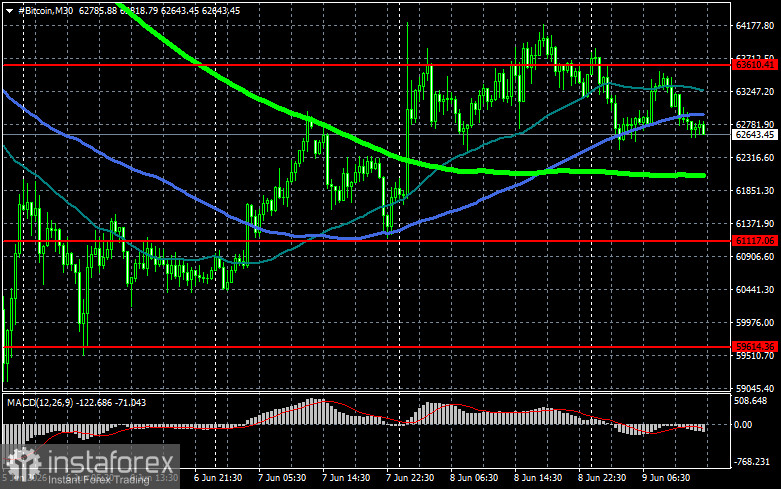
Bitcoin
Buyers are now targeting a return to $63,600, which would open the path to $65,800, and from there to $67,700 — a break above which would signal attempts to restore a bull market. On the downside, buyers are expected at $61,100; a drop below that could quickly push BTC toward $59,600. The next downside target would be around $58,200.
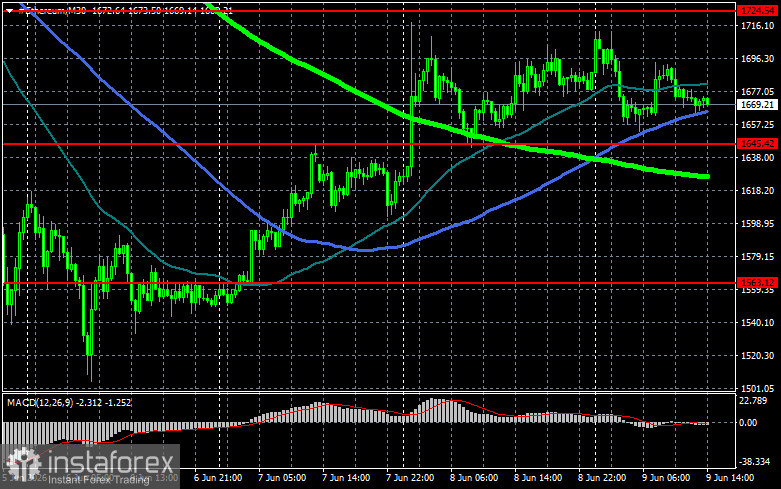
Ethereum
A clear close above $1,724 would open the way to $1,783. A further target is the high near $1,838; a break above that would indicate strengthening bullish sentiment and renewed buyer interest. On the downside, buyers are expected at $1,645; a return below that level could quickly push ETH toward $1,563. The further downside target would be $1,476.
What's on the chart
Price testing or crossing any of these moving averages often either halts movement or injects fresh momentum into the market.


