
Lihat juga


 18.02.2026 06:00 PM
Trade Review and Advice on Trading the European Currency
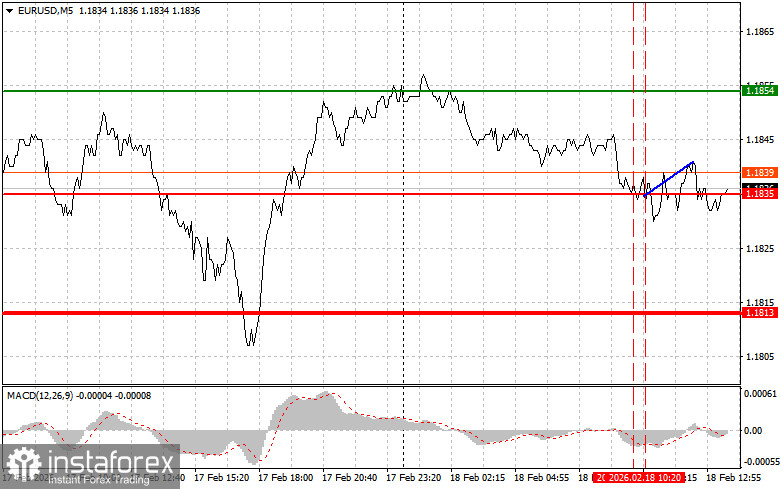
The test of the 1.1835 price level occurred when the MACD indicator had already moved significantly below the zero line, which limited the pair's downward potential. For this reason, I did not sell the euro. The second test of 1.1835 coincided with the MACD being in the oversold area, allowing Buy Scenario No. 2 to play out. However, the pair did not achieve any substantial upward movement.
The fact that inflation in France remained at the level forecast by economists did not lead to euro strengthening. Although France's consumer price data fully met expectations, the initial short-term rise of the European currency quickly faded, giving way to calm trading. This suggests that market participants had already priced in these figures and found no reason for any unexpected reaction.
The second half of the day promises to be rich in economic news that will undoubtedly have a noticeable impact on currency markets—primarily on the U.S. dollar. First, data on changes in durable goods orders will be released. The figures are expected to show further slowing, which may indicate some cooling in the manufacturing sector. Shortly afterward, industrial production data will be published. This indicator covers the entire industrial sector, including mining, manufacturing, and utilities. Stable or rising industrial output is a sign of a healthy economy and would likely support the dollar.
The statistical block will conclude with the release of building permits data. This is a leading indicator reflecting plans for future residential and commercial construction. An increase in issued permits signals rising investment in the construction sector, which positively affects related industries and employment levels.
However, the key event of the day will likely be the publication of the minutes from the Federal Reserve's January meeting. The minutes may shed light on potential future interest rate cuts or the possibility of keeping rates unchanged, which will significantly influence investor sentiment and currency pair movements.
As for the intraday strategy, I will primarily rely on the implementation of Scenarios No. 1 and No. 2.
Buy Signal
Scenario No. 1: Today, buying the euro is possible upon reaching the 1.1846 level (green line on the chart), with a target of 1.1871. At 1.1871, I plan to exit the market and also consider selling in the opposite direction, aiming for a 30–35 point move from the entry level. Strong euro growth can only be expected after weak U.S. statistics.Important! Before buying, make sure the MACD indicator is above the zero line and just beginning to rise from it.
Scenario No. 2: I also plan to buy the euro today in the case of two consecutive tests of the 1.1830 level while the MACD indicator is in the oversold area. This would limit the pair's downward potential and trigger a market reversal upward. Growth toward the opposite levels of 1.1846 and 1.1871 can be expected.
Sell Signal
Scenario No. 1: I plan to sell the euro after it reaches the 1.1830 level (red line on the chart). The target will be 1.1813, where I intend to exit the market and immediately buy in the opposite direction (expecting a 20–25 point move in the opposite direction from that level). Pressure on the pair will return in the event of strong U.S. data.Important! Before selling, make sure the MACD indicator is below the zero line and just beginning to decline from it.
Scenario No. 2: I also plan to sell the euro today in the case of two consecutive tests of the 1.1846 level while the MACD indicator is in the overbought area. This would limit the pair's upward potential and trigger a downward market reversal. A decline toward the opposite levels of 1.1830 and 1.1813 can be expected.
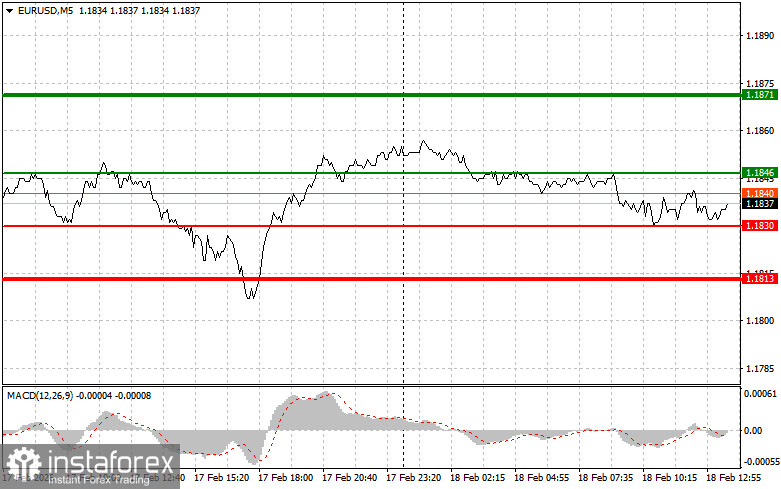
Chart Explanation
Important
Beginner Forex traders should make market entry decisions very cautiously. It is best to stay out of the market before major fundamental reports are released to avoid sharp price fluctuations. If you decide to trade during news releases, always place stop-loss orders to minimize losses. Without stop-loss orders, you can quickly lose your entire deposit, especially if you do not use proper money management and trade large volumes.
And remember, successful trading requires a clear trading plan like the one presented above. Spontaneous trading decisions based solely on the current market situation are an inherently losing strategy for an intraday trader.


