
Lihat juga


 23.09.2026 11:38 AM
The euro continued to slide yesterday, driven more by politics than macro data: in recent regional elections in Germany, the opposition Alternative for Germany once again outpolled the ruling CDU, extending a string of heavy defeats for Chancellor Friedrich Merz's party. The rout in Mecklenburg?Western Pomerania — where the CDU took just 4.9% versus AfD's 38.2% — was the party's largest humiliation in its history. The market reaction was predictable: the euro sold off further against the dollar, and the pound followed suit before managing a small bounce.
Additional pressure on risk came from the Fed. Richmond Fed President Thomas Barkin said inflation remains sufficiently high and unlikely to retreat on its own, and that the risk of persistent price pressures may require further rate increases. Boston Fed President Susan Collins appears to have echoed that view in an interview, and similar signals were apparently delivered earlier by Chicago Fed's Austan Goolsbee and St. Louis Fed's Alberto Musalem.
The beneficiaries of this chorus of hawkish comments are dollar holders: the current policy range of 3.50–4.00% is still seen by the market as relatively soft, so a tougher path is being priced in. If a rate hike does not occur in October — and the meeting takes place only days before the midterms on November 3 — it is likely to follow shortly after the vote. That prospect, rather than today's statistics, remains the dollar's main support, which continues to weigh on the euro, the pound, the yen and other risk assets.
From today's calendar, the focus is on preliminary September PMI readings across three regions. For the euro area, the manufacturing PMI is expected at 52.6 versus 52.7 in August — since the region's industry has been actively recovering since June, a small miss won't change the overall picture, while an upside surprise could spark a corrective rally for the euro. The services PMI is forecast at 51.4 versus 51.6 previously, i.e. virtually unchanged; matching the forecast is unlikely to shift market balance.
The UK picture is similar but less clear: one PMI is expected at 52.0 versus 52.5 in August — a decent reading — while the other has been gradually slowing since May and is forecast at 51.4 versus 51.7. A disappointment here would add pressure to the pound sterling, since there are few other catalysts for the currency right now. Last week, the Bank of England left interest rates unchanged and signaled no change in policy direction, while the Federal Reserve is moving toward tightening — it is this divergence between the two central banks that provides background pressure on the pound.
US expectations are noticeably firmer: manufacturing PMI is forecast at 53.4 and the services index at 56.5 (up from 56.0 in August) — numbers that could support the dollar if they beat forecasts. Volatility may also rise around a scheduled Fed speaker today, which could be an additional trigger for dollar buying and weakness in the euro and pound.
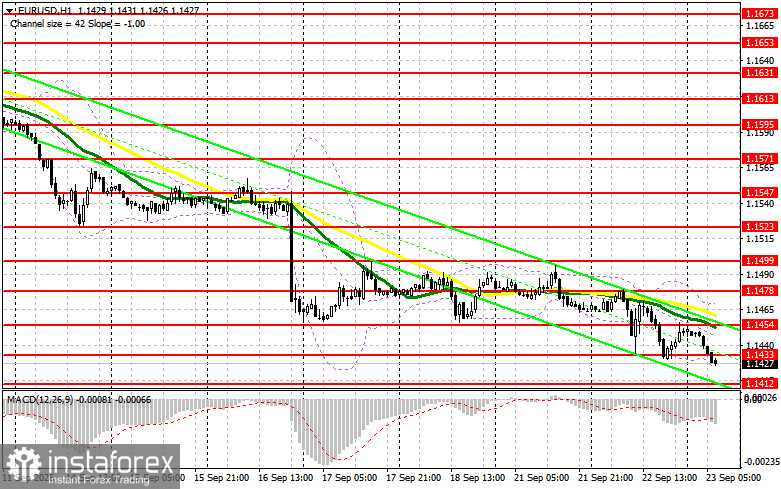
EUR/USD: 1-hour chart strategy For buy positions, I look to 1.1433, but only after a return and hold above this area, targeting 1.1454; a break of that area opens a path to 1.1478, where I recommend taking profits and switching to short positions, targeting about 20–25 pips lower. For sell positions, I would consider a failed hold at 1.1433 after weak euro area data or a false break above 1.1454 (which coincides with the moving average). If the move down continues, initial support is 1.1412 — a failed hold there would give a chance for a recovery to 1.1433. If buyers are absent at 1.1412, a breakout of this area would send the currency pair to 1.1392 and 1.1376, where I would look to buy the bounce for a 10–15 pip move.
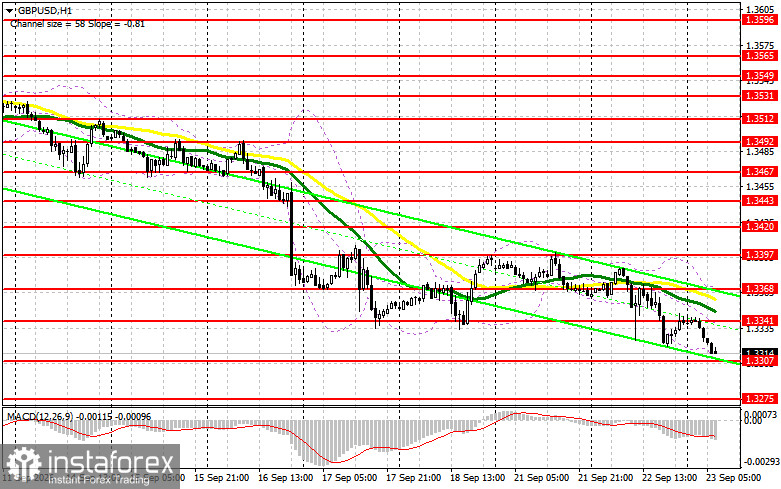
GBP/USD fits into a similar logic I'm trading the buy on a false break at 1.3307 as a good entry for a corrective move to 1.3341. Strong UK PMI could push the instrument out of this area: a confirmed break and hold above 1.3341 would open the way to 1.3368 and 1.3397, where I would look to sell the bounce for 20–25 pips. Short positions from 1.3368 or 1.3341 are allowed only on false breaks; bears' target remains support at 1.3307. Weak UK data, conversely, could prompt a retest of that range with a false breakout to the upside, offering an entry for shorts down to 1.3285 and 1.3243, where I would look to buy the rebound for 20–25 pips. Longs from 1.3285 or 1.3307 are only on false breakouts.
I expect today to be dominated by two parallel themes: political instability in Germany continuing to weigh on the euro, and a rising chorus of hawkish Fed voices strengthening the dollar across risk assets. Strong US PMI could amplify this pressure even before the Fed speaker's later remarks, while the pound — squeezed between the diverging paths of the BoE and the Fed — will struggle to find an independent reason to rally.


