
Lihat juga


 21.10.2026 09:41 AM
The wave structure on the 4-hour EUR/USD chart has become more complex. On the higher timeframe (lower chart), the downward trend segment has taken the form of a five-wave structure labeled A-B-C-D-E, which could be complete at any moment, as it appears structurally complete. All the waves in this segment are approximately equal in size, so this structure is considered corrective. If this assumption is correct, a new upward impulsive trend segment will begin once it is complete, with targets well above the 1.2000 level.
On the lower timeframe (upper chart), an impulsive wave sequence is still developing and may belong to wave E of the higher timeframe. If this is indeed the case, the dollar's strengthening is nearing its end, regardless of how much further it rises. The presumed wave 5 of E is either complete or close to completion. In any case, the current wave structure suggests that the downward wave sequence is nearing completion on both charts. News developments and a sharp shift in market sentiment have led to a strong appreciation of the US dollar, but the number of factors supporting further dollar strength is steadily declining.
The British Pound Receives Support on Tuesday, but Will It Continue to Do So on Wednesday?
The EUR/USD pair rose by 25 basis points on Tuesday, which is undoubtedly too little to suggest that the euro has dominated the market, even over the course of a single week. The euro remains extremely weak, while the market continues to focus on further monetary policy tightening by the Federal Reserve and the crisis in France, ignoring all other factors. However, movements in the euro exchange rate have been very limited this week, and there will be very little economic data for both the euro and the dollar. Meanwhile, the UK released its unemployment rate yesterday, an indicator that traders usually view with limited interest because forecasts generally match the actual figures. This time, however, the actual reading differed from market expectations by a full 0.2 percentage points. This triggered a fairly strong appreciation of the British pound on Tuesday. Initially, the pound lifted the euro along with it, but market participants quickly concluded that they wanted to buy only the pound.
Today, the UK will release another important report: September inflation data. In fact, this report could even be considered secondary, as market participants understand that inflation will continue to rise if oil prices keep increasing worldwide. Inflation in the UK is currently lower than in the US or the European Union, but that does not mean it is low. Therefore, the Bank of England is expected to tighten monetary policy, just like the ECB and the Federal Reserve. On this basis, the pound has grounds for further appreciation. However, the market tends to interpret important reports in its own way. Consequently, a September inflation reading below 3.4% could trigger a wave of selling in the British pound, as the market might conclude that the Bank of England will abandon plans to tighten monetary policy in early November. Conversely, a year-on-year reading above 3.4% would increase the market's willingness to buy the pound.
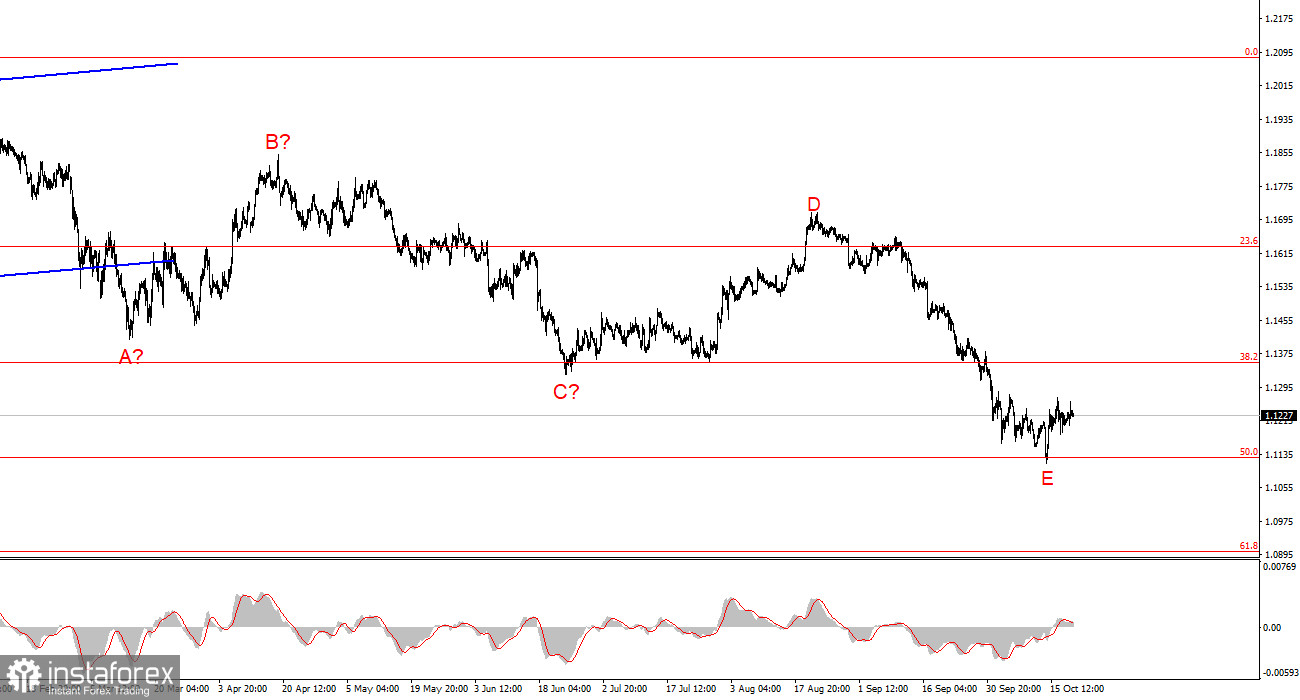
Based on the EUR/USD analysis, the pair remains within the broader corrective trend structure A-B-C-D-E. However, this structure appears complete and may therefore be nearing its end. In this view, the current period presents a favorable opportunity not only to buy the euro but also to anticipate the development of a sustained upward trend segment. According to the higher timeframe, the pair is expected to rise to at least the 1.1700–1.1800 level. The failed attempt to break above 1.1126, which corresponds to the 50.0% Fibonacci retracement level (lower chart, higher timeframe), also indicates that the market may be ready to buy.
The higher timeframe shows a downward trend segment that has taken the form of A-B-C-D-E. The internal wave structure of wave E has developed into a five-wave impulse pattern, but this pattern may already be complete. If this assumption is correct, a new upward trend segment will begin now.
The Main Principles of My Analysis:


