
Lihat juga


 23.10.2026 12:23 PM
Yesterday, the euro and the British pound found some support during Asian trading and the European session. Most likely this reflected interventions by the Federal Reserve and the Bank of Japan, a pattern we have seen several times this year. The yen had strengthened substantially, which weakened the dollar and lifted the euro and the pound. But the situation then reversed, and both currencies began to give back gains.

The cause was events in the Middle East, where, as a reminder, nothing good is happening. Fresh reports of talks and claims that the situation was moving toward a compromise proved false. New Iranian attacks and statements about preparation for a major war with the US and Israel pushed risk assets lower. That lifted oil, raised inflation expectations, and strengthened the dollar. In my view yesterday once again showed that targeted interventions can only buy the market a short respite, while geopolitics sets direction for the long run.
So we should not count on a sustained bullish impulse yet. Failed attempts by the euro to clear 1.1260 look more like breakdowns, and a larger downward correction is likely soon. There are plenty of reasons for further euro weakness, foremost among them France. Large rallies and unrest are again expected this weekend, as before, and authorities are preparing for still bigger events, building up military presence intended to prevent riots.
Now to the economic calendar. For the UK, we expect September retail sales data. After a 0.5% rise in August (and a matching -0.5% in July), the consensus calls for only a 0.1% drop, which could give some support to the pound. If the figure disappoints and is much weaker than forecast, sterling will most likely continue to fall versus the dollar. Preliminary October PMIs are also due: manufacturing is expected to edge down to 51.8 from 51.9, services to 51.8 from 52.1, and the composite to fall slightly. Weak data could materially increase the pound's downside into the end of the week.
Similar releases arrive for France, Germany, and the euro area as a whole. Eurozone manufacturing PMI for October is expected at 52.7 versus 52.9 last month, and services 52.6 versus just above 53 previously. Economists broadly expect little change. But recent reports show energy-driven inflation is hitting sales and production in Germany and across the euro area. So disappointing prints could send the euro into a larger decline and continue the downward correction that began yesterday.
For the US the manufacturing PMI is due, and the picture there looks solid: consensus 55 versus 55.9. Services are forecast at a strong 58, and remember the sector was still contracting in March at 49.8 before rebounding strongly. The University of Michigan consumer sentiment index is expected near 46.3, about last month's level. Inflation expectations could be revised higher—economists' forecast is 4.7%—and a higher print would likely strengthen dollar demand into the week's end.
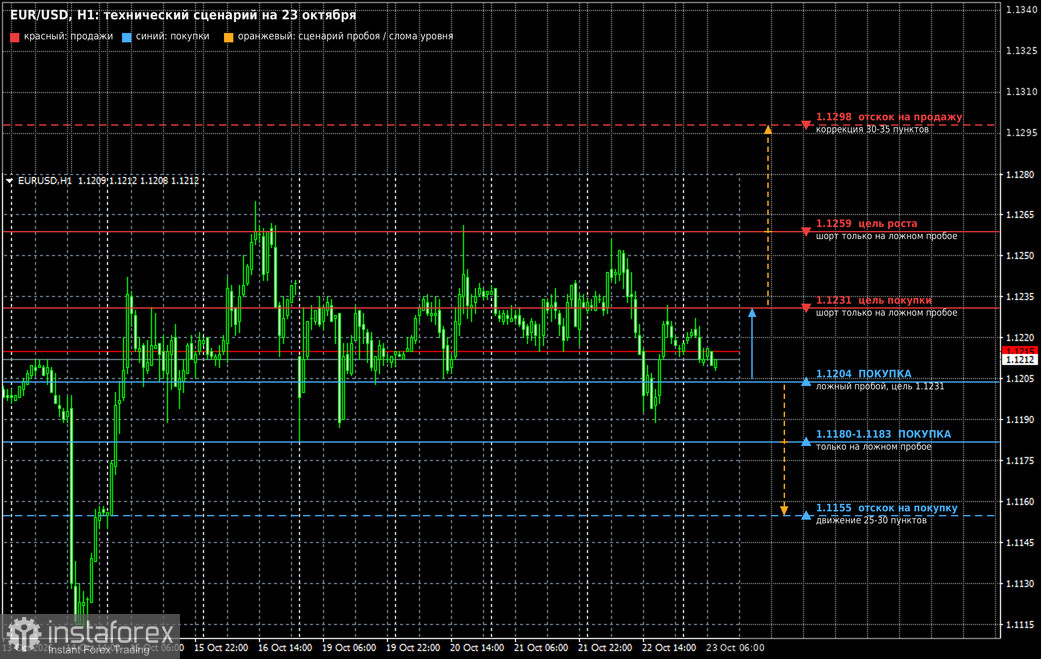
As for the EUR/USD pair, I mark 1.1204 as my buying level. A drop to that area that produces a false break would be a reason to accumulate longs aiming for a return to 1.1231. A break above that band would open a move to 1.1259, with a farther target at the channel top near 1.1298, where I would sell rallies for 30–35 pips. Shorts from 1.1231 on strength are only on failed holds, the same for 1.1259. If buyers do not appear at 1.1204, wait for a new low around 1.1180–1.1183 for longs on a false break, or consider a bounce buy from 1.1155 for 25–30 pips.
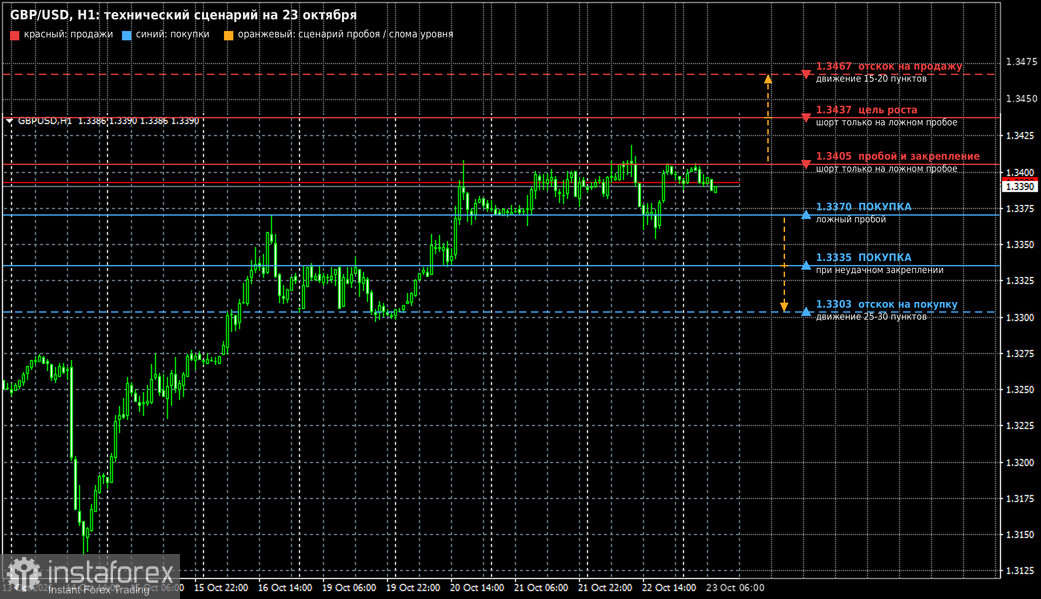
As for the GBP/USD, the pound pulled back slightly from marked highs, but buyers still control the market. A false-break dip to 1.3370 would be a buy signal. A break and sustained trade above 1.3405 on strong UK data would open a path to 1.3437 and 1.3467, where I would sell on a failed hold for 15–20 pips. Shorts from 1.3405 and 1.3437 are only on failed holds. If buyers do not show at 1.3370, a larger leg down toward 1.3335 is likely; longs there are only on failed holds, and I would buy a bounce from 1.3303 for 25–30 pips.
I lean toward the view that the euro has a higher chance of deeper correction this week than the pound: France's troubles and weak industry weigh much more heavily on the euro. If UK data are strong, the pound may try to hold its ground, but disappointing prints could provoke a sharp fall. The week's tone may be set by the combination of oil and US business activity indices.


