
Lihat juga


 25.11.2026 01:16 PM
Analysis of Trades and Trading Tips for the Japanese Yen
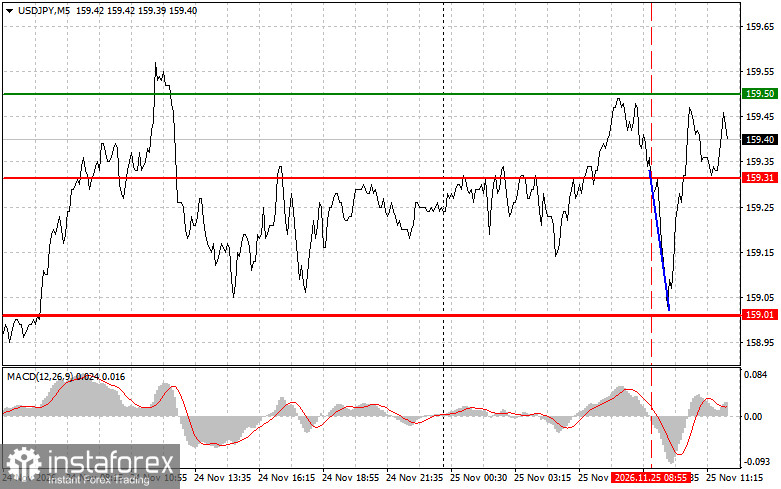
The price tested the 159.31 level when the MACD indicator had just started moving downward from the zero line, confirming that the entry point for a short position on the US dollar was appropriate. As a result, the pair declined toward the target level of 159.01.
The yen received support today following the release of economic data. The Corporate Services Price Index rose to 4.2% in October, compared with a forecast of 3.6% and 3.8% in the previous month. Meanwhile, the Bank of Japan's core CPI index came in at 2.3%, below the expected 2.5%.
Swaps now indicate an approximately 86% probability of the Bank of Japan raising its interest rate from 1.25% at its December 18 meeting. Expectations of monetary policy tightening were also reinforced by former Bank of Japan board member Makoto Sakurai. In his assessment, the regulator is likely to raise the interest rate to 2% by the middle of next year, with the next increase potentially taking place as early as December 18. He does not rule out the possibility that borrowing costs could eventually exceed 2% if warranted by the inflation outlook.
The Bank of Japan's main priority is now to keep inflation close to its 2% target without allowing it to overshoot. Sakurai identified rising oil prices as the most significant factor that could drive up the cost of living.
However, US economic data released in the second half of the day could change the market outlook. The October Core Personal Consumption Expenditures (PCE) Price Index is expected to reach 3.2% year-over-year, compared with 3.1% previously, while the headline index is forecast at 3.8%, up from 3.6%. The revised third-quarter GDP growth estimate is expected to come in at 3.4%, following 2.2%, while personal spending is forecast to increase by 0.4%, compared with 0.5% previously.
In addition, the market will receive personal income data, Durable Goods Orders, which are expected to rise by 0.7% following an increase of 1.8%, Initial Jobless Claims, forecast at 201,000, and New Home Sales figures.
In my view, strong inflation data and resilient US economic growth could restore demand for the dollar and put the yen under pressure. However, the market remains cautious for now, while expectations that the Bank of Japan will raise interest rates to 2% by the middle of next year are preventing a sharp decline in the yen.
As for the intraday strategy, the focus will primarily be on implementing Scenarios #1 and #2.
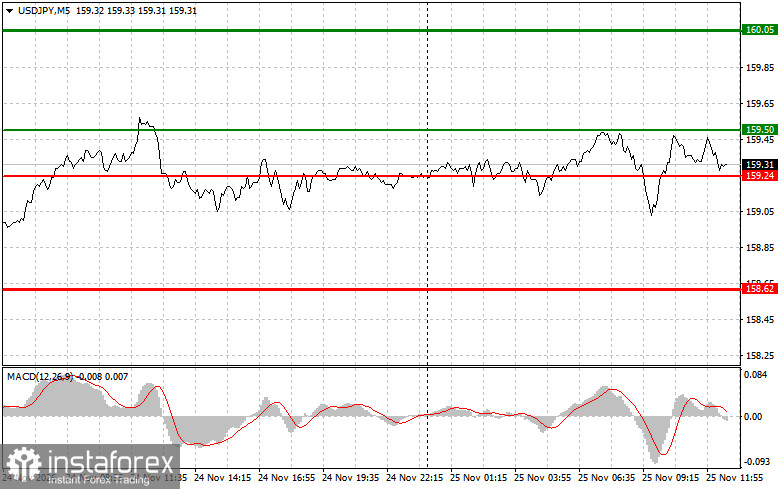
Scenario #1: The plan is to buy USD/JPY today when the price reaches the entry level around 159.50 (green line on the chart), with an upward target of 160.05 (thicker green line on the chart). Near 160.05, long positions will be closed and short positions opened in the opposite direction, targeting a move of 30–35 points from that level. The pair is likely to rise today only if US economic data comes in strong.
Important! Before opening a long position, make sure that the MACD indicator is above the zero line and has just started moving upward from it.
Scenario #2: USD/JPY can also be bought today if the price tests the 159.24 level twice consecutively while the MACD indicator is in the oversold zone. This would limit the pair's downward potential and trigger an upward market reversal. A rise toward the opposite levels of 159.50 and 160.05 can then be expected.
Scenario #1: The plan is to sell USD/JPY today after the price breaks below the 159.24 level (red line on the chart), which could trigger a rapid decline in the pair. The sellers' main target will be 158.62, where short positions will be closed and long positions opened immediately in the opposite direction, targeting a rebound of 20–25 points from that level. Selling pressure on the pair may return today if the central bank intervenes.
Important! Before opening a short position, make sure that the MACD indicator is below the zero line and has just started moving downward from it.
Scenario #2: USD/JPY can also be sold today if the price tests the 159.50 level twice consecutively while the MACD indicator is in the overbought zone. This would limit the pair's upward potential and trigger a downward market reversal. A decline toward the opposite levels of 159.24 and 158.62 can then be expected.
Important. Beginner Forex traders should exercise extreme caution when making entry decisions. Before the release of important fundamental reports, it is generally best to stay out of the market to avoid exposure to sharp exchange rate fluctuations. If trading during news releases, always place Stop Loss orders to minimize potential losses. Without Stop Loss orders, the entire trading account balance can be lost very quickly, especially when large position sizes are used without proper money management.
It is also important to remember that successful trading requires a clear trading plan, such as the one outlined above. Making spontaneous trading decisions based on current market conditions is fundamentally a losing strategy for intraday traders.


