
یہ بھی دیکھیں


 27.04.2026 12:41 AM
The euro has been trading very technically in recent weeks, following wave patterns. Recall that a five-wave impulsive downward structure was first constructed, after which a standard three-wave correction was formed. It is also worth noting that an ideal scenario for any trader is such a clear wave structure, rather than complex formations that constantly become more convoluted and supplemented. Currently, the EUR/USD instrument is at a crossroads. Either a new downward wave set will begin to form, or the corrective structure a-b-c will complicate into a-b-c-d-e, or it will transform into an impulsive upward trend segment.
Next week, many news events are expected. Starting with economics, if we overlook all secondary events, we have inflation, the unemployment rate, and GDP for the first quarter in Germany, as well as GDP, the unemployment rate, and inflation in the eurozone, along with the European Central Bank meeting featuring a speech by Christine Lagarde. Interestingly, all these events are scheduled for one day—Thursday. Therefore, high trading activity is expected on that day.
The most significant event will undoubtedly be the ECB meeting. In recent months, the ECB has hinted at easing monetary policy, but in recent weeks, it seems to have abandoned this idea amid uncertainty over negotiations between Iran and the US. The conflict in the Middle East is on pause but not resolved. Because central banks do not understand how the situation in the Middle East will develop, they are reluctant to rush into major decisions on interest rate hikes. Tightening monetary policy will inevitably lead to a slowdown in economic growth, which is already low in Europe. If the ECB's policy parameters remain unchanged, there should be no change in the euro's exchange rate. Christine Lagarde will clarify when and under what circumstances the central bank will be ready to tighten policy at the press conference.
I would also like to highlight the geopolitical factor. In recent weeks, there have been few significant messages, but that doesn't mean there won't be any next week. Therefore, as they say, it's essential to keep a close eye on developments in the Middle East.
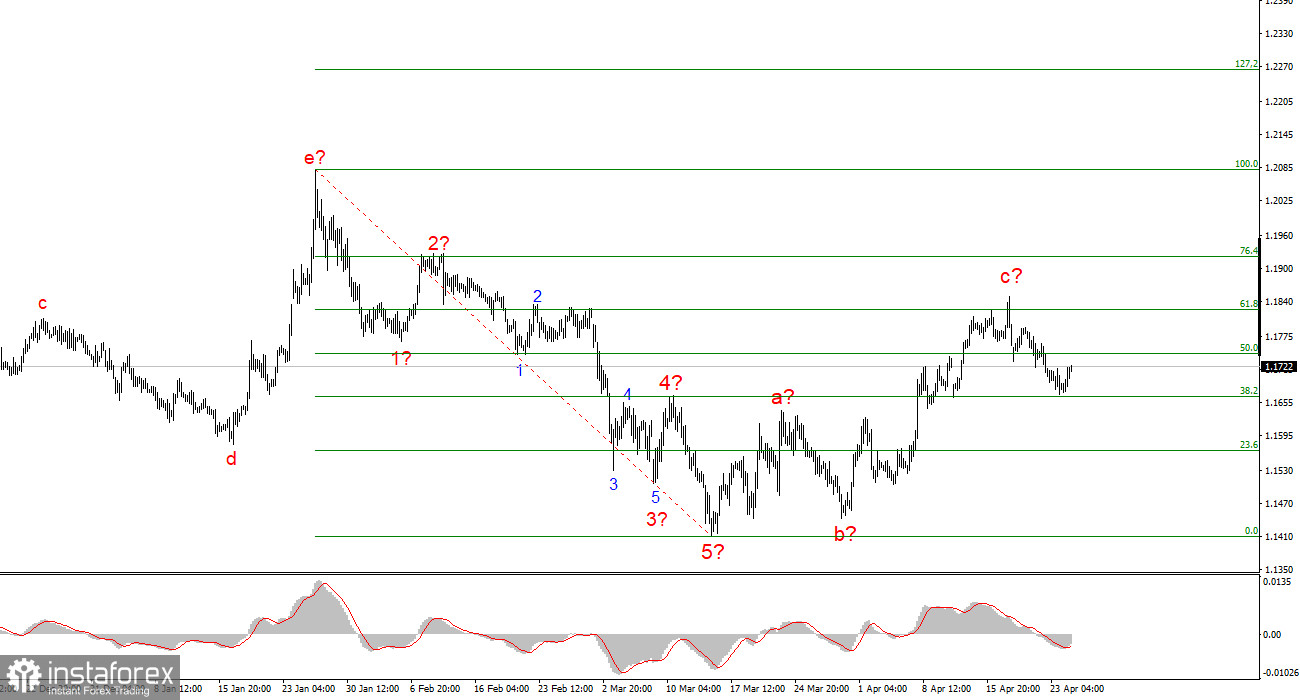
Based on my analysis of EUR/USD, I conclude that the instrument remains within an upward segment of the trend (as seen in the lower chart), while in the short term, it is within a corrective structure. The corrective wave set appears quite complete and may take on a more complex, extended form only if the geopolitical situation in the Middle East improves. Otherwise, I believe that a new downward wave set may begin from the current positions. We have seen the corrective wave, and further movement will depend on negotiations between Iran and the US.
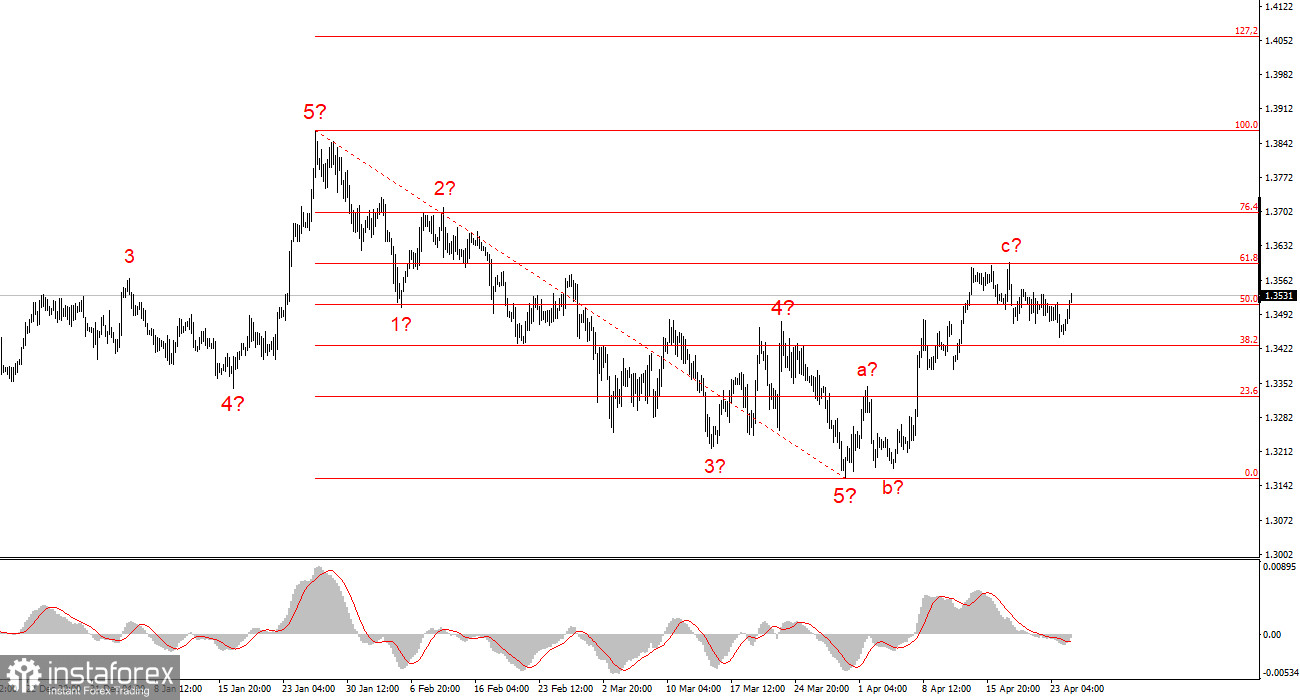
The wave structure of the GBP/USD instrument has become clearer over time, as I expected. We now see a clear three-wave upward structure on the charts, which may already be complete. If this is indeed the case, we can expect the formation of at least one descending wave (presumably wave d). The upward segment of the trend could take on a five-wave form, but for this to occur, the conflict in the Middle East needs to subside, not reignite. Therefore, the base scenario for the coming days is a decline to the 34th figure or slightly below. After that, everything will again depend on geopolitical factors.


