
یہ بھی دیکھیں


 02.07.2026 11:44 AM
On Wednesday, EUR/USD reversed once again in favor of the euro and consolidated above the 100.0% Fibonacci retracement level at 1.1409. This marks the fourth attempt by buyers to extend the upward move and develop something more substantial than a corrective rebound. However, a consolidation below 1.1409 would once again favor the U.S. dollar and open the way for a decline toward the 127.2% Fibonacci retracement level at 1.1290.
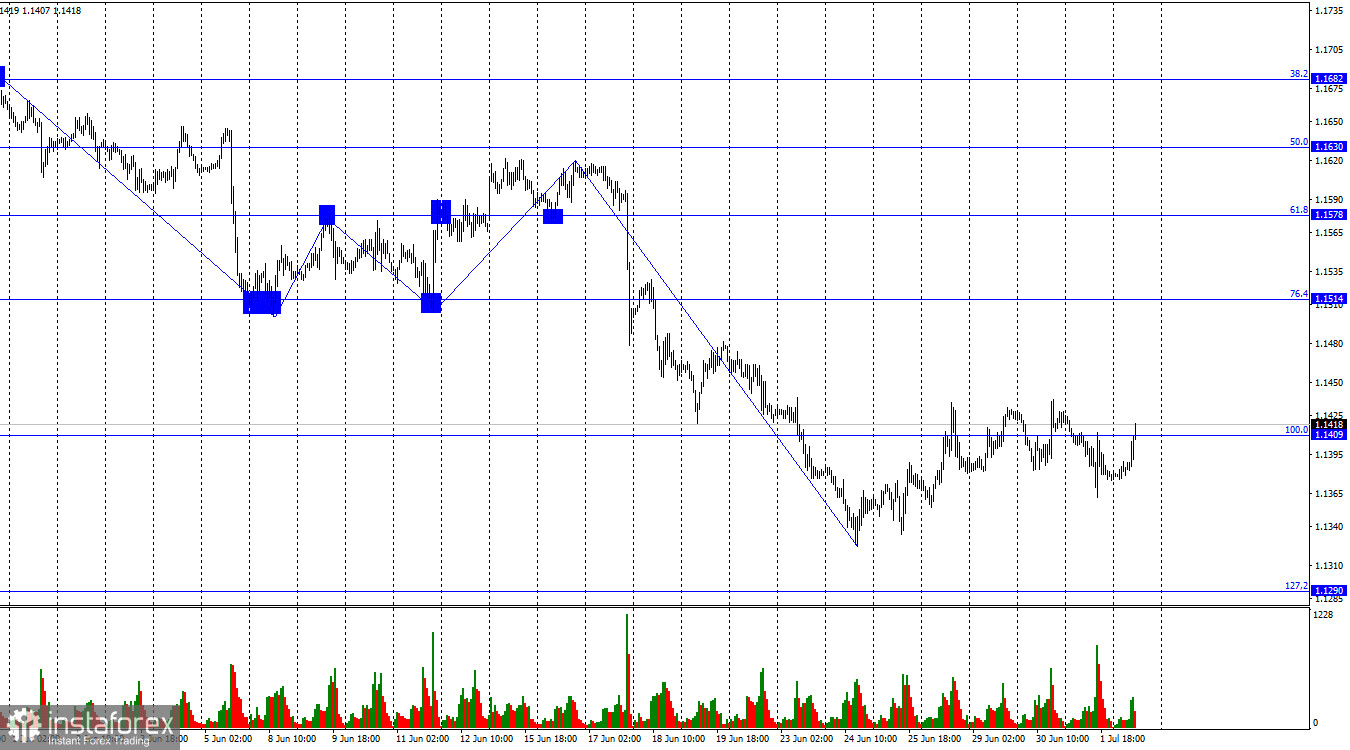
The wave structure on the hourly chart remains bearish. The latest completed downward wave broke below the previous low, while the latest upward wave failed to break above the previous high. The geopolitical backdrop has improved considerably in recent weeks, as the conflict in the Middle East has at least paused, and Iran and the United States have signed a memorandum. However, both the Federal Reserve's policy stance and geopolitical developments have recently supported the U.S. dollar, as the memorandum has failed to produce any meaningful progress in the negotiations.
Wednesday's news flow gave traders considerable room for interpretation. There was an abundance of news, much of which could be viewed from different perspectives. Eurozone inflation slowed to 2.8% year-on-year, marking a sharper deceleration than expected, while ECB President Christine Lagarde and several of her colleagues significantly softened their hawkish rhetoric during the economic forum in Sintra. Although some ECB policymakers still support further monetary policy tightening, their number has declined significantly following the de-escalation of the conflict in the Middle East and the continued slowdown in inflation.
Since the ECB may pause its tightening cycle in the near term to confirm that inflation continues to ease without additional policy action, this news would normally be expected to weigh on the euro. However, instead of renewed selling pressure, buyers have regained the initiative after weeks of persistent bearish pressure. Yesterday's advance was supported by the U.S. Manufacturing PMI, but several key U.S. labor market reports, including employment and unemployment data, are due for release later today, meaning the pair could come under renewed downward pressure.
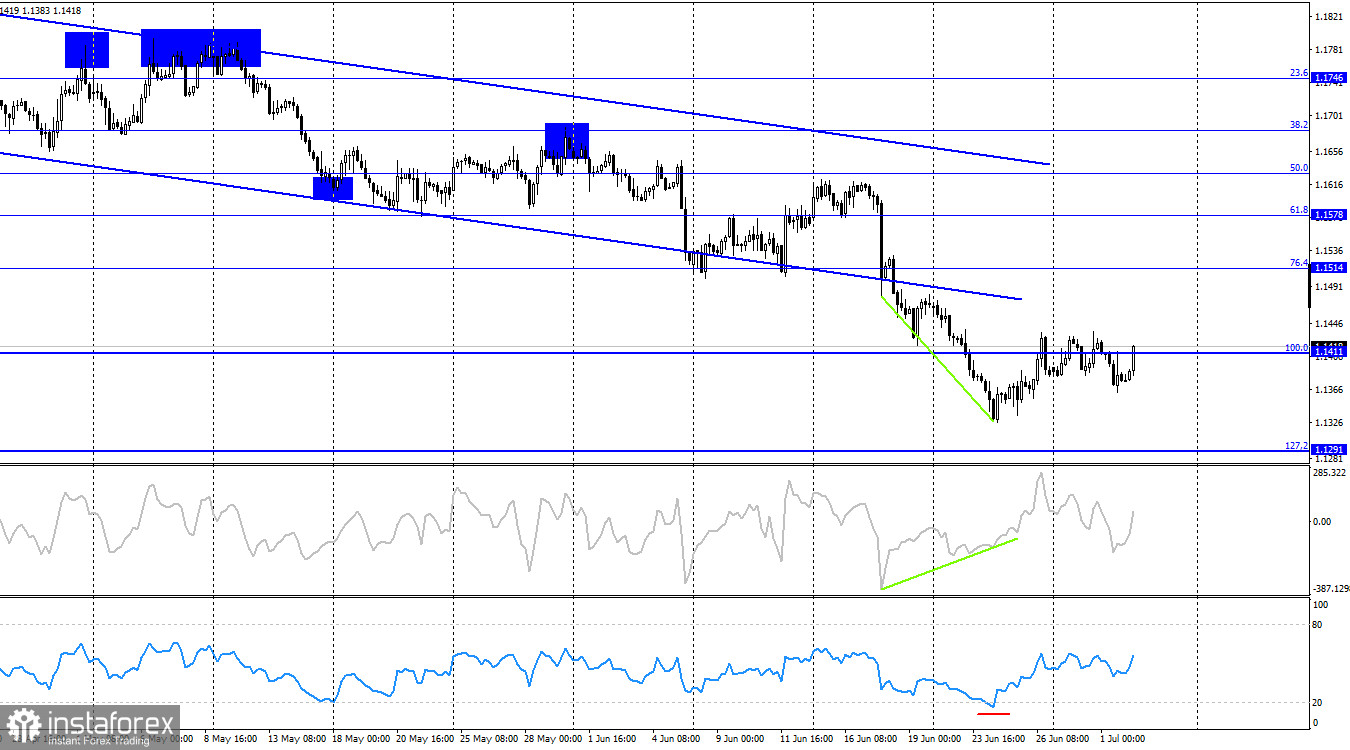
On the 4-hour chart, the pair has consolidated below the 100.0% Fibonacci retracement level at 1.1411, supporting expectations of a further decline in the euro. However, the CCI has formed a bullish divergence, while the RSI remains in overbought territory. These technical signals have temporarily halted the bearish momentum. A consolidation above 1.1411 would strengthen the case for further gains in the euro and a return to the descending trend channel.
Commitments of Traders (COT) Report:
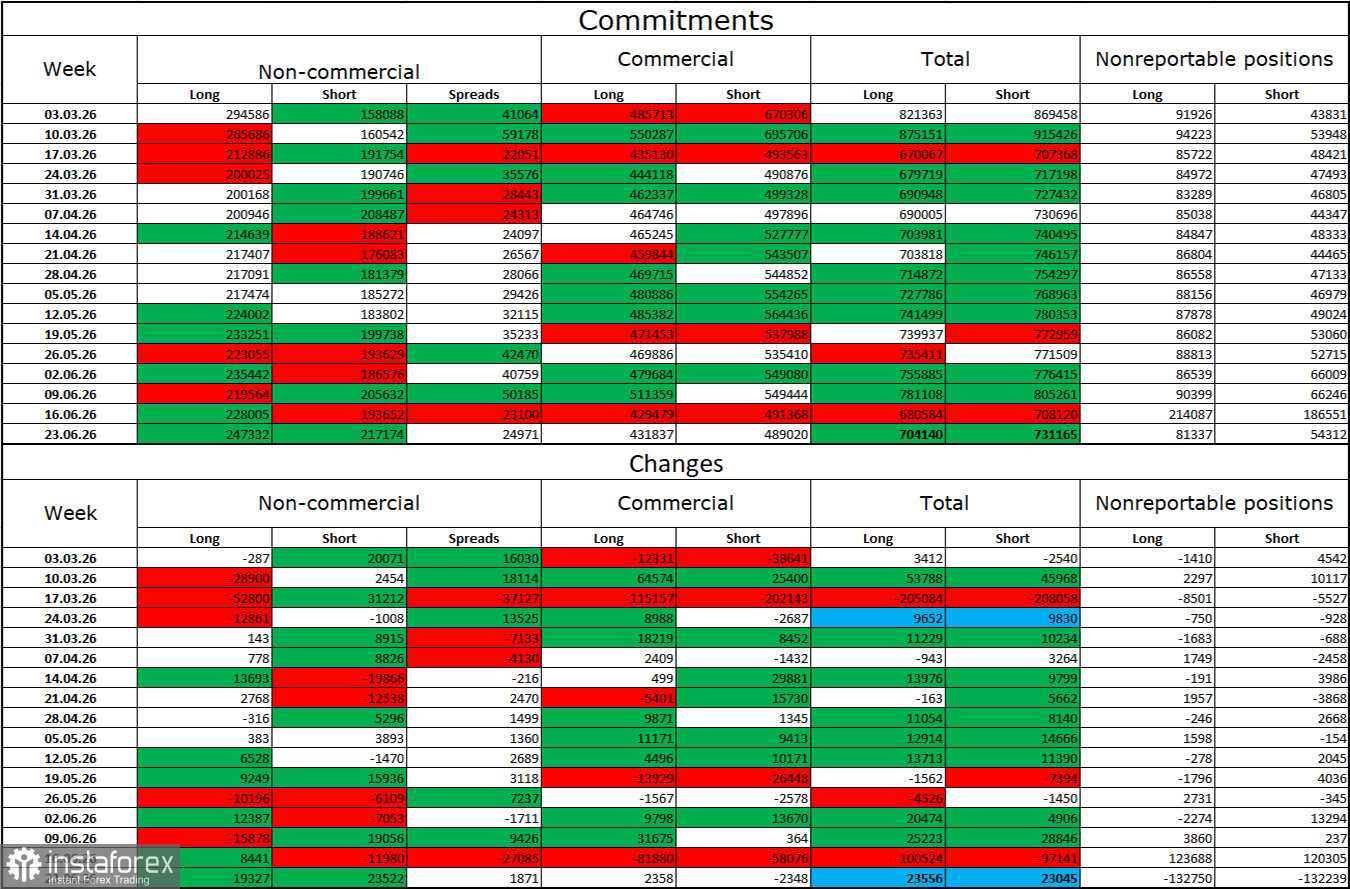
During the latest reporting week, professional traders opened 19,327 Long positions and 23,522 Short positions.
Over the seven weeks spanning February and March, the bulls' overwhelming advantage disappeared due to the conflict involving Iran. During the past thirteen weeks, the balance has gradually normalized following the suspension of hostilities in the Middle East, with buyers once again regaining the upper hand. Speculative traders currently hold approximately 247,000 Long positions compared with 217,000 Short positions.
From a longer-term perspective, large institutional traders continue to maintain a constructive view on the euro. Naturally, global developments—which have been plentiful in recent years—continue to influence investor sentiment. At present, market attention remains focused on the Middle East, where the conflict is on hold and serious negotiations are underway that could eventually lead to a lasting peace agreement. However, the market continues to largely ignore both the improvement in the geopolitical situation and several other factors that are supportive of the euro.
Economic Calendar for the United States and the Eurozone:
The economic calendar for July 2 includes four scheduled releases, at least two of which are considered high-impact events. As a result, macroeconomic data could have a significant influence on market sentiment during the second half of Thursday's session. Friday is Independence Day in the United States.
EUR/USD Forecast and Trading Tips:
Long positions may be considered today following a consolidation above 1.1409 on the hourly chart, with a target at 1.1514. New short positions may be considered following a consolidation below 1.1409 on the hourly chart, targeting 1.1290. However, the last six trading signals generated around this level have failed to produce any significant price movement.
Fibonacci retracement grids are drawn from 1.1409 to 1.1850 on the hourly chart and from 1.1411 to 1.1850 on the 4-hour chart.


