
یہ بھی دیکھیں


 15.10.2026 08:55 AM
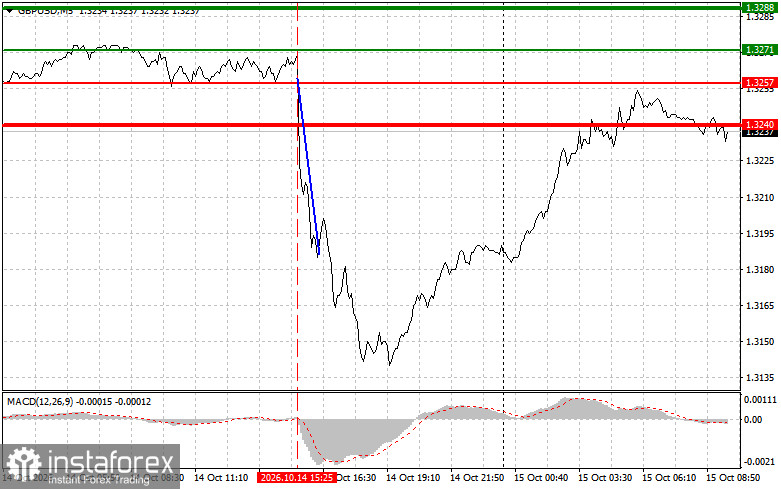
A price test at 1.3257 occurred as the MACD indicator began moving down from the zero line, confirming a correct entry point to sell the pair. As a result, the pound plunged more than 100 pips.
However, today the pound has already recovered everything it lost to the dollar yesterday. The US consumer-price index for September rose 0.6% month-on-month and 3.7% year-on-year—exactly in line with expectations, so there was no headline surprise. But the details were tougher. Core CPI rose 0.3% versus a 0.2% forecast and accelerated to 2.6% year-on-year from 2.4%, while gasoline jumped 9.1% and accounted for more than half of the overall monthly rise. That is why the dollar rallied yesterday, especially versus GBP/USD, which has no own drivers today. After a sharp decline in US Treasury yields, the dollar lost yesterday's edge against the pound, and the pair returned to pre-release levels.
Today's setup for GBP/USD is simple: no major external drivers, but the domestic data slate is relatively heavy. In the first half of the day, the UK will publish GDP, industrial production, manufacturing output and the goods trade balance. It matters that July GDP was strong — +0.4% month-on-month versus +0.3% in June — with services contributing +0.4%, manufacturing +0.2% and construction +0.1%. The ONS even singled out AI and cloud computing as growth drivers, with computer programming up 3.5% and contributing 0.12 percentage points to the overall result. The market now wants to know whether July was a one-off spike.
Survey indicators paint a mixed picture. Composite PMI in September fell to 52.0 from 52.5 in August (a three-month low), and the services PMI was 52.1 versus 52.5. The services sector has grown for three months but at a slowing pace, while employment has been contracting for a second year. Construction PMI rose to 46.1 from 44.3, meaning the contraction eased to the least pronounced in eight months but remains below 50. Given these data, I expect industrial production to be most sensitive—comparing actual output with PMI will show whether managers' sentiment aligns with real production.
If the figures beat economists' forecasts, the pound could return to the weekly high and hawkish Bank of England members would gain another argument for tightening. If the numbers disappoint, pressure on the pair will increase materially, especially after such a large Asian-session rally, as speculative buyers may begin to take profits.
For intraday strategy, I will mainly rely on Scenarios 1 and 2.
Scenario 1: I plan to buy the pound today near 1.3245 (green line on the chart), targeting 1.3263 (thicker green line on the chart). I will exit long positions at 1.3263 and open short positions there, aiming for a 30–35 pip move back. Expect pound gains today only after good UK data. Important: before buying, ensure MACD is above zero and just beginning to rise from it.
Scenario 2: I will also consider buying the pound if price tests 1.3230 twice while MACD is in the oversold area. That would limit downside potential and trigger an upward reversal. Expect moves to 1.3245 and 1.3263.
Scenario 1: I plan to sell the pound after a break below 1.3230 (red line on the chart), which should lead to a rapid decline. Sellers' key target is 1.3213, where I will exit shorts and immediately open longs (aiming for a 20–25 pip reversal). Bad news can restore pressure on the pound. Important: before selling, ensure MACD is below zero and just beginning to fall from it.
Scenario 2: I will also consider selling if price tests 1.3245 twice while MACD is in the overbought area. That would limit upside potential and trigger a reversal downward. Expect declines toward 1.3230 and 1.3213.
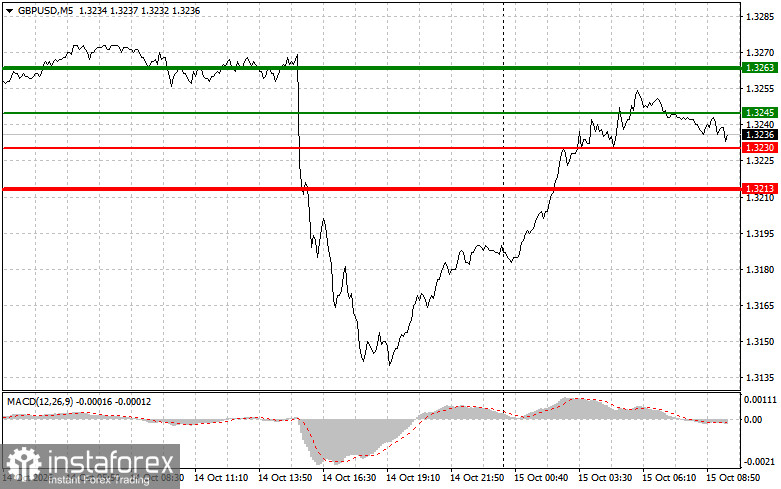
Thin green line — entry price where you can buy the instrument.
Thick green line — approximate price where you can place Take Profit or manually lock in profits, because further upside above this level is unlikely.
Thin red line — entry price where you can sell the instrument.
Thick red line — approximate price where you can place Take Profit or manually lock in profits, because further downside below this level is unlikely.
MACD indicator. When entering the market, it's important to consider overbought and oversold zones.
Important. Novice Forex traders must be very cautious when deciding to enter the market. It is best to stay out before major fundamental reports to avoid getting caught in sharp price swings. If you decide to trade during news releases, always place stop orders to minimize losses. Without stop orders, you can quickly lose your entire deposit, especially if you don't use money management and trade large volumes.
Remember: successful trading requires a clear trading plan, like the example above. Spontaneous trade decisions based solely on the immediate market situation are, by definition, a losing strategy for an intraday trader.


