
یہ بھی دیکھیں


 23.10.2026 11:01 AM
The wave count on the 4-hour EUR/USD chart has become more complex. On the higher timeframe (lower chart), the downward trend segment has taken the form of a five-wave A-B-C-D-E structure, which could be completed at any time, as it appears structurally complete. All the waves in this segment are approximately the same size, so this structure is considered corrective. If this assumption is correct, an impulsive upward trend segment will begin once the correction is complete, with targets well above the 1.2000 level.
On the lower timeframe (upper chart), an impulsive wave structure is still developing and may belong to wave E of the higher timeframe. If this is indeed the case, the dollar's strengthening is nearing its end, regardless of how much further it rises. The presumed wave 5 of E is either complete or close to completion. In either case, the current wave structure suggests that the downward wave sequence is nearing completion on both charts. News developments and a sharp shift in market sentiment have driven a strong appreciation of the US dollar, but few new factors remain to support further dollar strength.
EUR/USD fell by 10 basis points on Thursday, but overall, the pair has traded within a narrow price range throughout the current week. The only significant developments this week came from the United Kingdom, where unemployment and inflation reports substantially increased the likelihood of the Bank of England tightening monetary policy at its next meeting. This factor has contributed to a considerable increase in demand for the pound recently.
The euro also has monetary policy as a supporting factor. However, buyers remain cautious because of unrest in France, which has already spread to Italy, Spain, Portugal, and other European Union countries. As a result, market participants are reluctant to trade EUR/USD and prefer to wait until next week, when the European Central Bank and the Federal Reserve will hold their meetings.
The outcomes of these meetings are largely known already. However, Kevin Warsh or Christine Lagarde may provide markets with information that is not currently available, such as details of the central banks' future actions and policy plans. This information could alter market expectations for interest rates through the end of 2026 and into early 2027.
As for today, Germany and the European Union will release their services and manufacturing business activity indices. These reports are unlikely to affect market sentiment because, as noted above, market participants are already focused on next week. Furthermore, business activity indices currently have little influence on central banks' monetary policy decisions. Therefore, these reports can be considered secondary under the current circumstances.
No significant market movements are expected today. Traders will be waiting for the crisis in France to subside, the US elections, and the central bank meetings.
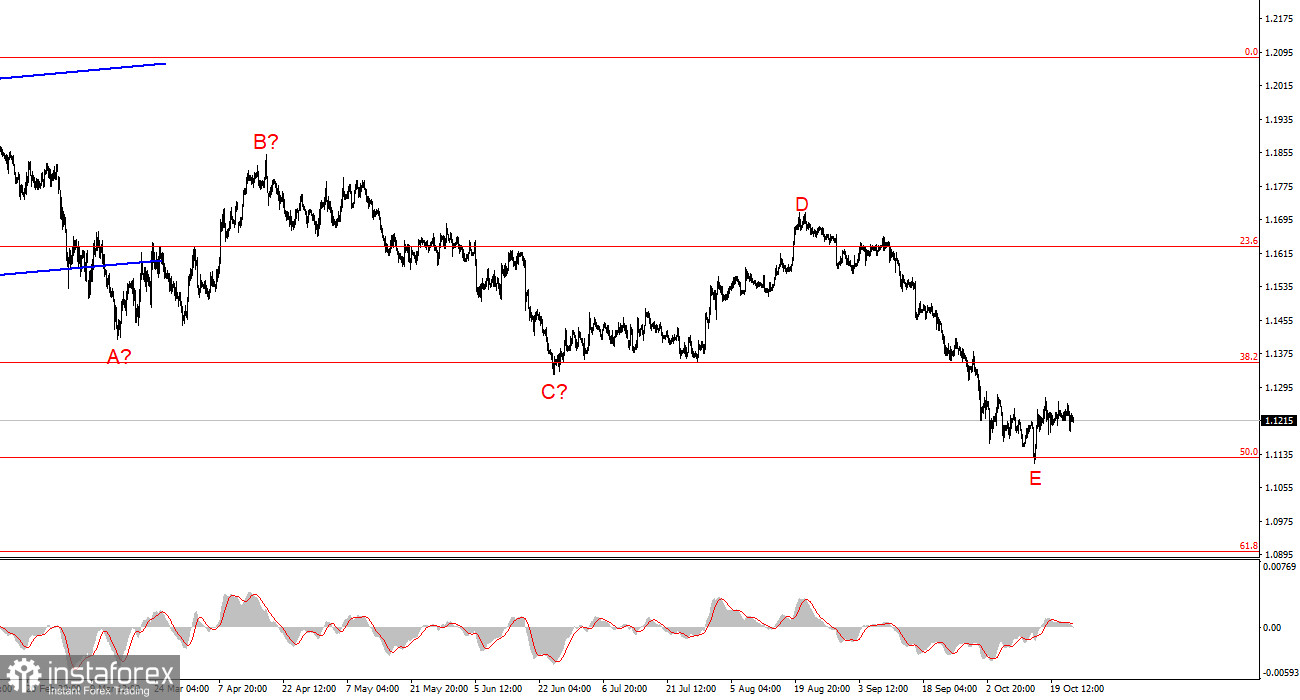
Based on the EUR/USD analysis, the pair remains within the broader corrective A-B-C-D-E trend structure. However, this structure appears complete and may therefore be nearing its end. In this context, the current period appears favorable not only for buying the euro but also for anticipating the development of a sustained upward trend segment. According to the higher timeframe, the pair is expected to rise to at least the 1.1700–1.1800 level. The failed attempt to break above the 1.1126 level, corresponding to the 50.0% Fibonacci retracement level (lower chart, higher timeframe), also indicates that the market may be preparing for a move higher.
The higher timeframe shows a downward trend segment that has taken the form of an A-B-C-D-E structure. The internal wave structure of wave E has developed into a five-wave impulse pattern, but this pattern may already be complete. If this assumption is correct, a new upward trend segment will begin to develop.
The Main Principles of the Analysis:


