
یہ بھی دیکھیں


 04.11.2026 06:59 PM
Trade analysis and trading tips for the Japanese yen
The test of the 158.24 price level in the first half of the day occurred when the MACD indicator had just started moving upward from the zero line, confirming a valid entry point for buying the yen. As a result, the pair rose toward the target level of 158.58.
At the beginning of the day, the yen acted as a safe-haven currency, but the situation subsequently changed. Although the US dollar weakened following the US election results and US Treasury yields declined, this did little to ease the pressure on the yen.
In the second half of the day, the market will receive several US economic reports, including the ISM Services PMI, the Composite PMI, and the trade balance. Economists generally expect the previous readings to remain unchanged, indicating continued strength in the services sector without further acceleration, along with a slight widening of the trade deficit.
If the figures exceed expectations, Treasury yields could rise again, allowing the dollar to recover some of its losses and providing support for USD/JPY. Conversely, weaker data would reinforce demand for safe-haven assets, allowing the yen to maintain its advantage. Political uncertainty surrounding Iran remains an additional factor that could trigger renewed demand for safe-haven currencies at any time.
As for the intraday strategy, I will focus primarily on implementing Scenarios #1 and #2.
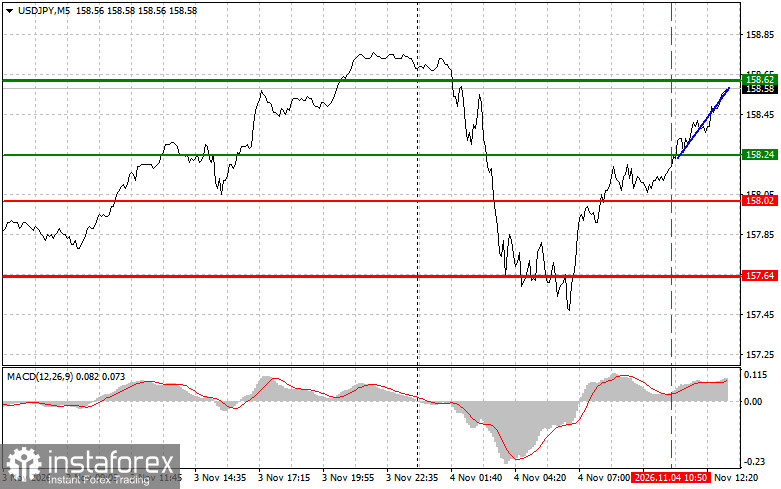
Buy Signal
Scenario #1: Today, I plan to buy USD/JPY when the price reaches the entry level of around 158.77 (the green line on the chart), targeting a rise to 159.31 (the thicker green line on the chart). Around 158.74, I plan to close my long positions and open short positions, targeting a reverse move of 30–35 points from that level. The pair is likely to rise today only if US economic data comes in stronger than expected.
Important! Before buying, make sure that the MACD indicator is above the zero line and has just started moving upward from it.
Scenario #2: I also plan to buy USD/JPY today if the price tests the 158.42 level twice consecutively while the MACD indicator is in the oversold area. This would limit the pair's downward potential and trigger an upward market reversal. The pair could then rise toward the opposite levels of 158.77 and 159.31.
Sell Signal
Scenario #1: Today, I plan to sell USD/JPY after the price breaks below the 158.42 level (the red line on the chart), which could trigger a rapid decline in the pair. The sellers' main target will be 157.95, where I plan to close my short positions and immediately open long positions, targeting a reverse move of 20–25 points from that level. Selling pressure on the pair could return today if the central bank intervenes.
Important! Before selling, make sure that the MACD indicator is below the zero line and has just started moving downward from it.
Scenario #2: I also plan to sell USD/JPY today if the price tests the 158.77 level twice consecutively while the MACD indicator is in the overbought area. This would limit the pair's upward potential and trigger a downward market reversal. The pair could then decline toward the opposite levels of 158.42 and 157.95.
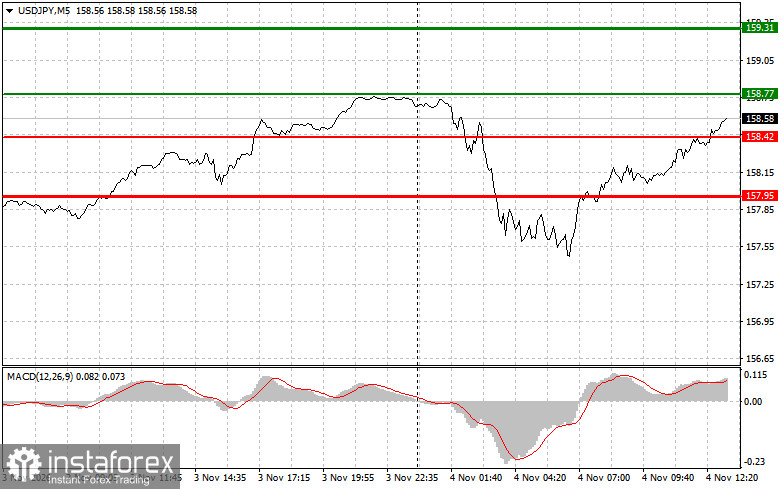
What the Chart Shows
- Thin green line – the entry price at which the trading instrument can be bought.
- Thick green line – the projected price level at which Take Profit can be set or profits can be closed manually, as further gains above this level are considered unlikely.
- Thin red line – the entry price at which the trading instrument can be sold.
- Thick red line – the projected price level at which Take Profit can be set or profits can be closed manually, as further declines below this level are considered unlikely.
- MACD indicator – when entering the market, it is important to consider the overbought and oversold zones.
Important: Beginner Forex traders should exercise extreme caution when making market entry decisions. It is best to stay out of the market ahead of major fundamental economic releases to avoid exposure to sharp exchange rate fluctuations. If you decide to trade during news releases, always use stop-loss orders to minimize potential losses. Without stop-loss orders, you can lose your entire trading deposit very quickly, especially if you do not use proper money management and trade with large position sizes.
Remember that successful trading requires a clear trading plan, such as the one presented above. Making spontaneous trading decisions based on current market conditions is a losing strategy for an intraday trader from the outset.


