
یہ بھی دیکھیں


 06.11.2026 05:35 AM
The GBP/USD currency pair also remained largely unchanged throughout most of Thursday. However, it is worth noting that the euro and the pound have been trading very differently in recent weeks. While the British currency has been rising for several consecutive weeks, in line with broader market conditions, the euro has been trading sideways for a month. Therefore, the lack of gains in the euro is not surprising, whereas the pound had reasons to appreciate during Thursday's trading session.
Essentially, the Bank of England made exactly the decision the market had expected. Several weeks ago, it became clear that the British regulator would have to begin tightening monetary policy, as inflation in the United Kingdom was expected to reach 4% by the end of the year. Consequently, traders anticipated a hawkish decision from the Bank of England, and that expectation was confirmed. However, the outcome of the Bank of England's meeting was even more hawkish than anticipated. Most analysts expected seven of the nine Monetary Policy Committee members to vote in favor of raising interest rates. In reality, the entire committee unanimously supported the increase. This means that the market may have already priced in the rate hike in advance, but it could not have anticipated such a hawkish stance from the regulator.
What does a more hawkish stance from the regulator indicate? It suggests that interest rates could be raised again at the final meeting in December. It also indicates that the Bank of England may implement at least three or four additional monetary tightening measures. If the Monetary Policy Committee's voting results had been less decisive, it would have been reasonable to conclude that its members were uncertain about the need to raise interest rates as soon as possible. However, the voting results demonstrated that there was no such uncertainty.
Therefore, the British currency may continue to appreciate against the US dollar. First, the price has not yet reached the upper boundary of the sideways channel on the daily timeframe. Second, it has also not reached the upper boundary of the sideways channel on the weekly timeframe. Third, the global upward trend that began in 2022 remains intact and has not been invalidated. Fourth, the Bank of England is expected to raise its key interest rate at least as many times as the Federal Reserve. Fifth, geopolitical developments are unlikely to trigger another major wave of market panic, meaning that the US dollar is unlikely to receive further support from this factor.
The outlook remains that the market has already priced in the factors supporting the US dollar several times over. Essentially, geopolitical developments were the main reason behind the dollar's appreciation in 2026, while the Federal Reserve's monetary tightening was a consequence of those geopolitical factors. Moreover, the dollar should not have benefited significantly from tighter US monetary policy because the Bank of England is also raising its key interest rate. The British regulator may have started tightening monetary policy a month and a half later, but the market began pricing in Federal Reserve rate hikes back in the summer. Despite this considerable advantage, the dollar has failed to achieve substantial gains in 2026. A look at the weekly timeframe reveals a prolonged sideways movement that has already lasted 16 months.
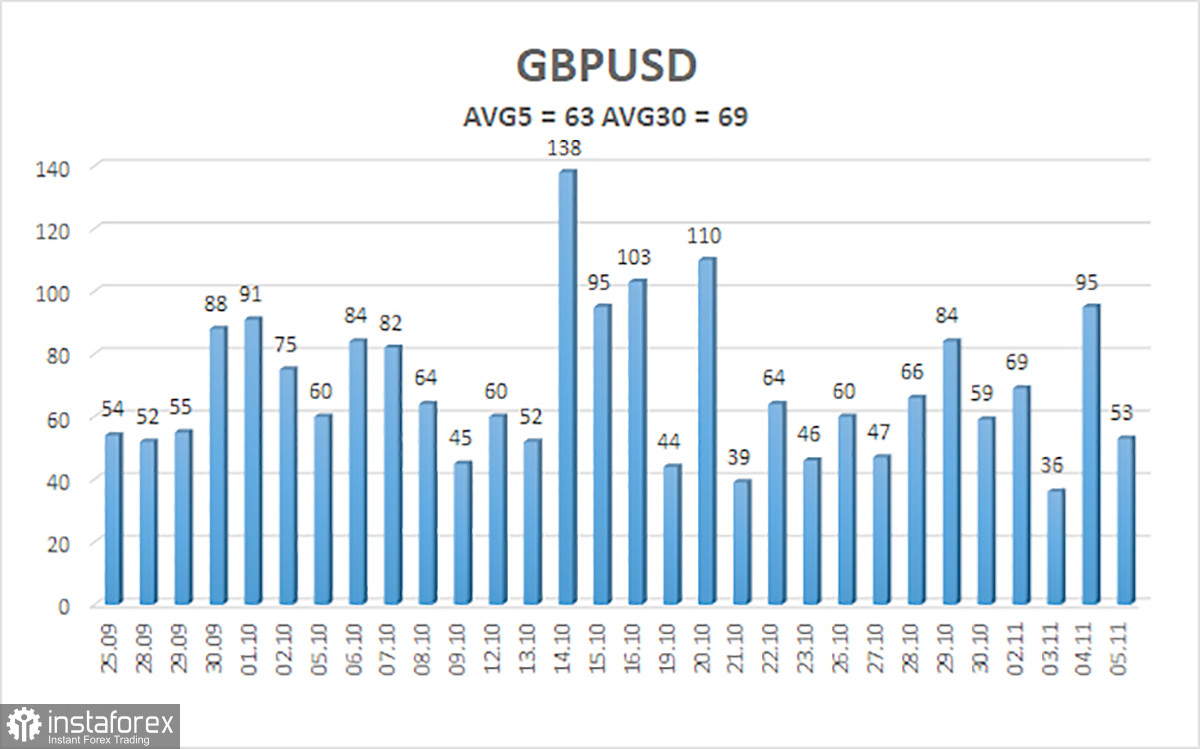
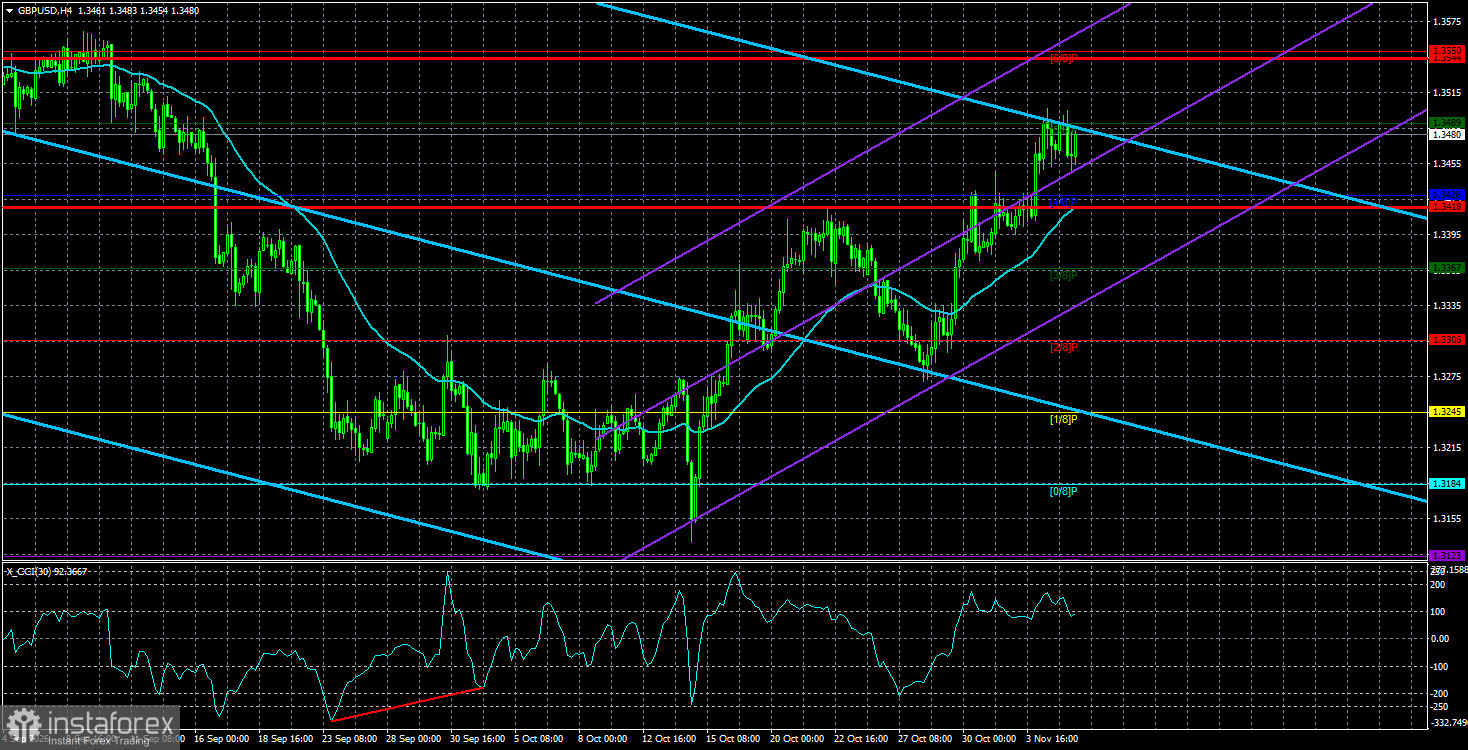
The average volatility of GBP/USD over the last five trading days stands at 63 points. This is considered an average level for the pound/dollar pair. On Friday, November 6, the pair is therefore expected to trade within a range bounded by 1.3418 and 1.3544. The higher linear regression channel has turned downward again. The CCI indicator entered oversold territory twice and also formed a bullish divergence, signaling the end of the downward trend.
Nearest Support Levels:
S1 – 1.3428
S2 – 1.3367
S3 – 1.3306
Nearest Resistance Levels:
R1 – 1.3489
R2 – 1.3550
R3 – 1.3611
Trading Recommendations:
The GBP/USD currency pair continues to follow an upward trend that may form part of the broader trend that began in 2022. Donald Trump's policies are likely to continue putting pressure on the US economy, so substantial long-term gains in the US dollar are not expected. So far, 2026 has been relatively favorable for the dollar due to geopolitical developments and inflation, which prompted capital outflows from riskier assets and forced the Federal Reserve to resume monetary tightening. However, the weekly timeframe still shows a sideways range between 1.3150 and 1.3780 within the four-year upward trend. This suggests that the British currency could continue appreciating over the medium term.
Long positions with targets at 1.3544 and 1.3550 may be considered if the price remains above the moving average. If the price moves below the moving average, short positions may be considered with targets at 1.3367 and 1.3306.
Explanations for the Charts:
Linear regression channels help identify the current trend. If both channels point in the same direction, the current trend is strong.
The moving average (settings: 20.0, smoothed) identifies the short-term trend and indicates the preferred trading direction.
Murray levels serve as targets for price movements and corrections.
Volatility levels (red lines) indicate the probable price channel within which the currency pair is expected to trade over the next 24 hours, based on current volatility readings.
The CCI indicator: entry into oversold territory (below -250) or overbought territory (above +250) indicates that a reversal in the opposite direction may be approaching.


