
یہ بھی دیکھیں


 19.11.2026 08:39 AM
Yesterday, U.S. data showed a mixed housing picture. Housing starts—the number of new construction projects begun—came in at an annualized 1.309 million versus a 1.250 million forecast and 1.191 million a month earlier. On a monthly basis, starts rose 9.9% versus an expected 2.4% after a 7.0% decline, meaning builders completed work planned earlier. Leading indicators were weaker. Building permits, which reflect developers' plans for the coming months, totaled 1.295 million versus a forecast of 1.380 million and 1.398 million previously. The volume of pending home sales — signed contracts not yet closed — fell 4.7% versus an expected -2.0% after -7.2%, marking a second consecutive decline. Taken together, this suggests the economy is growing fast enough to withstand another rate increase.
In October 20 weak starts and pending sales had weakened the dollar. This time, weak housing figures did not dent the dollar because the Federal Reserve minutes were released—a detailed account of the October 28 meeting, where the rate was left unchanged on a 10–2 vote. The minutes were tighter than the vote implied. Almost all participants now think another hike will be needed to return inflation to 2%; some call the current rate insufficiently restrictive, and two members allowed for a step larger than 25 bps as early as December if inflation data disappoint. By comparison, in the September minutes all 19 participants supported a hike and most expected only one more move by year-end.
Today the eurozone current account balance for September will be published. It shows the balance of trade in goods and services, investment income, and transfers with the rest of the world. A rise to a surplus of €16.6 billion is expected, up from €8.7 billion in August. A larger surplus means stronger external demand for the euro, since foreign buyers must convert currency. On October 20, the August figure disappointed — €8.7 billion versus a €25.2 billion forecast and €27.2 billion a month earlier — and the euro fell. However, monthly changes in this indicator rarely drive the pair on their own and are usually treated as background. The Bundesbank's monthly report is also unlikely to surprise: in October it noted German GDP stagnation in Q3, and the current report is expected to contain more summaries on growth and inflation than fresh data.
Therefore, the main event of the day will be a speech by European Central Bank President Christine Lagarde. Traders will want to hear whether the central bank is prepared to lift the deposit rate from 2.50% to 2.75% at the December 17 meeting and whether that step will be the last. In my view, until Lagarde's rhetoric turns noticeably firmer, EUR/USD will remain under pressure from the dollar.
Now EURUSD stands at 1.0964, inside the range between 1.0956 and 1.0989, closer to the lower boundary. A move beyond the border is a breakout, but one touch is not enough—consolidation is required, meaning several consecutive five-minute candles must close beyond the level. Otherwise, it is easy to get caught on a false breakout after which the price returns.
From above 1.0989 is active. Consolidation above it opens the way to 1.1022 and then to 1.1047. Yesterday, price rose only to 1.0981 and then fell overnight to 1.0979, missing the level by about eight to ten pips; this is a proven ceiling. The first target, 1.1022, lies near the November 17 high around 1.1024, so sales often occur there; the second, 1.1047, remains below the November 13 high near 1.1062. It is about 25 pips away, and the hawkish Fed minutes support the dollar. I have little faith in this upside scenario.
From below, the reference is 1.0956; consolidation below it leads to 1.0927 and then to 1.0897. I consider this direction primary. Lows have been refreshed for the third day in a row: 1.0969, then 1.0961, and overnight about 1.0957. Overnight, the price missed the level by only one pip and bounced roughly eight pips. Since November 10, when the pair was around 1.1229, EURUSD has lost about 265 pips. It is about eight pips to the level. A true breakout requires consolidation below, not another poke. If Lagarde does not add hawkishness, the decline could be rapid. I would not enter on the first touch.
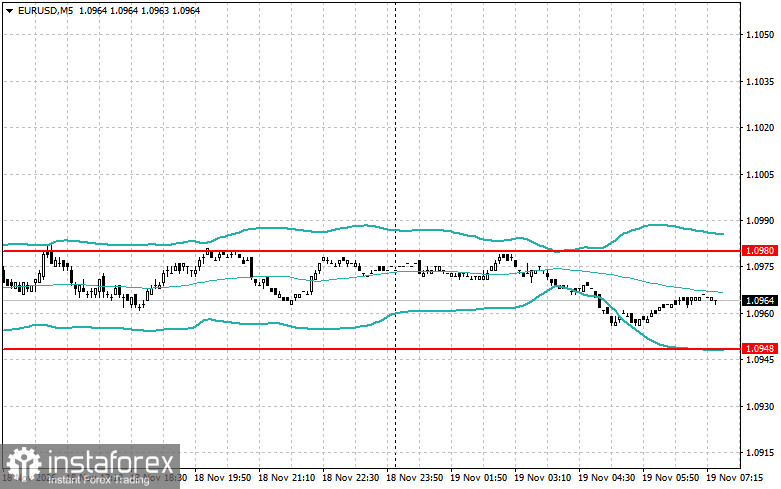
There are two levels here, 1.0980 and 1.0948. The upper reference, 1.0980, lies nine pips below the buy breakout point, 1.0989, so special caution is required. These two marks sit close together, and on the first touch it is impossible to determine which scenario has been triggered. If the price consolidates above 1.0989, the upward breakout is working, and you must not sell there. If, however, it reaches 1.0980, finds no continuation and quickly returns below, I consider selling toward 1.0948 with a stop above 1.0995 — i.e., above the breakout point with a small margin. Yesterday and overnight, the price twice reached this zone, 1.0981 and 1.0979, and reversed. This picture is most likely to repeat if the current-account data print close to the forecast and the market retraces after the initial reaction. The difference between the two scenarios may take several minutes, so it is better to skip the first reaction in the zone.
The lower reference 1.0948 lies eight pips below the sell breakout point 1.0956 and 16 pips below the current price, so the price first needs to pass the breakout point. The scheme is this: the price falls to 1.0948, cannot consolidate below and returns above, and then I look to buy toward 1.0980 with a stop below 1.0942. A buffer is essential because price sometimes slips one or two pips below the level, and a stop exactly at 1.0948 would have been hit. Such a rebound is most likely if the Fed offers no new hawkish words and the market starts taking profits after the decline. If price consolidates confidently below 1.0948, the return is canceled and the downward breakout to 1.0927 works.


