
یہ بھی دیکھیں


 25.11.2026 09:05 AM
After yesterday's session, the euro and the pound noticeably recovered from Monday's drop. EUR/USD rose from about 1.0909 to roughly 1.0980, GBP/USD from about 1.3038 to around 1.3120, and the currency pairs are now trading near 1.0942 and 1.3083 respectively. In the prior review, I expected continued pressure on the euro with a brief correction to 1.0925 after decent Ifo data, but in practice, buyers pushed the instrument back above 1.0963. As suspected, the move on November 23 was excessive: US data that day were weak, Fed officials spoke about rate hikes being gradual, and there were no strong reasons for such a dollar surge.

Let's start with Germany, which gave the euro a morning boost. The Ifo business climate index for November came in at 90.6 versus a forecast of 90.5 and 90.1 a month earlier; the current?conditions assessment rose to 89.4 versus an expected 89.2 (after 88.8), and business expectations were 91.9 versus a forecast of 92.0 and 91.5 in October. Importantly, in October, the index's rise rested on expectations while current conditions deteriorated; now, the picture has evened out, and the assessment of the present situation has improved. The data are mixed but overall slightly better than economists' forecasts, and for the euro — which had weak services PMIs and a divergence between Germany and France the day before — that was enough for a bounce.
Then US consumer?confidence data were released and proved strong. The Conference Board index jumped to 103.3 in November from 91.9 in October, beating a forecast of 92.4 — the highest since January last year (it had fallen to 84.2 in September). Notably, the dollar barely reacted. Why? I would venture the market saw the spike as a one?off: some economists link it to reduced post?election uncertainty, while primary concerns shifted to the risk that aggressive Fed tightening would slow the economy. Those worries showed up in equity sell?offs and demand for bonds, which in turn weakened the dollar versus the euro, the pound and other risk assets. I believe that after the jump on November 23, the market re?priced the situation and absorbed it into prices, producing the current upward drift and the muted response to US data.
As for today, Germany's preliminary Q3 GDP estimate is published in the morning. Quarter?on?quarter growth of 0.2% is expected after 0.3% in Q2, and year?on?year growth of 1.2% versus 1.0% in Q2. The first estimate on October 30 already showed 0.2% q/q and 1.2% y/y (consensus then 0.1% and 1.1%), so an upward revision would provide modest support to the euro. I'll also note that a non?monetary ECB meeting is taking place simultaneously. No rate decisions are made there, so I don't expect it to have a big market impact; the nearest policy guide remains the December rate path to 2.75%.
There is no major UK data today, so focus shifts to US reports — many of them — which I think will set the dollar's tone. The preliminary US Q3 GDP reading is due and is expected to show 3.4% growth after 2.2% in Q2, unchanged from the preliminary estimate on October 29. Then the PCE price index for October is released. The headline is forecast at 0.3% m/m (after 0.5% in September) and 3.8% y/y (after 3.6%), while core PCE is forecast at 0.3% m/m (unchanged from the prior month) and 3.2% y/y (after 3.1%). This is the Fed's key inflation gauge: a print above forecasts could materially strengthen the dollar and bring back market expectations of a more aggressive Fed at the end of this year and into early next year — expectations that had been pared back after Friday's stock sell?off. I'll also highlight personal income and spending (forecasts 0.4% vs. 0.5% previously) and new home sales.
In addition to the data, Fed speakers Bowman and Barkin will speak tonight; Barkin on November 5 expressed support for a gradual pace of hikes without naming a terminal rate. In the afternoon, Bank of England Governor Andrew Bailey speaks. The BoE raised the rate to 4.00% on November 5 by a 9?0 vote, and Bailey then said a second rate hike was more likely than not if energy prices reverted, calling December a 50/50 outcome. After recent disappointing services PMIs and 3.6% inflation in October, the pound sterling needs clarity, and I don't rule out that the lack of it will once again weigh on sterling.
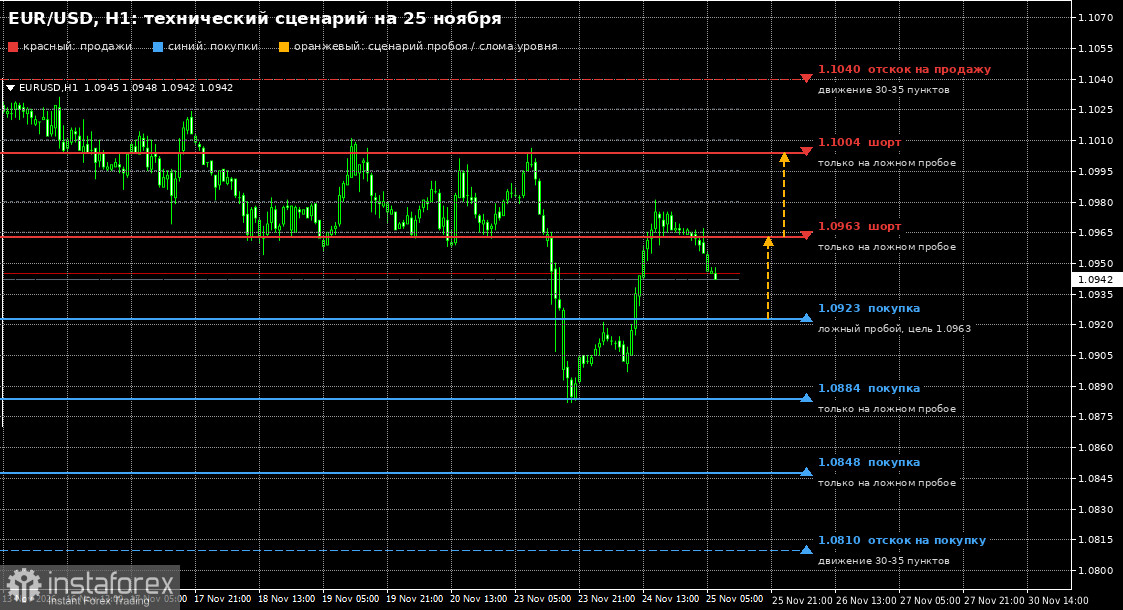
Technical view on EUR/USD
On the hourly chart, the nearest support for buyers is at 1.0923. A drop and false break there after weak European data would offer a long entry targeting a return to 1.0963. Strong German GDP could produce a breakout and hold above 1.0963, with a retest driving the instrument toward 1.1004; a further target is 1.1040, where I'd consider selling into the bounce for a 30–35 pip move. Shorts from 1.0963 and 1.1004 are planned only on false?break setups. If bulls fail to defend 1.0923, a break below would quickly push the euro to 1.0884, and very strong US data, especially on inflation, could drive it down to 1.0848 and 1.0810, where I'd look to buy the bounce for 30–35 pips. Long positions from 1.0848, 1.0884 and 1.0923 are counter?trend and should be taken only on false breaks. All reference levels have shifted by about +36–40 pips at the top and -39 pips on the buy side versus the prior session: if yesterday's sell?on?bounce started at 1.1004, today it starts at 1.1040.
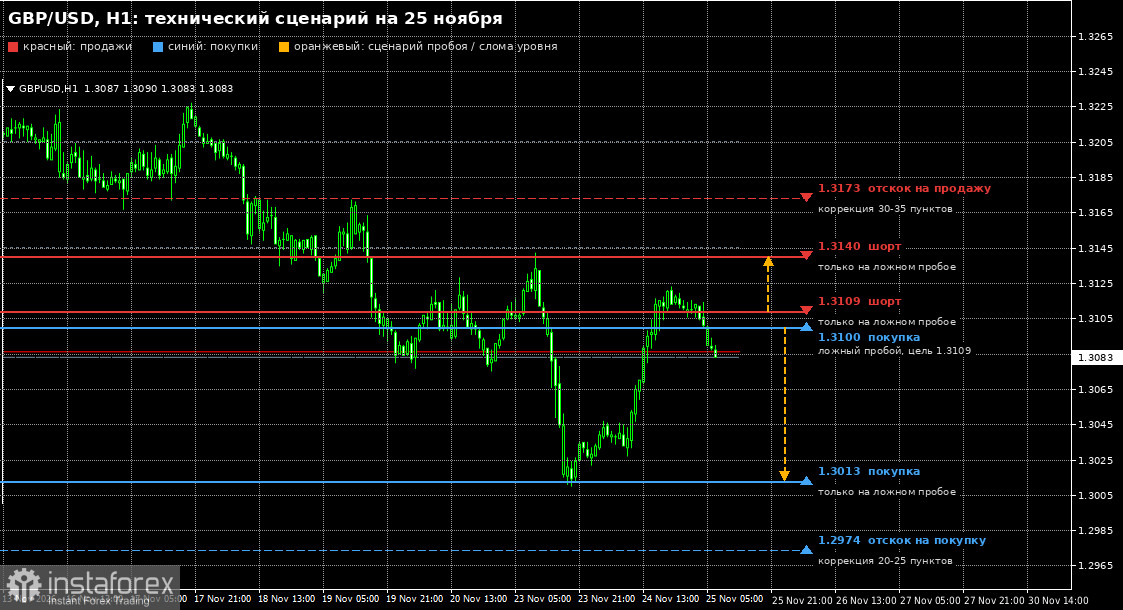
GBP/USD
There is little to trade on in the morning, so I expect the first meaningful bullish action around 1.3100. A drop there with a false break would be a buying opportunity targeting a return to 1.3109. Only a break above that level opens the way to 1.3140 and 1.3173, where I'd look to sell sterling on a bounce for a 30–35 pip correction; shorts from 1.3109 and 1.3140 are opened only on false breaks. A break of 1.3100 will reintroduce pressure on the pound and, combined with strong US GDP/PCE, could push it down to 1.3013, where long positions are again planned only on a false break. Bounce buys from 1.2974 are possible on a first test for a 20–25 pip correction. For comparison, yesterday's working levels were 1.3049 and 1.3013; now the main range has shifted higher to 1.3100–1.3109.
The overall picture remains mixed, though near term the bias favors euro and pound buyers. I lean toward pairs trading below recent highs ahead of the PCE and US GDP prints, with pullbacks to 1.0923 and 1.3100 where buyers can try to re?enter. But if US inflation surprises to the upside, expectations of an aggressive Fed will return, and the dollar could erase yesterday's losses. Until the Fed's December 9 and the ECB's December 17 meetings, the market will likely react to each such signal; stocks will remain the decisive catalyst.


