
یہ بھی دیکھیں


 25.11.2026 09:56 AM
Asian stocks are plunging today as renewed doubts about the sustainability of AI names have pushed investors out of the tech sector. The MSCI Asia-Pacific index fell 2%, while Taiwan dropped 5% and South Korea 5.7% — the two markets viewed as the main barometers of AI trading. The global MSCI All Country World index declined 0.4% and is headed for its eighth drop in ten sessions.
Futures point to continued weakness in the US. Contracts on the Nasdaq 100 lost 1.2%, signaling a second day of declines for US tech stocks after Monday's rally from the bear-market threshold. S&P 500 futures fell 0.7%. Over three sessions, the market moved from Friday's selloff, when the AI sector imploded, to Monday's bounce on Jensen Huang's return to Nvidia, and then back to declines on Tuesday. Optimism, therefore, proved short?lived.
Anthropic shares traded below their IPO price of $83 yesterday, although they had closed 17% higher on their first day of trading on November 19. Interestingly, Nvidia posted its best one?day gain since 2003 on Monday, November 23, yet the market was back to selling a day later. The reason for the sell-off is that investors do not believe prior levels of AI investment will persist, at least sustainably. This aligns with concerns voiced by Fed participants in the October meeting minutes, where nearly everyone flagged the risk of investor disappointment in AI returns and the opacity of financing schemes.
Against this backdrop, safe?haven assets saw separate demand. The 10?year Treasury yield fell three basis points to 4.90% (it was 5.01% on November 20 and 5.14% on November 16). Oil is weakening as well: Brent dropped more than 1% and approached $90 per barrel amid signs of rising supply and increased attacks on ships around the Strait of Hormuz; since October 30, when Brent was $116.06, the decline has exceeded one?fifth. Gold is set for its seventh decline in eight sessions and trades near $3,550 an ounce.
Pressure on markets is also sustained by two other factors. US inflation data due today could influence the Fed's policy trajectory — the policy rate stands at 3.75–4.00% and markets expect a hike on December 9. In addition, US authorities, according to sources, are preparing an announcement to raise tariffs on goods from China, the EU and more than a dozen other countries to replace duties overturned by the Supreme Court.
All this suggests the market recovery that began after Huang's return was a technical respite, not a trend reversal.
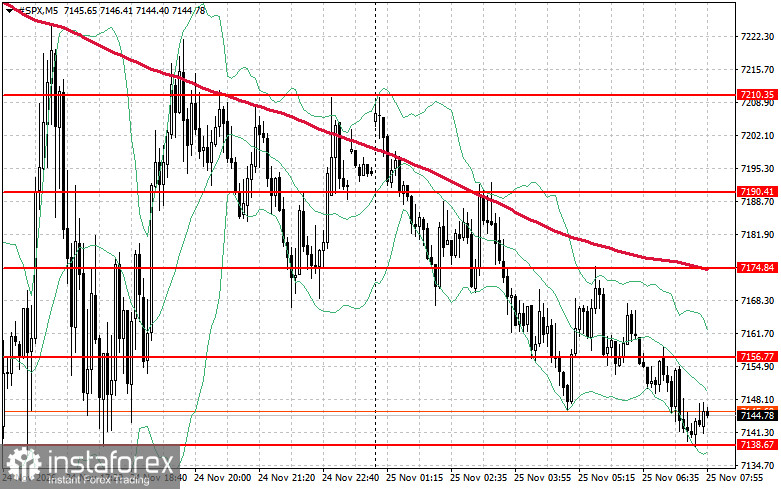
Technical view on the S&P 500 The main task for buyers today is to overcome the immediate resistance at 7,156. That would demonstrate upside and open the way to a push toward the next level at 7,174. Controlling 7,190 is also a priority for bulls, as it would strengthen their position. On a downside move amid falling risk appetite, buyers must show presence around 7,138 — a break there would quickly push the instrument back to 7,120 and open the road to 7,106.


