
یہ بھی دیکھیں


 26.11.2026 08:37 AM
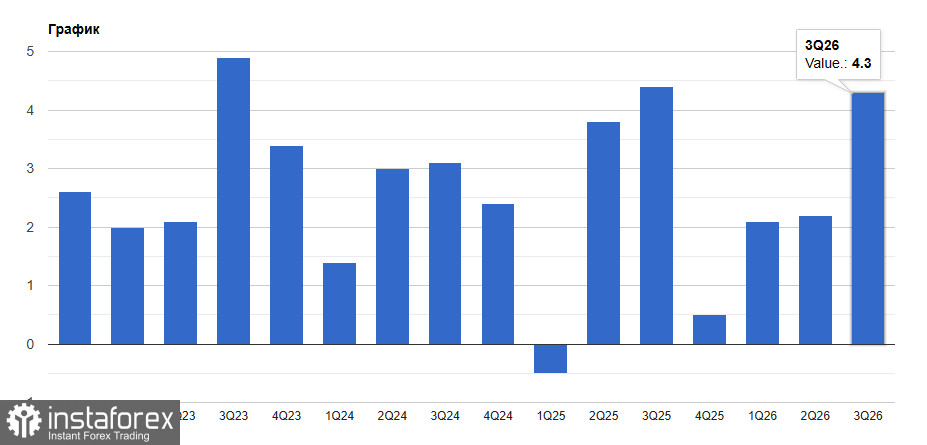
The US economy turned out materially stronger than previously thought. Second-estimate GDP from the Bureau of Economic Analysis on November 25 showed that real US GDP expanded at an annualized 4.3% in Q3, up from 2.2% in Q2. That marks a 0.9 percentage-point upward revision from the initial October 29 estimate of 3.4%. The revision mainly reflects stronger investment and consumer spending, and that in itself says a lot — yet the dollar didn't rally on the news, which is telling.

The upgrade was driven largely by firmer investment and household spending. Q3 growth was supported by business investment, consumer and government outlays, while net exports detracted as imports rose and are subtracted in GDP accounting. Compared with spring, the acceleration came primarily from investment and a pickup in government spending, while exports weakened. Imports rose more in Q3 than in Q2, so part of domestic demand leaked abroad.
One headline metric captures the story well: real final sales to private domestic purchasers, the sum of consumer spending and private fixed investment, rose 5.8% annualized and was revised up by 0.9 percentage point. In short, domestic demand is not just holding up — it is accelerating — and there is no obvious consumer pause yet. November reads confirm the pattern: Conference Board confidence jumped to 103.3, and October payrolls showed a 165k gain.
Price measures in the release are calmer but not a reason to relax. The index of prices for gross domestic purchases rose 2.7% annualized (revised down 0.3ppt), and the PCE price index for the quarter was roughly 2.1% annualized (the core PCE price index stood at 2.5%), numbers unchanged from the prior estimate. Remember that these are quarter-to-annualized rates; they are not directly comparable to year-over-year PCE, which stood at 3.6% in September with core at 3.1%.
On the income side, the picture is likewise vigorous. Real gross domestic income rose 4.4% annualized after a revised 2.3% in Q2, so the average of GDP and GDI is about 4.4% versus 2.2%. Corporate profits from current production increased by $206.0bn in the quarter, compared with a $384.0bn rise in Q2 — profit growth has slowed even as the economy accelerates.
So why didn't the dollar benefit? In my view, the market has already priced in a December Fed hike, and these are backward-looking numbers that add little to that narrative. The funds rate is 3.75–4.00%. Markets price in a 25-bp hike for December 8–9 virtually in full, and the dollar index is already near its April 2025 highs.
All told, strong GDP alone will not give the dollar a new leg up while markets focus on inflation and Fed policy. I think the key for the dollar will be the path of prices in upcoming reports: if inflation reaccelerates, the Fed will need to remain restrictive, and that would support the dollar. Risks remain, however: weak exports and slowing profits are reminders that the expansion is driven mainly by domestic demand, which could cool.
EUR/USD
Buyers should take 1.0990. Only that would open a test of 1.1030. From there, a run to 1.1060 is possible, but doing so without large-player support will be difficult. On a pullback, I expect increased buying activity only near 1.0940. If bids are absent there, wait for a dip to a fresh low at 1.0890 or consider long positions at 1.0850.
GBP/USD
Pound buyers need to overcome the nearest resistance level of 1.3140. That would enable a move toward 1.3170; above that further gains would be challenging. The next upside target is around 1.3200. On the downside, bears will try to seize 1.3090. If they succeed, a break below that deal would deal a serious blow to bulls and push GBP/USD to 1.3050, with the prospect of extending weakness to 1.3010.


