
یہ بھی دیکھیں


 26.11.2026 09:07 AM
After yesterday's session the euro and the pound benefited from U.S. data more than the dollar did. EUR/USD rose roughly from 1.0933 to 1.0993 and now trades near 1.0961, while GBP/USD bounced from about 1.3047 to 1.3127 and sits near 1.3100. Recall that the day before yesterday the market expected dollar pressure to persist in the form of short-covering, and the scenario the day prior envisaged either a return to 1.0963 after a false break of 1.0923 or a thrust to 1.1004; no buys from 1.0923 were required, support held, and the advance stopped a few points short of 1.1004. Notably, the dollar, which on November 23 rose for no obvious reason, gave up part of that gain despite the strong data.
We start with U.S. GDP. Third-quarter annualized growth was revised to 4.3% from an initial 3.4% and 2.2% in Q2—an upward revision of 0.9 percentage points, driven mainly by investment and consumption. Real final sales to private domestic purchasers, the series used to judge demand resilience, rose 5.8% and were revised up as well. The report beat the 3.4% forecast by a wide margin, so the dollar had something to lean on.
Now to inflation, which the Fed uses as the primary guide for rate decisions. The PCE price index for October was 3.8% year-on-year after 3.7% in September, in line with the forecast, while core PCE (excluding food and energy) rose to 3.3% versus a 3.2% forecast and 3.1% a month earlier. Both series printed 0.3% month-on-month, also as expected. I will add that personal consumption rose 0.3% versus a 0.4% forecast after 0.6% in September, while incomes rose 0.7%—Americans are earning more than they spend. In addition, initial jobless claims came in at 189k versus a 201k forecast, and new home sales reached 701k versus 650k expected.
Answering the question why the dollar did not rise after all this: in my view the market had already priced in higher values, and core inflation exceeded the forecast by only 0.1 percentage point, so there was virtually no reaction.
It is worth noting that the euro faced its own difficulties the day before. Germany's Q3 GDP was weaker than expected: growth was 0.1% q/q versus a 0.2% forecast and 0.3% in Q2; year-on-year growth was 1.1% versus a 1.2% forecast, whereas the first estimate on October 30 was 0.2% q/q and 1.2% y/y. Nevertheless, the euro remained in a fairly tight range, which I take as confirmation that the move was driven by dollar weakness, not European economic strength.
As for today, U.S. markets are closed for Thanksgiving, so volatility should be low and trading volumes thin. In the morning a number of eurozone and U.K. releases will appear. Germany's GfK consumer confidence index, a leading indicator, is due; the consensus is -29.4 after -30.8, and a negative reading means pessimists still outnumber optimists. The lower the print, the worse for the euro. Then eurozone private sector credit and M3 money supply data for October will be released (prior prints were 3.1% and 3.5%), though they are unlikely to move the euro much. The main event will probably be the ECB minutes. Recall that on October 29 the deposit rate was left at 2.5% by unanimous vote, and Lagarde said a hike was discussed, but the Council chose to wait, most likely until December. The market priced that long ago, and the euro did not gain much that day, so I will look for new details in the minutes, especially on core inflation and wages.
For the U.K., the Bank of England's minutes and its Financial Stability Report will be published. I expect the market to compare them with recent BoE comments because the Bank raised the rate to 4.00% on November 5 by a 9-0-0 vote, and Andrew Bailey judged a December hike quite possible. If the minutes diverge from recent rhetoric, we will rely on them because they are more important; if they show further tightening is needed and many policymakers lean that way, that could help the pound recover versus the dollar—especially with U.S. markets closed.
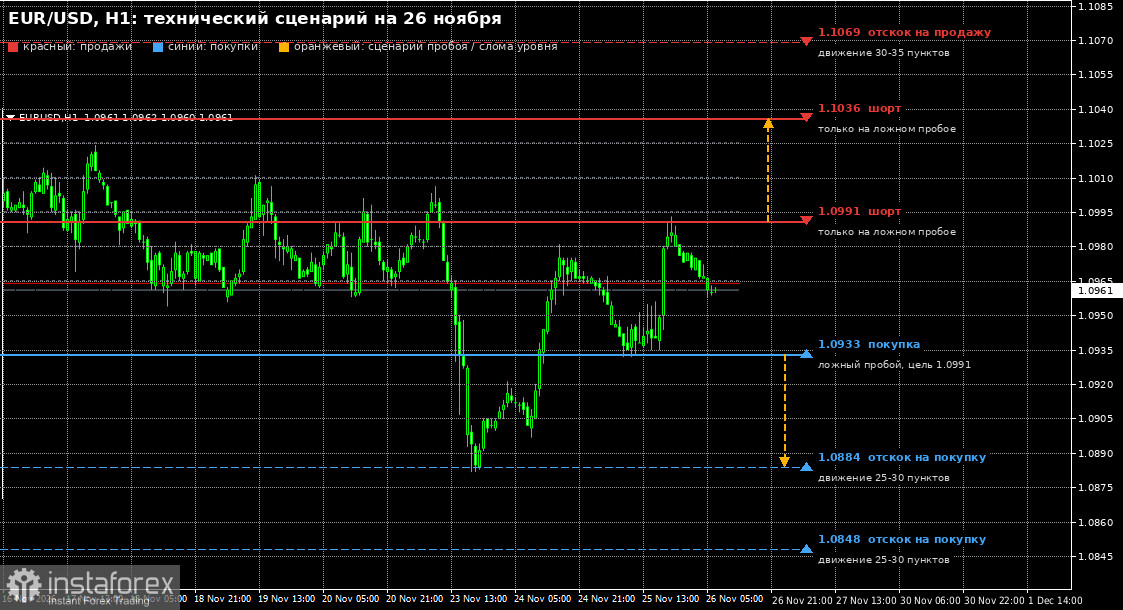
Technical picture for EUR/USD (hourly): selling is possible from 1.0991. A false break at that level would be a reason to remain within the bear market; a break and hold above it would give a chance for a larger recovery to 1.1036. A farther target is 1.1069, where I will look to sell the bounce for 30–35 pips. Shorts from 1.0991 and 1.1036 are valid only on false breaks. The main focus is the major support at 1.0933 formed after yesterday; a false break there would be a reason to add longs aiming back to 1.0991, especially given that high volatility is expected only in the morning. If price breaks 1.0933 to the downside, the next levels are 1.0884 and 1.0848, from which I will look to buy the bounce for 25–30 pips. Compared with the prior session, the sell-on-bounce start was at 1.1040; today it is 29 pips higher at 1.1069, and the channel midpoint moved up ten pips from 1.0923 to 1.0933.
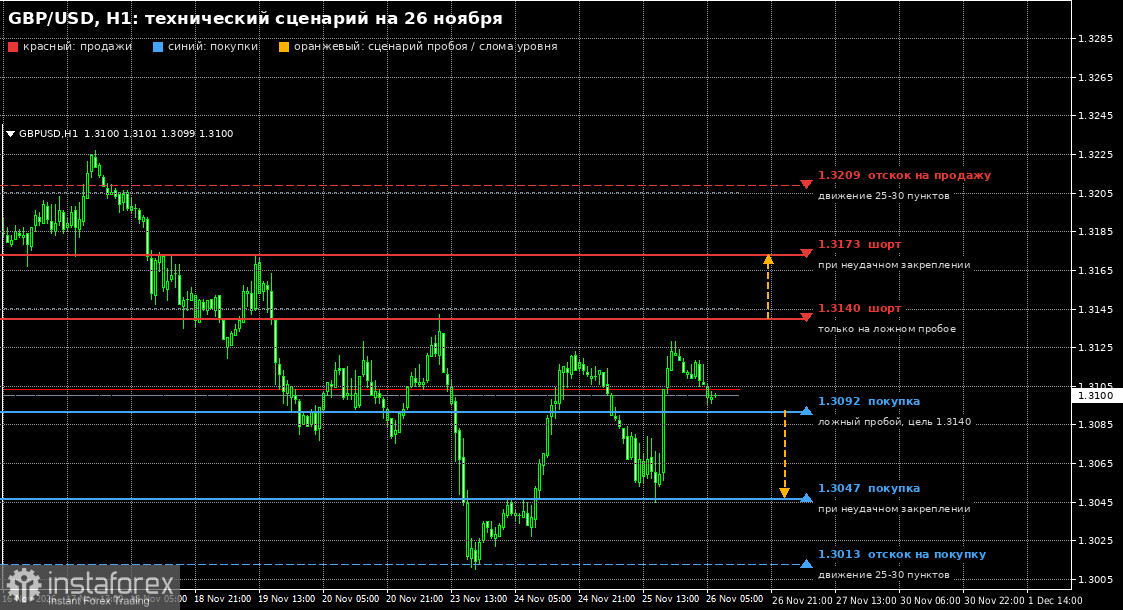
As for GBP/USD, the situation is similar. I expect the first buyer interest near 1.3092; a false break there I will treat as a buy, aiming for a recovery to 1.3140. A break of that level opens a move to 1.3173, and a farther target is 1.3209, where I will sell the bounce for 25–30 pips. Shorts can be considered from 1.3140 on a false break and from 1.3173 on a failed hold. If buyers fail at 1.3092, wait to buy until 1.3047 on a failed close, or buy an immediate bounce from the 1.3013 low with a 25–30 pip intraday target. Compared with the previous session, the upper target rose 36 pips from 1.3173 to 1.3209, and the buy zone near 1.3100 shifted down eight pips to 1.3092.
The overall picture is fairly calm, though the trend remains down. I expect in the thin holiday trade the pairs to range between 1.0933 and 1.0991 for EUR/USD and between 1.3047 and 1.3140 for GBP/USD, with GfK and the ECB and BoE minutes determining which side will provide the next impulse. I do not rule out a more noticeable move being delayed until Friday, and when U.S. markets reopen, interest in the dollar should return because Fed expectations remain hawkish; until the December 9 and 17 meetings, the market will react to every inflation print.


