
یہ بھی دیکھیں


 27.11.2026 12:44 PM
After yesterday's session, the euro generally remained inside a sideways channel, and a similar picture was observed for the British pound. This was expected ahead of Thanksgiving in the U.S., and the holiday continues today with U.S. markets closing early. No U.S. data were released yesterday, so focus shifted to eurozone releases.
Let's start with Germany. The leading GfK consumer confidence index for December printed -30.2 versus a -29.4 forecast, after a revised -30.9 in November. The indicator improved but less than economists had expected, and the market typically reacts to surprises versus consensus—so the euro slipped a little in the first half of the day. A negative reading means pessimists still outnumber optimists, and households prefer to save rather than spend. Notably, this happens alongside a solid Ifo index and the fastest services growth since March 2022 in the preliminary PMIs—i.e., consumer sentiment lags business sentiment.
Attention then switched to the minutes of the ECB meeting on October 28–29. Traders found nothing materially new. The Governing Council left the three key rates unchanged; the deposit rate stayed at 2.50%, and the president's proposal was supported by all members. The minutes show a significant part of the Council could have backed a hike in October—the benefit of waiting was small, and the policy rate sits around neutral estimates, so the debate was mostly about timing. It is worth noting that on October 29 Lagarde said a hike was discussed and the Council chose to wait—now it is clear how close that decision was.
Pause supporters pointed to stable core inflation, an absence of second-round effects, tightening financial conditions, and a desire to wait for December projections. The minutes stress a pause does not mean less concern, and another hike will likely be needed if the inflation outlook does not improve meaningfully. For comparison, five-year consumer inflation expectations rose to 2.5% from 2.0%—flagged in the minutes as worrying—while Brent oil fell from about $115 at the meeting to roughly $95.5. In my view this increases the odds of a December hike, but it does not add drama: a move to 2.75% in December is long priced in, and many expect it to be the last step. The minutes gave no tangible support to the euro or new guidance to the market.
As for today, a lot of European data will be released, notably for France, Germany, and Italy. France's Q3 GDP is forecasted at -0.1% q/q after 0.0% in Q2 and -0.1% y/y after 0.5%—preliminary. France's November CPI is forecasted at -0.2% m/m after +0.4% in October; the harmonized index is expected to be +0.4% m/m after +0.4% previously. Consumer spending for October is forecasted to be +0.1% after -0.5%; Bundesbank president Nagel will speak. German unemployment is due: November unemployment is expected to be 6.4%, as in October, with a 5k rise in claimants after 4k. I would suggest even good prints may not strongly strengthen the euro given thin volumes and lack of big player support; the only U.S. print today is the goods trade balance.
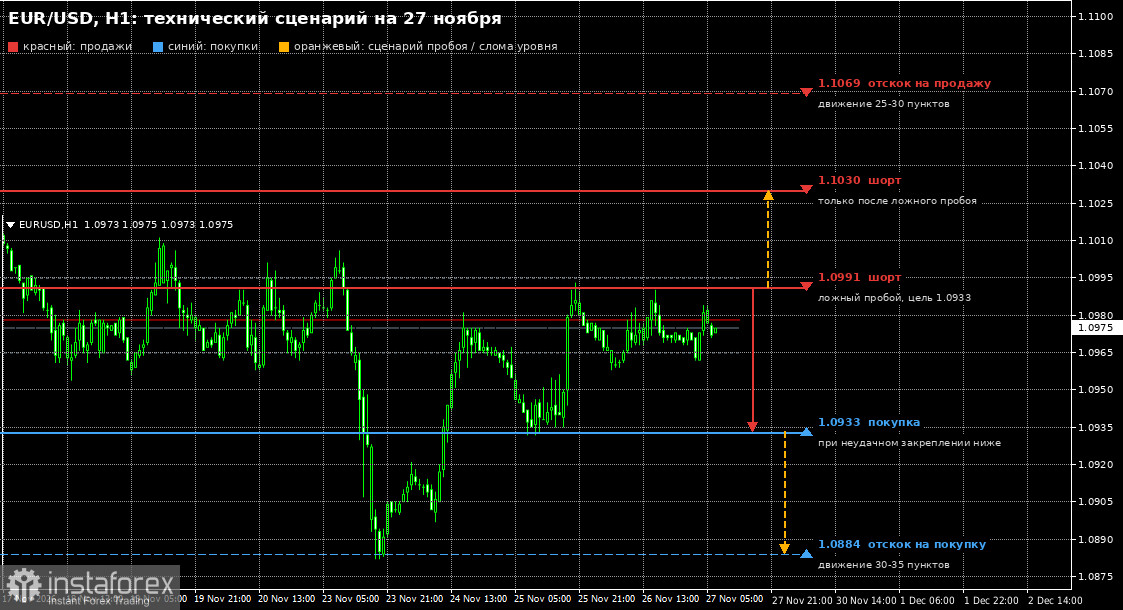
Technical picture for EUR/USD (hourly): yesterday the 1.0991 level failed to hold, so attention returns to it today. If the price rises on good euro data to that level and prints a false break, that will be a reason to sell toward 1.0933, where I expect stronger buyer activity. Overall, we trade inside this range. If the price breaks and holds above 1.0991, expect a thrust to 1.1030, where I will short on a false break, or sell a bounce from 1.1069 for 25–30 pips. I buy only on a failed break below 1.0933 or a bounce from 1.0884 for 30–35 pips. Compared with the prior session, the key levels 1.0991, 1.0933, and 1.1069 are unchanged; the sell level shifted six pips down from 1.1036 to 1.1030.
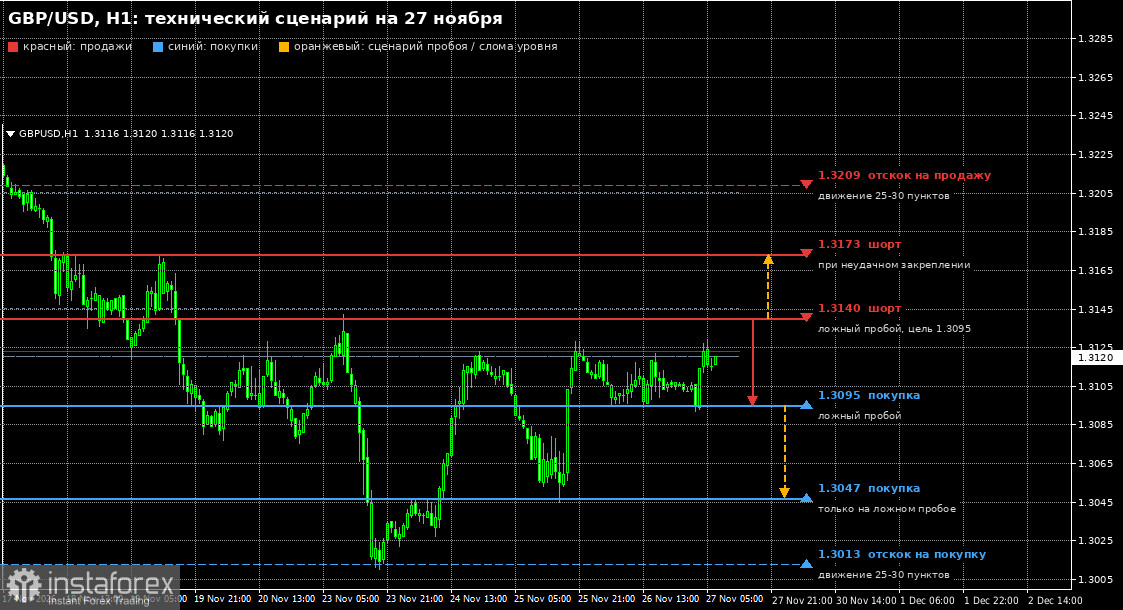
GBP/USD shows the same theme. Yesterday, 1.3095 underperformed and drew attention again today as Asian trading showed activity there. If the pair rallies without U.K. prints, I expect the first bear reaction near 1.3140; a false break there would be an opportunity to sell toward 1.3095. If that level is breached, prefer to buy only after a failed break at 1.3047 or buy a bounce from 1.3013 with a 25–30 pip intraday target. A false break at 1.3095, then a break above 1.3140, would target 1.3173, where I will short on a failed close or sell the bounce from 1.3209 for 25–30 pips. Compared with yesterday, the buy zone shifted up three pips from 1.3092 to 1.3095; other targets remain.
The overall situation remains calm, and I expect pairs to trade within recent ranges through the holiday; a bigger move may await U.S. markets reopening. If weekend France and Germany prints disappoint, the euro should quickly return to 1.0933, and buyers will need a false break to show up. Next week is busier: U.S. employment on December 4, Fed meeting on December 9, and ECB on December 17 with new projections—the market will begin positioning now.


