
یہ بھی دیکھیں


 27.11.2026 10:24 AM
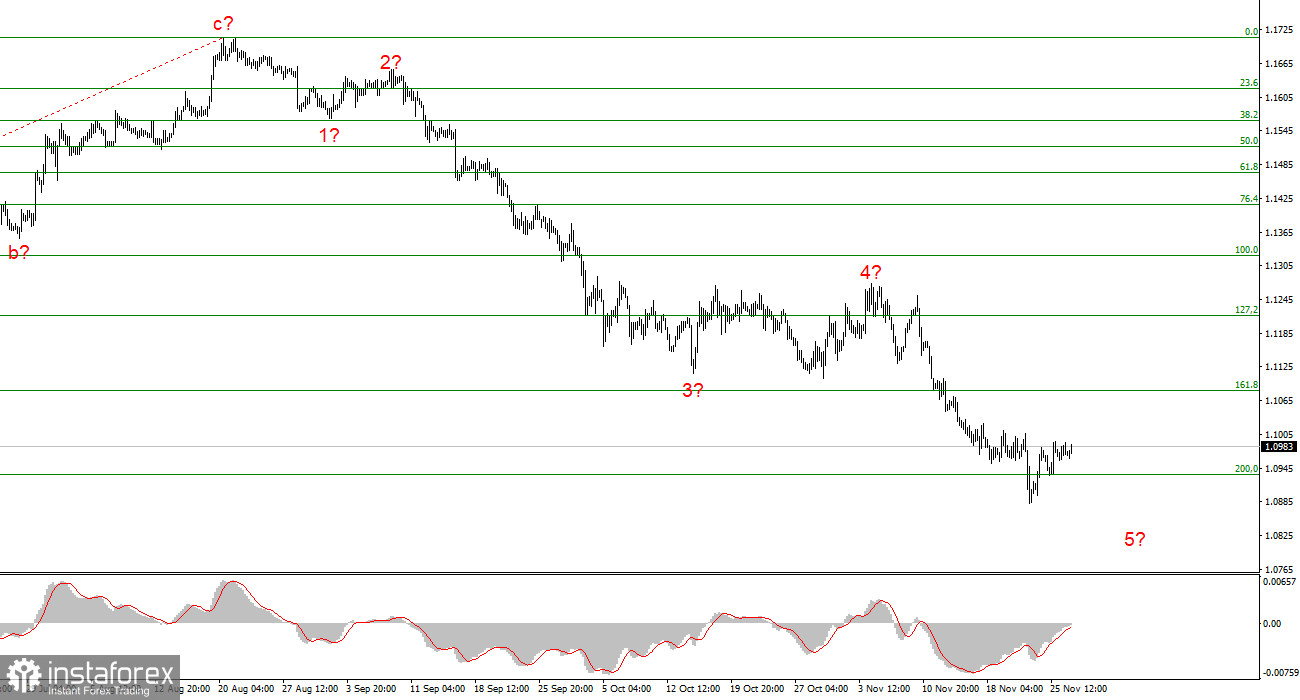
The wave structure on the 4-hour chart for EUR/USD has become more complex. On the higher timeframe (lower chart), the downward trend segment has taken the form of a five-wave structure, A-B-C-D-E, which could be completed at any moment, as it appears to be fully developed. All the waves within this segment are approximately equal in size, which is why it is considered corrective. If this assumption is correct, the completion of this structure will be followed by the development of a bullish impulsive trend segment, with targets located well above the 20.00 level.
On the lower timeframe (upper chart), an impulsive wave structure continues to develop, which may belong to wave E of the higher timeframe. If this is indeed the case, the dollar's strengthening is approaching its end, regardless of how much further it manages to appreciate. The presumed wave 5 of E is nearing completion. In any case, the current wave structure suggests that the development of the bearish wave sequence is nearing completion on both charts. The news background and the sharp shift in market sentiment have triggered a strong appreciation of the US dollar, but there are few new reasons left for further dollar strength.
The Euro Is Delighted with ThanksgivingThe EUR/USD exchange rate remained unchanged on Thursday. Trading activity was minimal throughout the day, as the United States celebrated Thanksgiving, while the European Union decided to support its American friends by releasing no economic reports during the session. However, Europe did publish the minutes of the ECB's October meeting, which revealed a noticeably more hawkish stance among European policymakers than could be inferred from the October meeting itself, which ended with interest rates and other monetary policy parameters being left unchanged.
It emerged that most ECB policymakers had been prepared to vote for monetary tightening but opted for a more cautious approach, which involves gathering more information before taking a third consecutive hawkish step. However, this is precisely where the whole point lies. When the Fed adopts a more hawkish stance, the dollar takes off. When the ECB adopts a more hawkish stance, the market has supposedly already priced it in, and the stance is considered not particularly hawkish.
The same applies to the Bank of England. Yesterday, Andrew Bailey, Governor of the BoE, openly stated that the Monetary Policy Committee (MPC) could vote in December for a second consecutive round of monetary tightening. How did this help the pound? Not at all, because the market had supposedly already priced in this scenario as well. The only question that remains is when the market priced in the hawkish scenarios involving the ECB and the Bank of England, given that both the euro and the pound have only been declining in recent weeks. And how much longer will the market continue to price in the Fed's hawkish scenario?
In my view, it is obvious that any positive, bullish, or hawkish news from the European Union and the United Kingdom continues to be ignored. The euro and the pound cannot fully benefit from the US Thanksgiving holiday, as it is precisely this holiday that allows them to take a short break and trade at least somewhat more steadily.
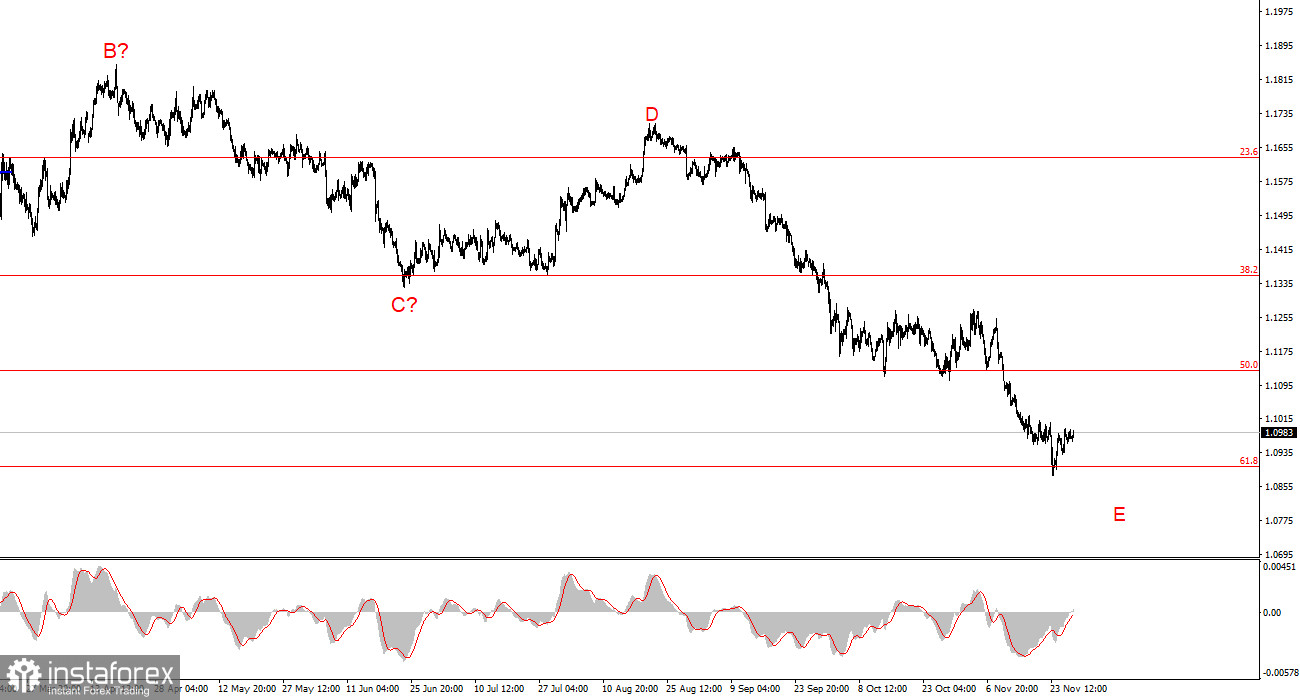
Based on the EUR/USD analysis, the pair remains within the global corrective trend segment A-B-C-D-E. However, this structure appears to be fully developed and could therefore be completed at any moment. In my view, current market conditions are favorable not only for buying the euro but also for anticipating the development of a full-fledged bullish trend. According to the higher timeframe, the pair is expected to rise to at least the 1.1700–1.1800 level. In my view, the deeper the pair declines now, the stronger its subsequent rise is likely to be. However, confirmation is needed that the bearish wave sequence has been completed. One possible signal would be a failed attempt to break below 1.0902, corresponding to the 61.8% Fibonacci retracement level on the higher timeframe.
The higher timeframe shows a downward trend segment that has taken the form of an A-B-C-D-E structure. The internal wave structure of wave E has developed into a five-wave impulsive pattern, but it may already be complete. If this assumption is correct, the development of a new upward trend segment will begin in the near future.
The Main Principles of the Analysis:


