
อ่านรายละเอียดเพิ่มเติม


 22.05.2026 08:37 PM
The EUR/USD pair reversed in favor of the U.S. dollar, fully pierced through Bullish Imbalance 14, reached Bullish Imbalance 13, and continued its downward movement. On Monday, Donald Trump encouraged bullish traders with conciliatory rhetoric regarding the Middle East conflict, which immediately triggered growth in the euro. The U.S. president stated that very serious negotiations are currently underway, the outcome of which could bring an end to the war and also satisfy the American side. However, beginning on Tuesday, only negative news has emerged. For example, reports today indicated that Iran and the United States still hold fundamentally different positions on the most controversial issues. Several well-known experts estimate the probability of reaching a deal at around 50% at the current stage. Iran has not even confirmed the existence of negotiations with Middle Eastern countries or the proximity of an agreement, and on Wednesday stated that in the event of new attacks on its territory, it would strike not only regional targets but also targets beyond the region. In effect, Tehran openly declared that any new aggression against it could cause the conflict to spread beyond the Middle East and become global in scale. Therefore, on Tuesday, Wednesday, Thursday, and even Friday, traders had little choice but to return to selling. It is worth noting that the selling pressure remained relatively restrained. Bullish Imbalance 13 is on the verge of invalidation, but it still continues to prevent prices from moving lower.
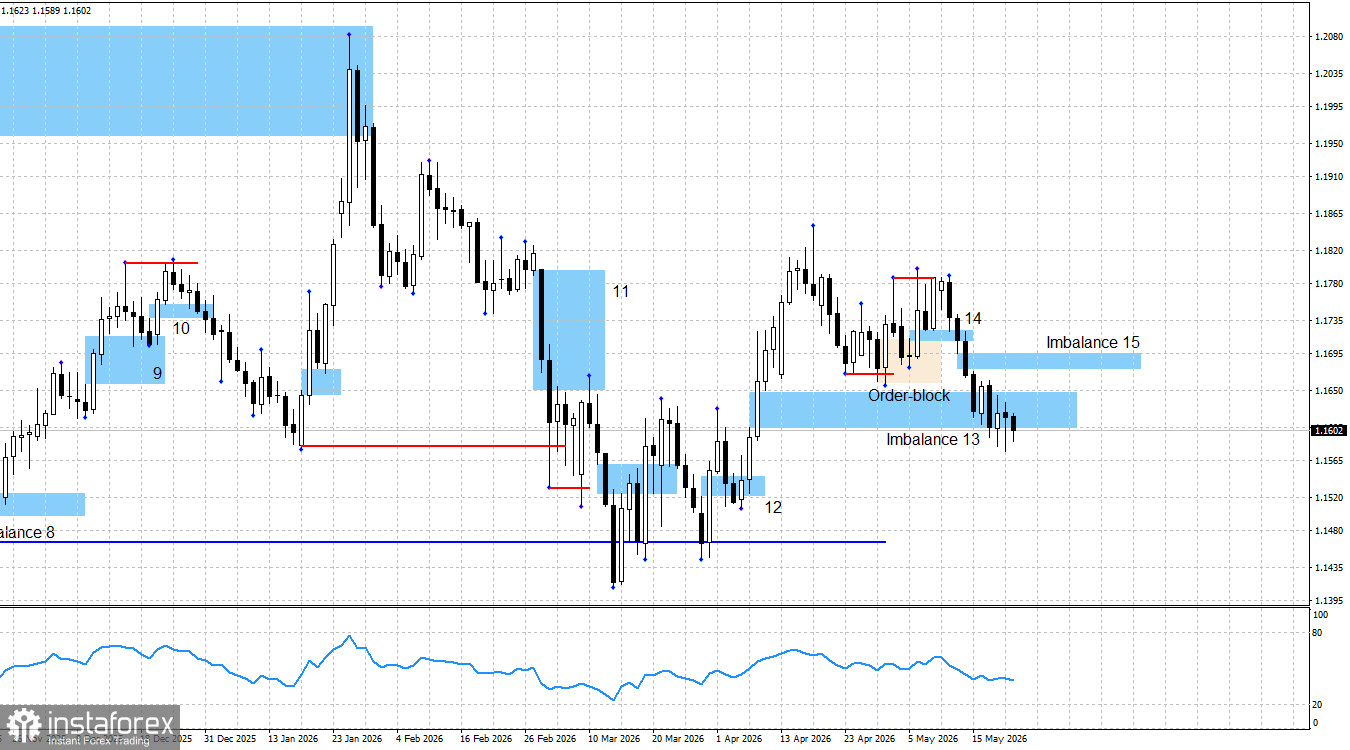
Under current conditions, traders can only wait either for another reaction from Imbalance 13, which remains the final bullish pattern within the current bullish impulse, or for its invalidation. If the current decline is viewed as a corrective pullback, then it could be completed within Imbalance 13. However, without geopolitical support, traders appear unwilling to return to buying. If the current movement is viewed as the beginning of a new bearish trend, then there is currently no suitable area for opening short positions, since the only bearish pattern — Imbalance 15 — was never fully worked out.
Once again, it should be emphasized that the entire appreciation of the U.S. dollar between January and March was driven exclusively by geopolitics. As soon as the United States and Iran agreed to a ceasefire, bears immediately retreated, and for more than a month bulls remained largely dominant. At present, the ceasefire remains extremely fragile, but negotiations have not been completely abandoned, and hopes for peace still exist. Unfortunately, traders themselves are increasingly losing confidence in a comprehensive resolution to the conflict and in a final agreement between Iran and the United States. More precisely, a deal will probably eventually be signed. However, "eventually" is not a timeframe that satisfies the market. For example, if a deal is signed a year from now, traders are unlikely to become optimistic about it today and aggressively sell the U.S. dollar.
The overall technical picture currently remains relatively clear. The bullish trend remains intact, but it is desperately in need of support. Ideally, this support should come from geopolitics — namely, renewed negotiations between Iran and the United States accompanied by genuine concessions from both sides. Without a positive news backdrop, it will be difficult for the euro to resume its upward movement.
The economic background on Friday was effectively nonexistent, which was clearly reflected in weak trading activity throughout the day. Selling pressure on the pair remains very limited, but it still dominates over buying interest, as the market continues to doubt that a deal between Iran and the United States will ultimately be signed.
There are still numerous reasons for bulls to remain active in 2026, and even the outbreak of conflict in the Middle East has not reduced their number. Structurally and globally, Trump's policies — which caused a sharp decline in the dollar last year — have not changed. Over the coming months, the U.S. currency may periodically strengthen amid investor flight to safety, but this factor requires constant escalation in the Middle East conflict. I still do not believe in the formation of a long-term bearish trend. The dollar has received temporary market support, but what fundamental drivers would allow bears to maintain pressure over the long term?
The economic calendar for May 25 contains no significant events. Therefore, the economic backdrop is unlikely to influence market sentiment on Monday.
In my view, the pair remains in the process of forming a bullish trend. The news backdrop changed sharply three months ago, but the trend itself cannot yet be considered canceled or completed. Therefore, in the near term, bulls may well resume their advance if they receive even modest support from geopolitics.
Traders had opportunities to open long positions based on the signal from Imbalance 12, as well as from the order block signal. The upward movement could resume toward this year's highs from Imbalance 13. However, in the coming days, it is important for bulls to maintain control of the market. For the euro to continue rising without obstacles, the Middle East conflict must move toward a sustainable peace process, and signs of de-escalation do occasionally appear. However, such developments remain rare. Bullish traders still lack sufficient support for launching a new upward impulse. The zone for new long positions is 1.1605–1.1649.


