
Lihat juga


 03.11.2026 07:48 AM
Bitcoin and Ether continue their downward move, which is repeatedly fed by new discouraging news. Recent developments in the crypto world have been broadly negative. Central banks—notably the Fed—continue to tighten monetary policy, which raises demand for safe assets rather than Bitcoin. The Clarity Act remains a bill; if Democrats win the U.S. Congressional elections, there is a strong chance it will never become law. Historically, Bitcoin has fallen after U.S. midterm elections. Last week the list of headwinds grew with the hack of the world's largest crypto exchange, Binance. Taken together, the fundamentals for further growth in the crypto market remain, to put it mildly, doubtful. We do not deny that the asset can rally in any news environment—the recent dollar rally proves that—but at present there are no technical signals or fundamental reasons to expect a sustainable rise.
Meanwhile, Strategy purchased another 811 Bitcoin, bringing its total crypto balance to 849,000 coins. The average purchase price in the latest trade was $80,850 per coin. As we see, Strategy remains utterly unconcerned about the price at which it conducts transactions. Bitcoin is bought at any price whenever funds are available. Judge for yourself how correct and profitable such an investment approach is. It is worth noting that Strategy has been accumulating "digital gold" en masse for six full years. The average purchase price across all its Bitcoin holdings is about $75,500. That means after six years of investing in Bitcoin, the overall portfolio profitability is minimal, and a modest additional decline in the leading cryptocurrency could push the portfolio into loss. Nevertheless, Strategy continues to bet on perpetual appreciation, so it keeps buying and accumulating, setting an example for other market participants.
At the same time, well-known crypto trader and head of consulting firm MN Trading, Michael van de Poppe, said he does not see strong reasons for continued declines in "digital gold." In his view, the market absorbed the Binance hack relatively painlessly, and overcoming resistance at $79,800 would help restore bullish momentum. If Bitcoin falls below $75,000, traders may use that decline to buy. As we see, crypto experts' strategy does not change over time: if Bitcoin rises, buy it because it will rise further; if Bitcoin falls, treat it as a correction and buy the dip.
Trading recommendations for BTC/USD:
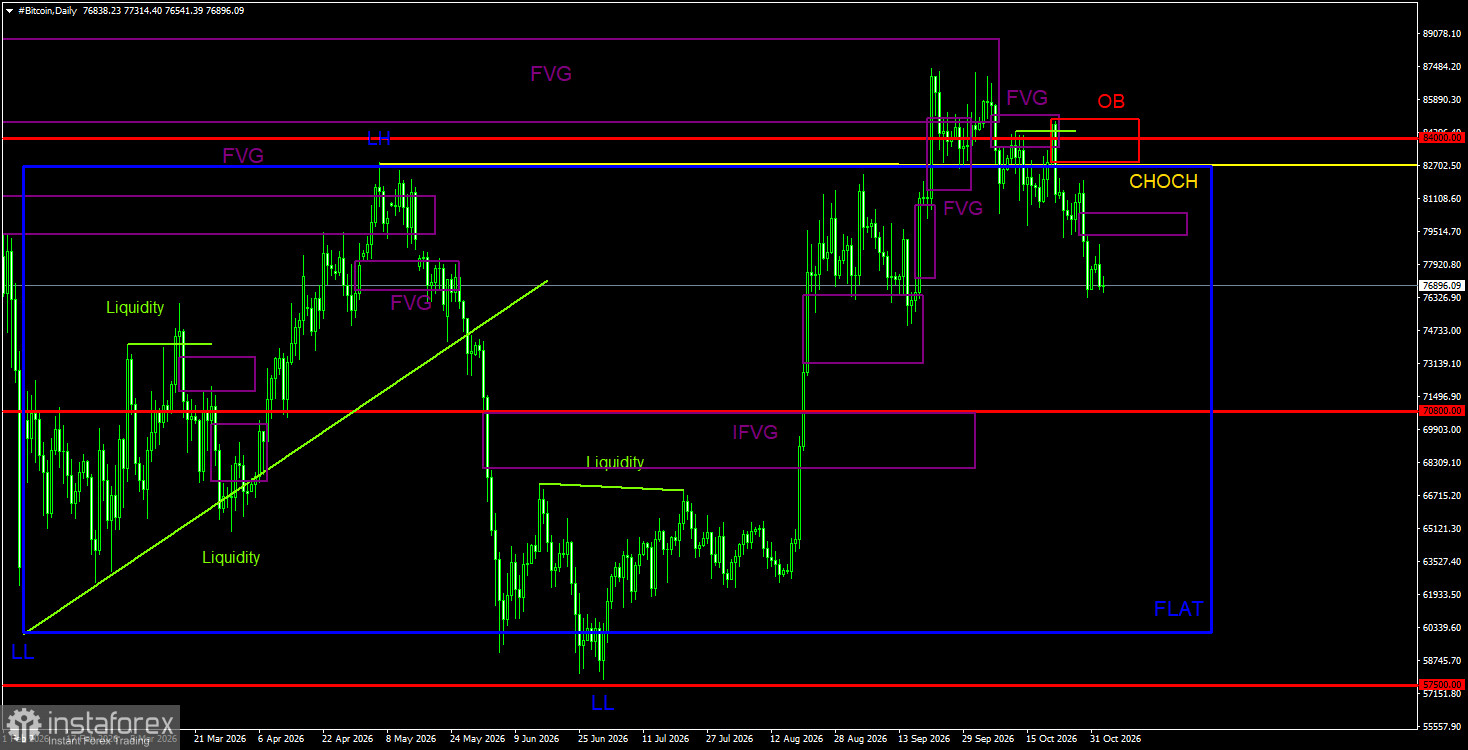
Bitcoin tried to start a new uptrend, but the fundamental backdrop, spot demand, and recent news are too weak to count on continuation. On the daily timeframe Bitcoin may remain in decline because the price reacted to the two recent bearish FVGs and formed a bearish order block. A move outside the sideways channel on the daily chart is currently interpreted as a deviation. Thus, Bitcoin produced a reversal signal and set course for $70,800. Because a flat does not guarantee the end of the primary trend, we do not believe the bearish trend is over. Short positions are the most relevant in the near term.
Trading recommendations for ETH/USD:
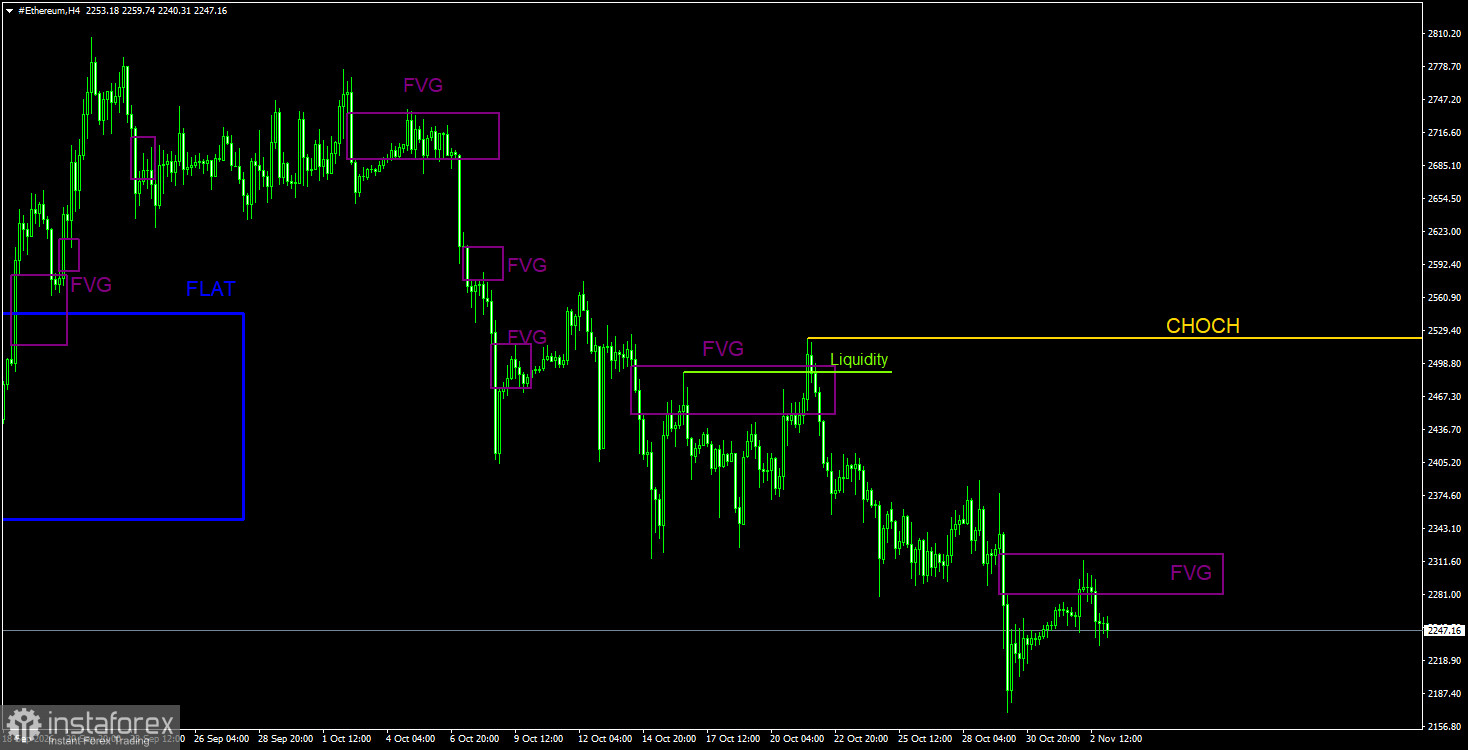
The daily technical picture for Ether has changed. Ether made a significant upward impulse in June–September 2026 that could be the start of a new long-term trend. However, at the same time, there is no confidence that Bitcoin's bear market has ended. If Bitcoin remains in a downtrend or even a flat, Ether's rise should not be expected. Bulls can rely only on the weekly chart, where Ether is heading to $4,800, the upper boundary of a five-year sideways channel. On the daily timeframe, Bitcoin has generated enough sell signals and bearish patterns to continue falling. Therefore, we expect Ether to decline as well, with targets near $1,850 and $1,391. On the 4-hour timeframe yesterday there was a reaction to the last bearish FVG.
Explanations for illustrations:
- CHOCH—change of trend structure.
- Liquidity—liquidity, stop losses, and pending orders that market makers use to build positions.
- FVG—fair value gap. A price inefficiency area that price traverses quickly, indicating the absence of one side of the market; subsequently, price tends to return and react to such areas in continuation of the main trend.
- IFVG—inverted fair value gap. After returning to such an area, the price often does not react but impulsively breaks through and then tests from the other side.
- OB—order block. The candle where a market maker opened a position aiming to take liquidity to form a position in the opposite direction.


