
Lihat juga


 06.11.2026 01:13 PM
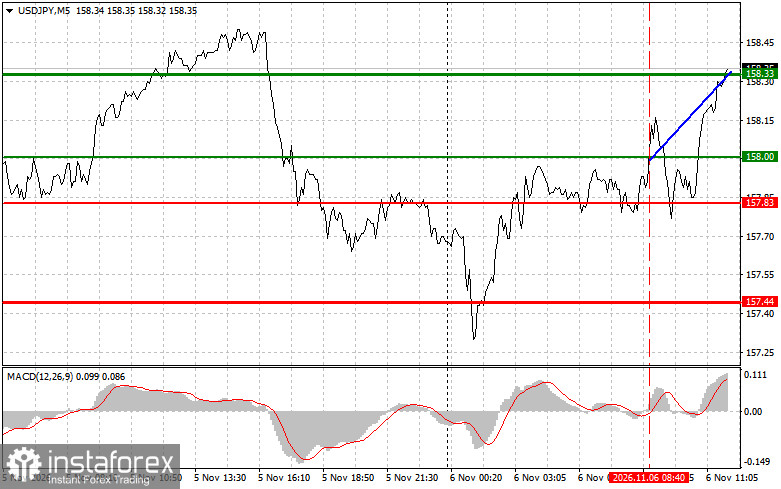
The test of 158.00 in the first half of the day occurred when the MACD indicator had just started moving upward from the zero line, confirming the validity of the entry point for buying the yen. As a result, the pair rose toward the target level of 158.33.
Today's US labor market report will be particularly important for USD/JPY, as its impact on this pair is reflected through the interest rate differential. Japan released strong economic data this morning. Specifically, nominal wages increased by 4.6% in September, compared with the forecast of 3.8% and the previous month's reading of 3.9%. This brought wage growth back to the July level of 4.7%. These figures strengthen the case for further interest rate hikes by the Bank of Japan, whose current policy rate stands at 1.25%. At its previous meeting on October 30, the central bank maintained its policy stance in an 8–1 vote, but many economists expect a rate hike as early as December 17–18. The problem is that the gap between Japanese and US interest rates remains substantial. The Fed's rate currently stands at 3.75–4.00%, exceeding Japan's rate by 2.5–2.75 percentage points. Even if the Fed raises rates to 4.00–4.25% in December, the differential will remain significant. This gap continues to support demand for dollar-denominated assets, and Japan has yet to catch up with the United States in this regard. If the US employment report is strong, with job growth exceeding 65,000 and wage growth reaching 0.3%, expectations of further Fed rate hikes will strengthen. Treasury yields will rise, providing support for USD/JPY and potentially pushing it closer to the psychologically important 160.00 level, where the market has come to expect a response from Japanese authorities. A weak report would have the opposite effect, bringing the scenario of a December rate hike by the Bank of Japan to the forefront and potentially supporting the yen. Bank of Japan Governor Kazuo Ueda is scheduled to speak in the evening, and his comments on the pace of monetary policy normalization could also influence the pair.
As for the intraday strategy, the focus will be primarily on the implementation of Scenarios #1 and #2.
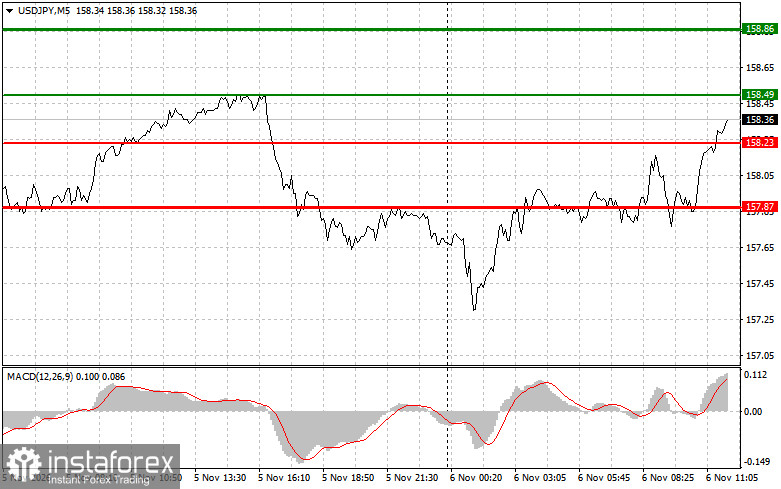
Scenario #1: USD/JPY can be bought today when the price reaches the entry level around 158.49 (the green line on the chart), with a target of reaching 158.86 (the thicker green line on the chart). Around 158.86, the long position will be closed and a short position will be opened, targeting a move of 30–35 points in the opposite direction from that level. The pair can be expected to rise today only if US economic data is strong. Important! Before buying, make sure that the MACD indicator is above the zero line and has just started rising from it.
Scenario #2: USD/JPY can also be bought today if the price tests 158.23 twice consecutively while the MACD indicator is in the oversold area. This will limit the pair's downward potential and trigger an upward market reversal. The pair can be expected to rise toward the opposite levels of 158.49 and 158.86.
Scenario #1: USD/JPY can be sold today after the price breaks below 158.23 (the red line on the chart), which could lead to a rapid decline in the pair. The sellers' main target will be 157.87, where the short position will be closed and a long position will be opened immediately, targeting a move of 20–25 points in the opposite direction from that level. Selling pressure on the pair could return today if the central bank intervenes. Important! Before selling, make sure that the MACD indicator is below the zero line and has just started declining from it.
Scenario #2: USD/JPY can also be sold today if the price tests 158.49 twice consecutively while the MACD indicator is in the overbought area. This will limit the pair's upward potential and trigger a downward market reversal. The pair can be expected to decline toward the opposite levels of 158.23 and 157.87.
Important. Beginner Forex traders should exercise extreme caution when making entry decisions. Before the release of important fundamental reports, it is generally best to stay out of the market to avoid exposure to sharp exchange rate fluctuations. If trading during news releases, always place stop-loss orders to minimize potential losses. Without stop-loss orders, the entire trading account can be lost very quickly, especially when trading large volumes without proper money management.
It is also important to remember that successful trading requires a clear trading plan, such as the one presented above. Making spontaneous trading decisions based on current market conditions is inherently a losing strategy for intraday traders.


