
Lihat juga


 01.06.2026 07:25 PM
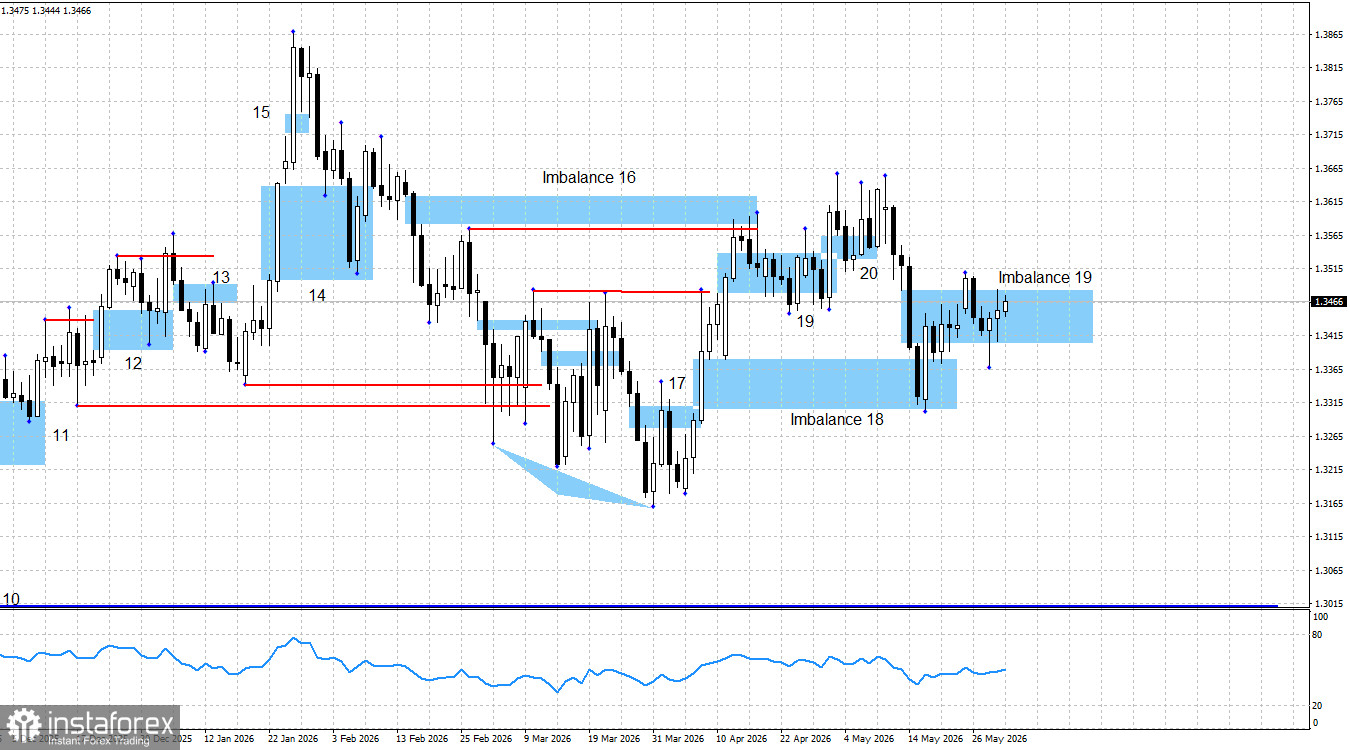
GBP/USD declined into bullish imbalance 18, reacted to this pattern, formed a Bullish Engulfing candlestick pattern, and then retraced into bearish imbalance 19. Since then, the pair has remained within this pattern, showing little willingness to move beyond its boundaries. No meaningful reaction followed from imbalance 19, meaning that the chart structure continues to support a bullish scenario. At the same time, the pattern has not yet been invalidated.
The British pound's appreciation over the past week and a half was driven by growing market optimism regarding the conclusion of a framework agreement between Iran and the United States. However, last week the chances of reaching such an agreement in the near future declined sharply, while the probability of prolonged tensions and a breakdown in negotiations increased significantly. As a result, bearish traders have once again received short-term support, which could evolve into a longer-term factor given the developments coming out of the Middle East.
Recent news has been far from encouraging. Donald Trump and Treasury Secretary Scott Bessent stated that Iran is conducting secret negotiations with Oman regarding control over the Strait of Hormuz and the possible introduction of transit fees for vessels passing through it. I cannot verify the accuracy of this information, but Scott Bessent threatened Oman with severe sanctions, while Donald Trump warned of potential military action. On Monday, Iran and the United States exchanged strikes once again, while officials in Tehran stated that no meaningful progress had been achieved in negotiations recently.
The situation surrounding a resolution of the Middle East conflict is slowly emerging from a prolonged stalemate, yet traders remain concerned that the next shift could once again favor escalation. In fact, this is exactly what has been occurring over the past week and a half. Last week, the United States launched two missile strikes against Iranian targets, while Iran responded with attacks on U.S. bases in Kuwait. The new week began with a repeat of the same pattern. One can only hope that negotiations will not collapse as a result and that the agreement, which reportedly has already been largely finalized, will not be abandoned. Recently, nearly all incoming reports have carried a pessimistic tone, significantly improving the outlook for bearish traders.
In my view, the broader trend remains bullish despite the pair's substantial declines earlier this year. At present, the ceasefire in the Middle East remains fragile, but it is still holding and has even been extended by 60 days. However, the Strait of Hormuz remains subject to a dual blockade, the nuclear issue remains unresolved, and any assessment of progress in negotiations relies largely on statements from Donald Trump. Iran continues to present a very different perspective. The situation continues to shift between positive and negative developments. For now, the market still retains some confidence that an agreement can be reached, but that confidence is not unlimited, and the latest developments surrounding the Strait of Hormuz could, at the very least, complicate future negotiations.
The chart structure currently remains straightforward. Bullish imbalance 18 generated a valid price reaction, while bearish imbalance 19 is likely to be invalidated. Consequently, the technical picture fully supports further gains in the British pound. The key task now is to monitor geopolitical developments closely in order to exit long positions in a timely manner if negotiations once again reach a deadlock and the framework agreement remains permanently "95% complete."
On Monday, the economic calendar was limited to the U.S. Manufacturing PMI report, which attracted little market attention.
In the United States, the broader fundamental backdrop remains such that, from a long-term perspective, it is difficult to expect anything other than continued weakness in the U.S. dollar. The conflict between Iran and the United States does little to alter this view. Geopolitical tensions have temporarily revived the dollar's safe-haven appeal over the past two months, but the longer-term outlook for the currency remains challenging.
The U.S. labor market continues to weaken, the economy is moving closer to recession, and the Federal Reserve is unlikely to be in a position to tighten monetary policy in 2026. In addition, four major nationwide protests against Donald Trump have already taken place, while the eventual departure of Jerome Powell could further complicate the outlook for the dollar, particularly if Kevin Warsh leads the FOMC toward a more dovish policy stance. From an economic perspective, I see no fundamental reasons supporting a sustained appreciation of the U.S. dollar. Only geopolitical developments appear capable of providing meaningful support.
News Calendar for the United States and the United Kingdom
United States
On June 2, the economic calendar contains only one event of moderate importance. Therefore, the impact of macroeconomic releases on market sentiment may become noticeable during the second half of the day.
GBP/USD Forecast and Trading Recommendations
For the British pound, the long-term outlook remains bullish. The Three Drives pattern warned traders of the beginning of an upward move, and since then three bullish patterns and three bullish signals have formed, all of which could have been utilized by traders.
Two weeks ago, geopolitical developments complicated what had appeared to be a favorable outlook for bullish traders. Nevertheless, buyers retained control and generated a new bullish signal within bullish imbalance 18. If geopolitical developments become more constructive, further gains are likely.
My target for GBP/USD remains the 2026 high at 1.3867, while the nearest upward target is 1.3656. At present, there are no grounds for considering a bearish trend scenario. The only bearish imbalance remains close to invalidation, and no new bearish patterns have emerged.


