
Lihat juga


 23.09.2026 08:39 AM
Bitcoin and Ether continued to rise amid strong inflows into spot ETFs: Bitcoin funds drew $998.95 million on the day — the largest single-day inflow since October last year — while Ether ETFs received $269.98 million, also a record for the same period. The rest of the altcoin market saw noticeably smaller but still positive flows: Solana attracted $26.1 million, HYPE $2.82 million, ZEC $2.36 million, DOGE $909.65k, AVAX $572.59k, LINK $472.08k, while LTC showed the only small outflow of $150.5k. XRP, TRX, HBAR, DOT, and BNB saw no net flows.

The causal link is clear: a near-$1 billion inflow into Bitcoin in one day is rarely random and usually reflects institutional reaction to an already established strong trend rather than its cause. In recent days, the market has been digesting several positive catalysts at once, from easing geopolitical tensions in the Middle East to signals of an emerging alt-season, and the current record ETF inflow looks like a logical continuation of that chain — institutions are catching up to a rally that has already begun, not initiating it.
At the same time, Bitcoin repeatedly runs into resistance above $87,000, where active sell-offs have occurred more than once. That is an important technical signal: the market appears to test the same ceiling repeatedly and receive rejections each time — which typically indicates not an immediate trend reversal but the formation of a new, higher trading band after a large run, during which market participants take profits gained in the prior leg before price can sustainably hold above the barrier. The beneficiaries of such a pause are traders who work the range off technical bounces. At the same time, buyers at the peak should be cautious, since repeated selling at the same level reduces the chance of a clean breakout on the first attempt.
I view the combination of record institutional inflows and simultaneous technical resistance at $87k as a healthy consolidation phase before the next leg, not as a warning of reversal — money continues to enter the market even during local sell-offs, which is rarely a sign of trend exhaustion.
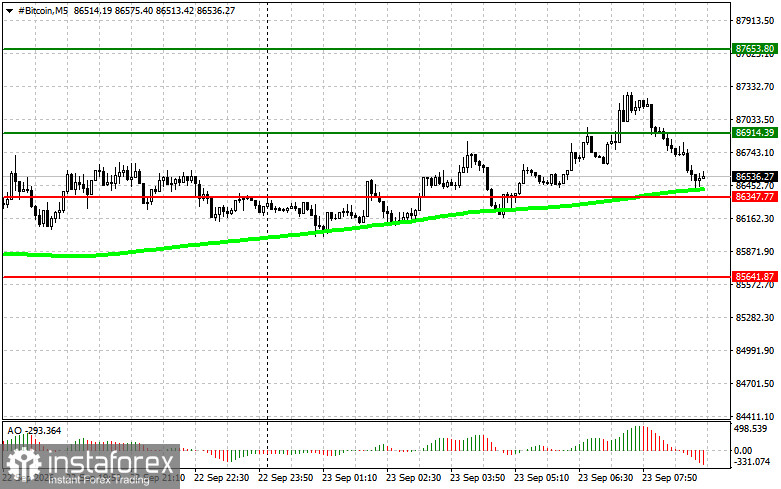
For Bitcoin, the price holds in the $85,600–87,600 range, and the trading plan is built around two mirrored directions with a full set of breakout and rejection scenarios. A breakout above $86,900 opens a buy position toward $87,600, where you should take profit and consider a reversal into a short on a possible pullback. Entry conditions are mandatory: price must remain above the 50-day moving average, and the Awesome Oscillator must be in positive territory. The second buy variant works on a rejection: if price approaches the lower boundary at $86,300 but a downside breakout is not confirmed, treat it as a false spike and open a long targeting $86,900 first, then $87,600 as a wider technical reference if the move extends beyond the near range.
Sell positions are arranged in the opposite direction. A confirmed break below $86,300 leads to a short targeting $85,600, with mirror conditions — the moving average above price and Awesome below zero. The second sell variant works on a rejection at $86,900; if an upside breakout is not confirmed, this opens the path for a short sequentially to $86,300 and then $85,600.
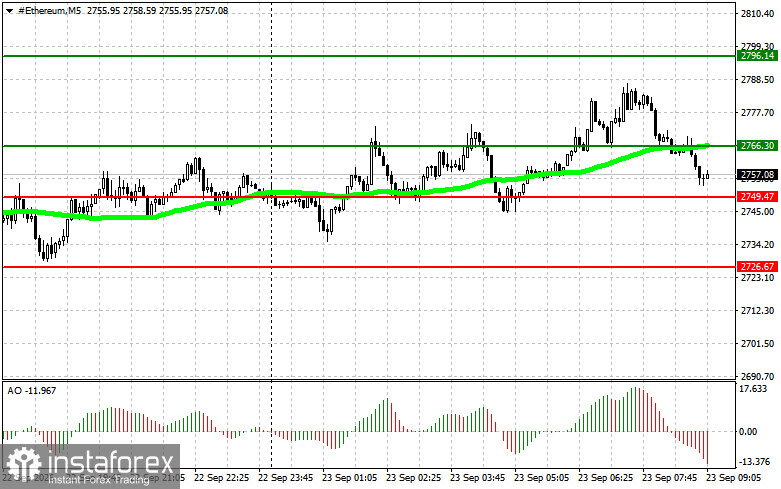
For Ether, the price trades in the $2,726–2,796 range, and the logic fully mirrors Bitcoin on its own price scale. A breakout above $2,766 signals a buy toward $2,796 under the same conditions: a rising moving average below price and Awesome above zero. The second buy variant works on a rejection at $2,749; if a downside breakout is not confirmed, target a return first to $2,766 and then to $2,796 as a wider reference for continuation.
Ether sells begin from a break below $2,749, targeting $2,726, with price below the moving average and Awesome in negative territory. The second sell variant works on a rejection at $2,766; if an upside breakout is not confirmed, the aim is to return to $2,749 and then to $2,726. Both indicators serve solely as filters to exclude false moves, not as independent reasons to enter early, so decisions are made only after price confirms the specified levels.


