
Lihat juga


 19.11.2026 09:23 AM
Bitcoin and Ether recovered after the Federal Reserve minutes were released, even though the document read tougher than the vote outcome. Recall that on October 28, when the Fed left the policy rate at 3.75–4.00% with two votes for a hike (Cook and Hammack), Bitcoin barely reacted and traded near $80,950. Now it trades around $63,000 — roughly 22% lower — showing how much the backdrop changed in three weeks as Fed rhetoric tightened further.

In the September minutes published October 7, all 19 participants supported a hike and most expected one more move by year-end. Now almost everyone thinks another hike will be needed, and two members allow for a step larger than 25 bps as early as December. According to CME FedWatch, roughly 90% now price a 25-bp hike on December 9 and about 10% a 50-bp move; on October 28 the chance of any December hike was above 70%, while on November 18 about 97% priced a 25-bp step. The question has shifted from whether there will be a hike to how large it will be, especially after Governor Waller urged consideration of 50 bps.
Why does crypto react to Fed minutes at all? Because the policy rate remains the chief liquidity regulator for risky assets. Higher rates push bond yields up — 10-year U.S. yields are near 5% — making risk-free returns competitive with bitcoin. This has led to stablecoin supply — the fuel for crypto buying — continuing to leave the market: Glassnode shows a 90-day decline in stablecoin supply of about 4.2% while three-month bill yields rose roughly 45 bps.
A second channel is AI. The minutes are notable because two themes converged: participants said AI-driven demand for equipment, power, and labor is lifting prices beyond the tech sector, and corporate debt in AI firms rose rapidly via complex, opaque financing concentrated at a small number of firms. That pushes the Fed toward higher rates and raises the risk of investor disappointment in AI returns, weighing on big tech stocks.
The post-minutes recovery reflects that the hawkish scenario was already priced in and most weak long positions had already been flushed out. The market had priced a December hike in advance; liquidations on November 15 exceeded $2bn in a day, and buyers absorbed about 66,000 BTC in the $62k–$66k range. So the minutes didn't add new reasons to sell.
All this indicates the Fed is tightening faster than the market expected a month ago. I view the bounce after the minutes as a pause rather than a trend reversal.
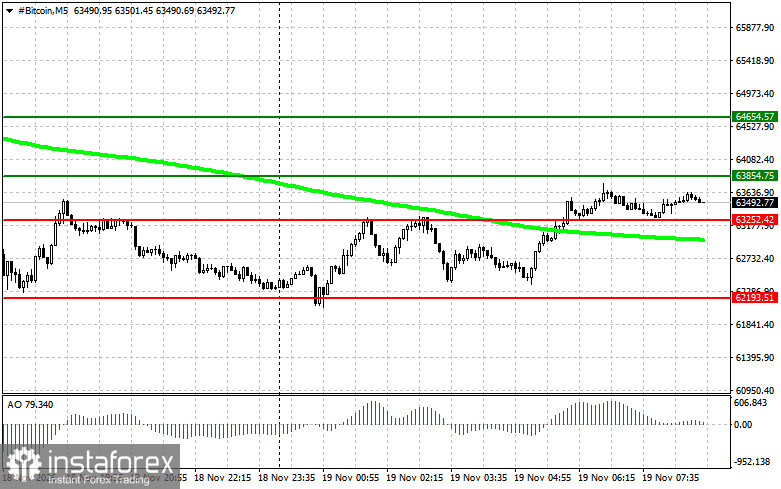
The current range is defined by nearest support at 63,200 and resistance at 63,800, and the plan centers on two mirror directions with a full set of breakout and bounce scenarios. For buying, the first option is a confirmed close above 63,800, in which case the target is 64,600—a logical place to take profits and consider a short on the pullback—provided price is above the 50-day moving average and the Awesome Oscillator is above zero. The second option is a rebound off 63,200 if a break below fails and proves a false spike; in that case, bullish target first a return to 63,800, then the wider target at 64,600.
The selling picture is symmetrical. A confirmed break below 63,200 would open a short with a target of 62,100, provided the moving average is above price, and the Awesome is below zero. If an upside break above 63,800 fails to confirm and price is rejected there, a short would first aim for a return to 63,200 and then to 62,100.
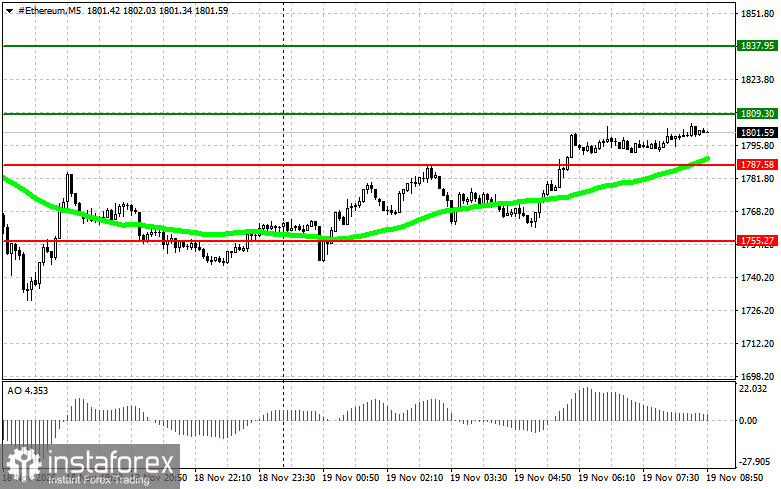
Ether's range is marked by support at 1,787 and resistance at 1,809, and the logic fully mirrors Bitcoin on its own price scale. Consider buy positions on a confirmed close above 1,809, targeting 1,837 (where to take profit and consider a short on the retrace), or on a rebound from 1,787 after a false downside break, targeting 1,809 first and then 1,837. In both cases, price should remain above the 50-day moving average with the Awesome Oscillator above zero.
Sell positions are considered on a confirmed break below 1,787, targeting 1,755, provided the moving average is above price and the Awesome Oscillator is below zero, or on a rebound at 1,809 without a confirmed upside break, targeting 1,787 and then 1,755. Both indicators serve as filters to weed out false moves rather than standalone entry signals, and decisions are taken only after price actually confirms the specified levels.


