
یہ بھی دیکھیں


 02.06.2026 08:44 PM
The wave pattern on the 4-hour chart for EUR/USD has undergone some modification. There is still no indication that the upward trend segment (shown in the lower chart), which began in January of last year, has been invalidated. However, the trend structure has now taken on a corrective form. In the longer term, a wave C may develop, with its low expected to fall below the low of wave A.
At the moment, it is difficult to believe in such a significant decline in the euro, but the first quarter of 2026 demonstrated that geopolitical developments can dramatically alter market trends.
On the lower time frame, I can identify a classic three-wave corrective structure to the upside. Following the completion of this structure, a new downward trend segment began to form, which logically should be impulsive in nature. If this assumption is correct, we can expect a five-wave structure within wave C of the higher degree, targeting levels below the 1.1400 level.
Are there sufficient fundamental reasons to expect such a strong appreciation of the US dollar? Not definitively. However, the market is gradually losing confidence in the prospect of a deal between the United States and Iran, which is providing support to sellers.
Positive News Emerged on Tuesday
EUR/USD gained 15 basis points during Tuesday's trading, while overall price action remained muted. The US session has not yet concluded, and this is typically the period when traders are most active. However, in recent weeks, strong movements in the currency market have become increasingly rare, and sustained trends have been virtually absent.
As illustrated in the chart above, the presumed wave 4 has continued to develop for two weeks. During that period, the euro has moved less than 100 points. Today, the Eurozone released an important and potentially market-moving inflation report for May, which could have increased demand for the euro. Instead, traders once again showed little interest in anything other than geopolitical developments.
According to the preliminary estimate, the Eurozone Consumer Price Index rose to 3.2% year-on-year in May. Core inflation increased to 2.5%, exceeding market expectations. Therefore, inflationary pressures in the Eurozone continue to accelerate despite signs of moderation in some countries, such as Germany.
This suggests that the European Central Bank is moving closer to resuming its monetary policy tightening cycle. This is not merely my own expectation. For example, Isabel Schnabel has repeatedly urged the ECB Governing Council to vote in favor of raising interest rates at its June meeting. In her view, inflation is becoming increasingly difficult to control, while the conflict in the Middle East and the blockade of the Strait of Hormuz are likely to drive energy prices higher, leading to a renewed acceleration in inflation.
Consequently, the ECB should act now. However, while the ECB may be prepared to act, the market appears less convinced. Demand for the euro changed little on Tuesday, and EUR/USD remains closer to a renewed decline than to a sustained advance.
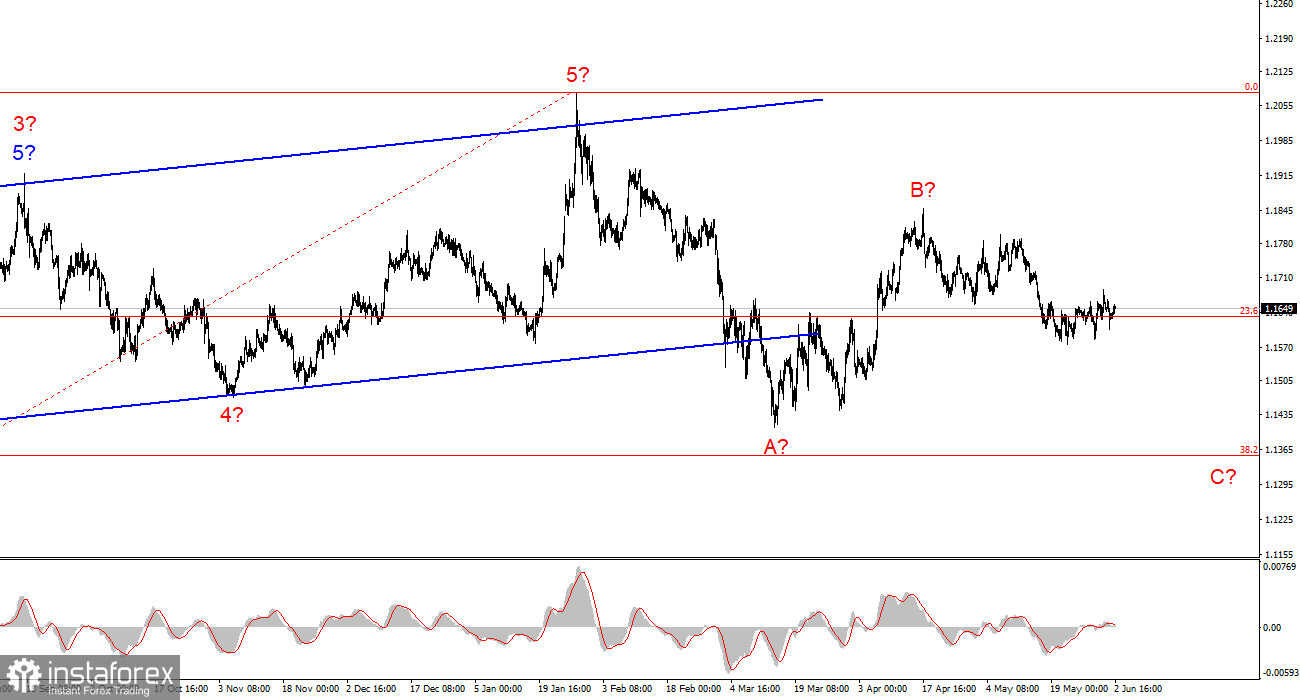
Based on my EUR/USD analysis, I conclude that the instrument remains within the broader upward trend segment (shown in the lower chart) while, in the shorter term, continuing to develop a corrective structure.
At present, wave 5 may be forming as part of wave C. If the current wave count is correct, the entire wave C structure could ultimately extend well below the 1.1400 level. However, such a substantial decline would require strong support from geopolitical developments. Otherwise, the bearish wave sequence may become truncated and complete only slightly below the 1.1600 level.
On the higher time frame, an upward trend segment remains visible, followed by the formation of a corrective wave structure. In the near term, wave C is expected to develop with targets around 1.1352, corresponding to the 38.2% Fibonacci retracement level. Once the A-B-C structure is completed, a new long-term bullish trend may begin to form.
Key Principles of My Analysis


