
یہ بھی دیکھیں


 05.06.2026 03:45 AM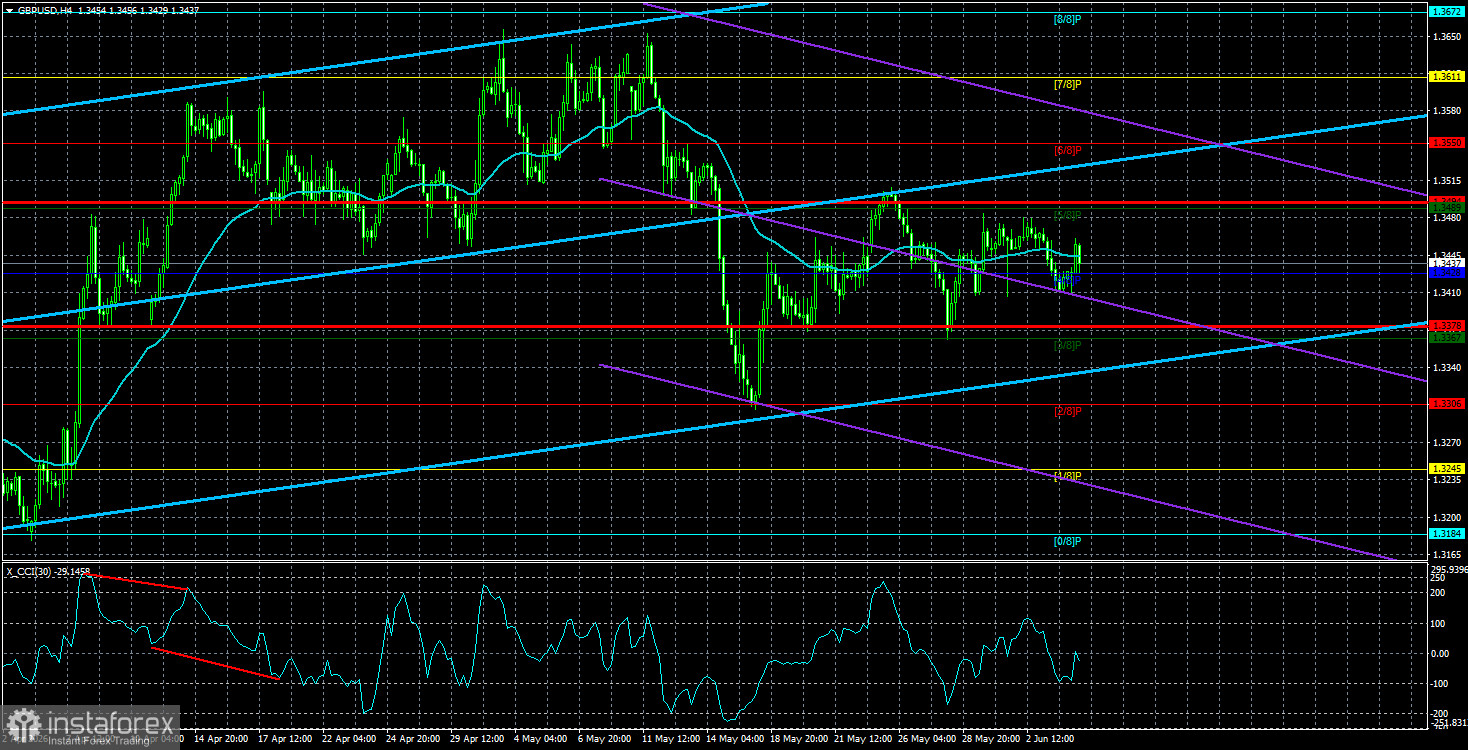
The GBP/USD currency pair continued to trade with low volatility on Wednesday within a slight upward slope. Overall, a bullish trend has formed for the British pound, which is particularly visible on the hourly timeframe. However, can we say that the pound's growth is linked to geopolitical relief? In our opinion, no. To be honest, we do not quite understand where and when some experts saw anything positive in the Middle East? This week, the US and Iran have already exchanged strikes "to keep the opponent from relaxing," and Tehran additionally conducted an attack on Kuwait International Airport. Iranian Foreign Minister Abbas Araghchi stated that there has been no progress in negotiations with the US this week, and on Tuesday, Iran even wanted to suspend any dialogue with Washington due to Israel's new strikes on Lebanon. Only Donald Trump managed to convince Jerusalem to refrain from attacking Lebanon, which supposedly brought Tehran back to the negotiating table. If amidst all this chaos and confusion, someone sees positivity and progress toward a peace agreement, we have nothing to add...
It should also be noted that in recent weeks, the British pound has risen more strongly than the euro. But why, if the geopolitical background is the same for both currency pairs, is the macroeconomic backdrop absent in the UK, whereas it is positive for the euro in the European Union? Logically, the euro should currently be trading higher, while the pound should be stagnant. Let us remind you that the UK's April inflation report showed a slowdown to 2.8%. Thus, there are no grounds for the Bank of England to tighten monetary policy in June, although we had previously expected it to. At the same time, inflation in the European Union reached 3.2% and has been rising for five consecutive months, moving from 1.7% to 3.2% during this time. Essentially, inflation in the Eurozone in 2026 has doubled. Therefore, the ECB is now set to raise the key interest rate as early as next week, which some board members are openly discussing.
Thus, the ECB will raise rates, the BoE will not, and the geopolitical situation is the same for everyone. So why is the pound rising while the euro is not? In our opinion, the British pound continues to correct after the 300-pip drop that occurred a few weeks ago. Let us remind you that back then, the UK "burst into a political crisis" (another one in the last 10 years), Keir Starmer's party suffered a crushing defeat in local elections, and Starmer himself was called to resign. Moreover, it was then that news of the slowdown in British inflation became known; hence, the market may already have priced in softening expectations regarding the British central bank's monetary policy. Now we are seeing a simple technical correction that explains everything in the best way.
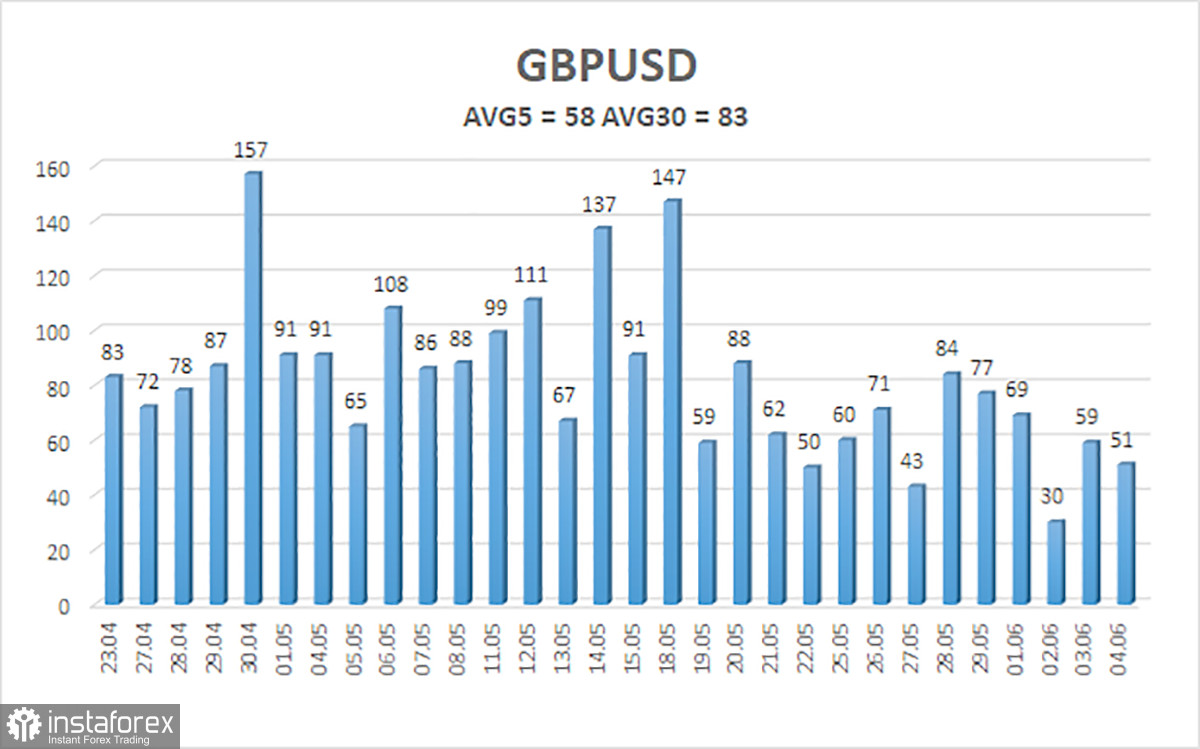
The average volatility of the GBP/USD pair over the past five trading days is 58 pips. For the pound/dollar pair, this value is considered "average." On Friday, June 5, we expect movement within a range bounded by 1.3378 and 1.3494. The upper linear regression channel is directed upward, indicating a recovery of the upward trend. The CCI indicator has not formed signals recently.
S1 – 1.3428
S2 – 1.3367
S3 – 1.3303
R1 – 1.3489
R2 – 1.3550
R3 – 1.3611
The GBP/USD currency pair continues to recover after the 300-pip drop. Donald Trump's policies will continue to put pressure on the US economy, so we do not expect long-term growth in the US dollar. However, 2026 is currently turning out to be super-positive for the dollar due to geopolitics. Therefore, long positions targeting 1.3489 and 1.3550 can be considered when the price is above the moving average. If the price is below the moving average line, it will allow for a bearish trade with targets of 1.3378 and 1.3306 based on geopolitical grounds. The market situation often changes; it continues to primarily track geopolitical news, which is not uniform. Movements at this time are weak, so it is better to trade on smaller timeframes.
Linear regression channels help determine the current trend. If both are directed in one direction, it means the trend is currently strong;
The moving average line (settings 20,0, smoothed) determines the short-term trend and the direction in which trading should currently be conducted;
Murray levels are target levels for movements and corrections;
Volatility levels (red lines) indicate the likely price channel in which the pair will spend the next 24 hours based on current volatility indicators;
The CCI indicator – its entry into the oversold area (below -250) or the overbought area (above +250) indicates that a trend reversal in the opposite direction is approaching.


