
یہ بھی دیکھیں


 07.10.2026 10:44 AM
The wave structure on the 4-hour chart for EUR/USD is becoming more complex. There is still no question of invalidating the upward trend segment (bottom chart) that began in January last year. On the contrary, we have seen a complete A-B-C corrective structure, which may have been completed. However, recent events related to the Fed and its monetary policy have once again affected the current wave structure, making it more complex. Let me remind you that the news background and wave structure often conflict with each other, making adjustments necessary.
The wave structure has now evolved into a more complex pattern. Wave C has taken a three-wave form, while the next wave is identified as wave D. The entire trend segment that began on January 27 may have taken a five-wave corrective form, A-B-C-D-E. If this assumption is correct, wave D is complete, and on August 21, EUR/USD entered the wave E formation phase. The low of wave E should be below the low of wave C at 1.1325. The pair has very little distance left to this level, and below it, the presumed wave E could complete its formation at any time.
EUR/USD rose by 40 points on Tuesday. Under the current circumstances, even such a rise in the euro looks relatively positive. Let me remind you that the market continues to focus solely on the Fed's monetary policy tightening, rising geopolitical tensions around the world, and debt problems in the European Union and the United Kingdom. Market participants are ignoring all other factors, such as weakness in the US labor market, US debt problems, the enormous national debt, the absence of any actual geopolitical escalation involving Iran, the ECB's monetary policy tightening, and the Bank of England's hawkish outlook. Consequently, it remains extremely difficult for the euro and the pound to strengthen. Not because the news background is weak, but because the market is not paying attention to it.
Yesterday, the European Union released a retail sales report showing a 0.1% increase in August, which was below market expectations. The United States also released the weekly ADP report, for which no forecast is provided. I have no doubt that the market did not even notice these reports. The next interesting event is the Fed minutes, commonly referred to as the FOMC minutes. At its latest meeting, the Fed made its first decision to tighten monetary policy in three years, and the decision was unanimous. The Fed also released its dot plot, which generally showed stronger hawkish expectations among Fed policymakers. Therefore, in my view, the minutes will not reveal a more hawkish stance than the market currently expects. Consequently, EUR/USD sellers will not receive any additional support. However, the dollar does not need support from the news background at present. The presumed wave E continues to develop. The lower-degree wave structure allows for the formation of a fifth wave within the current impulse.
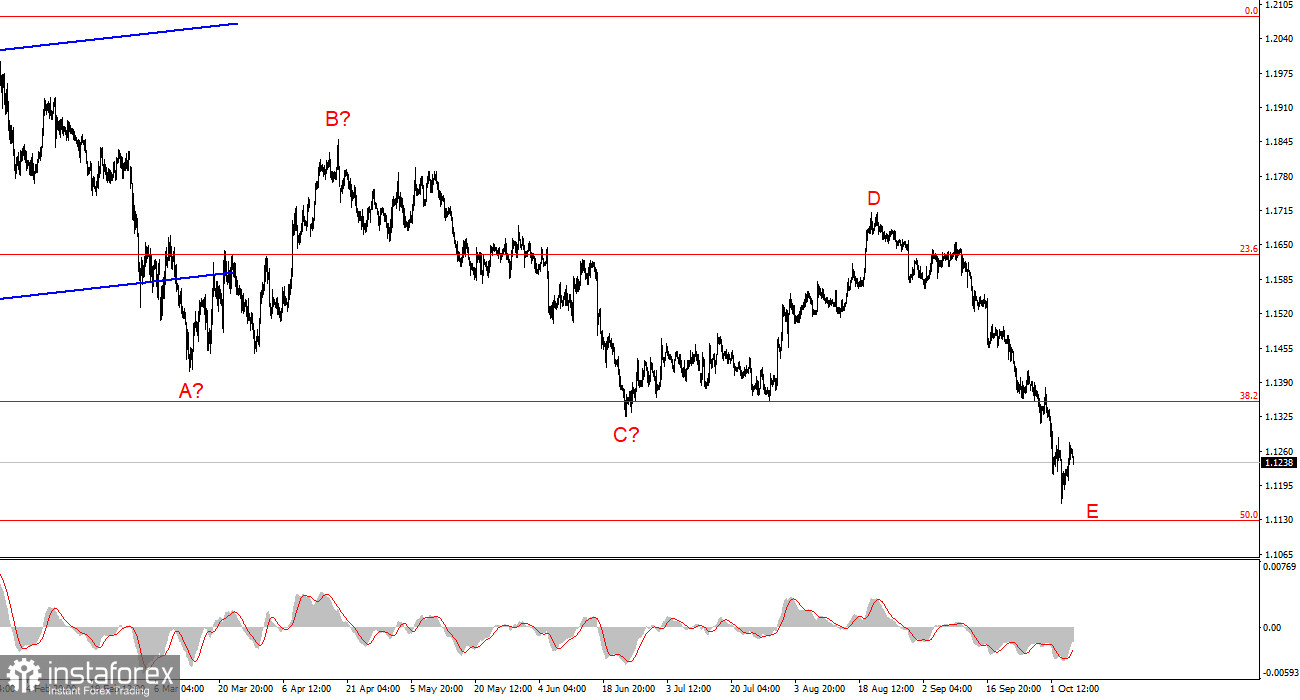
Based on my analysis of EUR/USD, I conclude that the pair remains within a global corrective trend segment, A-B-C-D-E. If this assumption is correct, the decline will continue toward targets below the low of wave C at 1.1325. I previously considered this scenario an alternative, and if it were not for the Fed meeting, it would have remained a reserve scenario. However, the Fed delivered a surprise, leaving the market with no other option but to initiate another wave of US dollar buying. However, buying has continued for several weeks, even though there are no new supporting factors for the dollar. I would not open short positions under such a news background; instead, I would prepare for a reversal.
On the higher timeframe, a downward trend segment can be seen, taking the form of A-B-C-D-E. Therefore, EUR/USD may continue to decline below the low of wave C, while the internal wave structure of wave E may take a five-wave impulsive form.
The Main Principles of My Analysis:


