یہ بھی دیکھیں


 26.11.2026 12:20 AM
On Wednesday, the AUD/USD pair broke the round level of 0.6600 but is attempting to recover after falling to its lowest level since December 2025. The Australian dollar is receiving support amid a weakening U.S. dollar, helped by falling U.S. Treasury yields. At the time of writing, the pair was near 0.6625, down 0.25% for the day.
U.S. Treasury yields are declining as investors reduce equity positions and reallocate capital into government bonds. Technology sector stocks are falling most noticeably on the U.S. stock market. Another pressure factor was the Trump administration's proposal to impose new import tariffs on 14 U.S. trading partners. The sell-off spread to commodity markets, including gold, hurting sentiment for the Australian dollar, whose economy depends heavily on commodity exports.
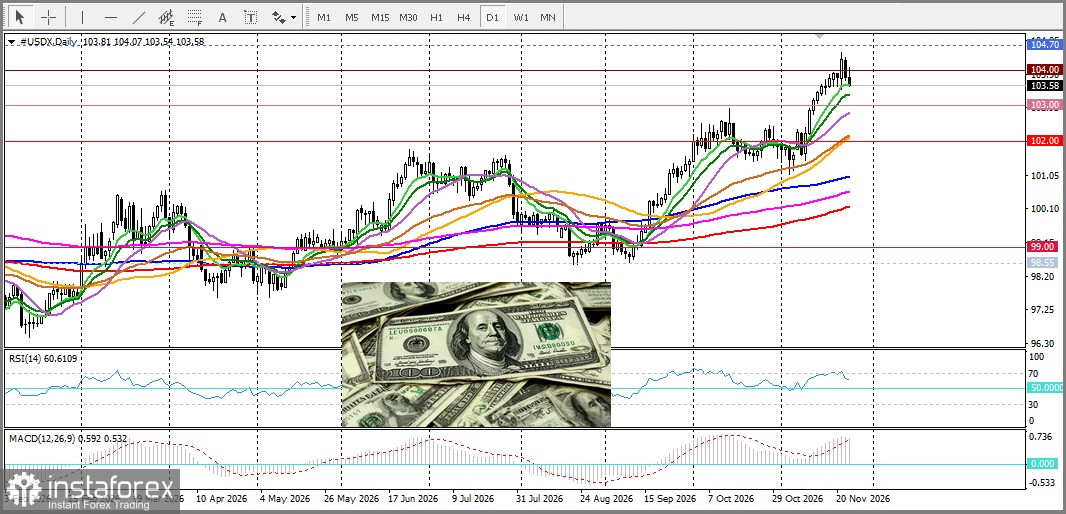
The 10-year U.S. Treasury yield is holding around 4.83%, after earlier falling to 4.80%—the lowest level since September 9. The U.S. Dollar Index (DXY), which tracks the dollar against a basket of six major world currencies, dropped to 103.58 after reaching a 20-month peak of 104.59 on Monday.
The US dollar is giving up ground despite the release of macroeconomic data that strengthen expectations of continued Federal Reserve "hawkish" rhetoric. In October, the core Personal Consumption Expenditures (PCE) price index rose 3.3% year-on-year versus 3.1% a month earlier, beating analysts' forecasts of 3.2%. Month-on-month, the core PCE rose 0.3%, in line with market expectations. At the same time, US GDP grew at an annualized 4.3% in Q3, well above the 3.4% forecast.
According to the CME FedWatch tool, market participants almost fully price in a 25 bp rate hike in December. Traders also expect further monetary tightening in 2027 as policymakers aim to bring inflation back to the 2% target.
But the Australian dollar remains relatively resilient after October CPI data exceeded the Reserve Bank of Australia's (RBA) forecasts, reducing the likelihood of imminent monetary easing.
Australian October inflation came in above market expectations. Headline CPI accelerated to 4.9% year-on-year from 4.3% in September, while the consensus forecast was 4.7%. The largest contributions came from electricity, new-home costs and transport. Both readings exceeded the RBA's December projections: 4.5% for headline CPI and 3.6% for trimmed-mean core inflation. Inflation is increasingly deviating upward from the RBA's 2–3% target range, weakening arguments for near-term rate cuts.
Consequently, the probability of a 25 bp RBA rate cut in March, as implied by futures, fell to 13% from 25%, indicating market participants are reassessing the near-term policy path.
From a technical standpoint, the pair shows a bearish picture. Oscillators are negative, confirming the bears' advantage. Nearest resistance remains at 0.6662, above which sits the 9-day EMA. Support is at the 0.6555 zone. The relative strength index is oversold, suggesting a possible corrective bounce.
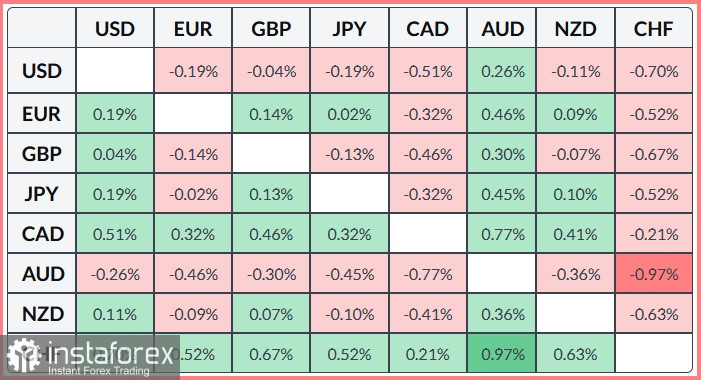
The table below shows Wednesday's movement of the Australian dollar against major currencies. The AUD posted its largest gain against the US dollar.