
یہ بھی دیکھیں


 27.11.2026 08:31 AM
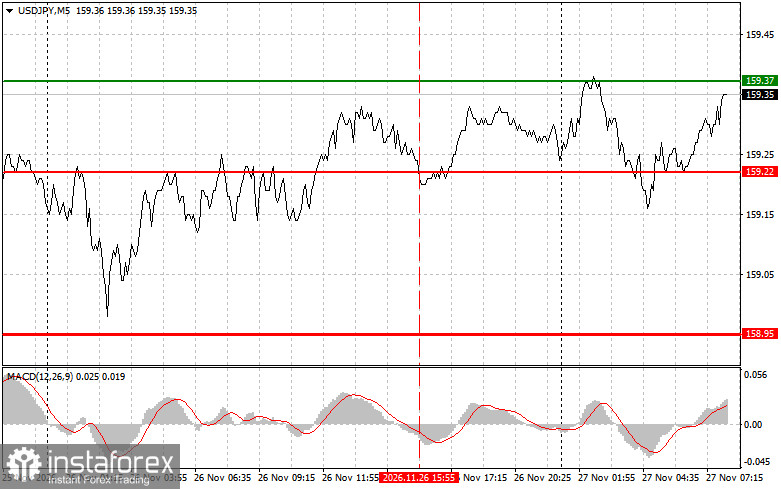
The price test at 159.22 occurred when the MACD indicator moved significantly below the zero line, limiting the pair's downside potential.
The yen begins Friday in calm mode, and there is a reason for this. Yesterday, the US observed Thanksgiving, and today US exchanges will close early, so market volumes are low and USD/JPY is trading in a narrow channel below the psychological 160 mark. On a thin market, volatility spikes are possible, but participants have few reasons now for a decisive move.
Fresh data from Japan were substantial. Tokyo's core consumer price index, which excludes fresh food, rose 2.9% year-on-year in November after 2.6% a month earlier. This is the fastest pace this year and the highest since July 2025. The main contribution came from higher electricity and city gas prices and an accelerating rise in processed food prices. Metropolitan inflation is usually considered a leading indicator for the national figure, and this reading looks even more important against recent data, since the Bank of Japan's core-core inflation (excluding fresh food and temporary factors) reached 3.5%, and corporate services prices rose 4.2% — the fastest in 36 years.
This picture strengthens the case for another BOJ step. Board member Naoki Tamura said yesterday that the rate should soon be brought to a neutral level around 2%, and at a press conference he signaled support for a December hike. The policy rate now stands at 1.25%, the meeting is on December 17–18, and the market prices in roughly an 80% chance of a hike.
In my view, while BOJ tightening expectations remain firm and the US market trades in holiday mode, the yen will continue to hold its ground, and an upward breakout of USD/JPY from the current channel is unlikely until normal volumes return.
For intraday strategy, I will rely mainly on scenarios No. 1 and No. 2.
Scenario No. 1: I plan to buy USD/JPY today when the entry point reaches around 159.40 (the green line on the chart), targeting a rise to 159.65 (the thicker green line on the chart). Around 159.65, I intend to exit long positions and open short positions in the opposite direction (expecting a 30–35 pip move back from that level). It is best to return to buying the pair on corrections and significant USD/JPY drawdowns. Important! Before buying, make sure the MACD indicator is above the zero line and is just beginning to rise from it.
Scenario No. 2: I also plan to buy USD/JPY today in the event of two consecutive tests of 159.27 when the MACD indicator is in the oversold area. This will limit the pair's downside potential and lead to an upward reversal. You can expect a rise to the opposite levels 159.40 and 159.65.
Scenario No. 1: I plan to sell USD/JPY today only after the 159.27 level is retested (the red line on the chart), which should lead to a rapid decline in the pair. The sellers' key target will be 159.01, where I intend to exit shorts and immediately open longs in the opposite direction (expecting a 20–25 pip move back from that level). Sellers can return at any moment — only a hint from the central bank is needed. Important! Before selling, make sure the MACD indicator is below the zero line and is just beginning to fall from it.
Scenario No. 2: I also plan to sell USD/JPY today in the event of two consecutive tests of 159.40 when the MACD indicator is in the overbought area. This will limit the pair's upside potential and lead to a downward reversal. You can expect a decline to the opposite levels of 159.27 and 159.01.
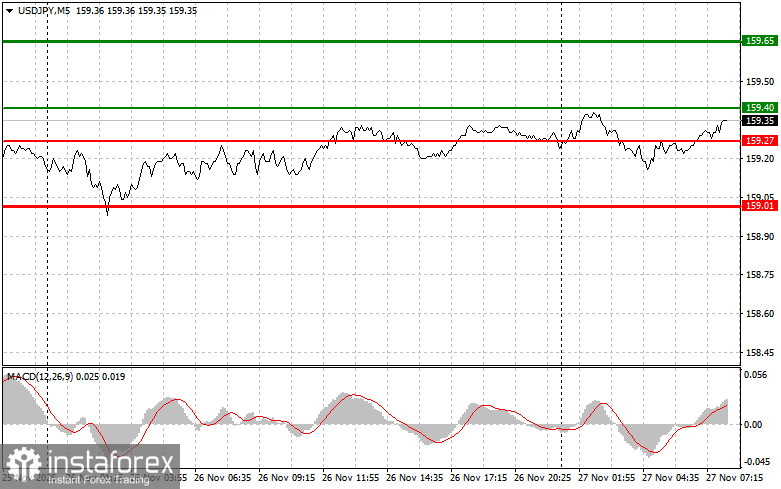
Thin green line – the entry price at which you can buy the trading instrument;
Thick green line – the suggested price where you can place a Take Profit or manually lock in gains, since further upside above this level is unlikely;
Thin red line – the entry price at which you can sell the trading instrument;
Thick red line – the suggested price where you can place a Take Profit or manually lock in gains, since further downside below this level is unlikely;
MACD indicator. When entering the market, it is important to follow the overbought and oversold zones.
Important. Beginner Forex traders must be very cautious when making entry decisions. Before the release of important fundamental reports, it is best to stay out of the market to avoid getting caught in sharp price swings. If you decide to trade during news releases, always place stop orders to minimize losses. Without stop orders, you can quickly lose your entire deposit, especially if you don't use money management and trade large volumes.
Remember, successful trading requires a clear trading plan, like the example I presented above. Spontaneous trading decisions based on the current market situation are a losing strategy for an intraday trader from the start.


