
আরও দেখুন


 15.01.2026 08:01 PM
The EUR/USD pair continues to trade without paying attention to either the news background or the chart picture. I expected—and still expect—a reaction to Imbalance 9, but on the ninth day of waiting I am now closer to the conclusion that the price "does not see" this pattern than to the idea that a new bullish impulse is being prepared. Over the past 15–20 days, the pair has covered a distance of roughly 180 points. And this has been a steady move in the same direction every single day. This means that, on average, the pair has been declining by about 10 points per day. Such strength of movement and the corresponding level of trader activity nullify all the efforts of both the news background and the chart picture.
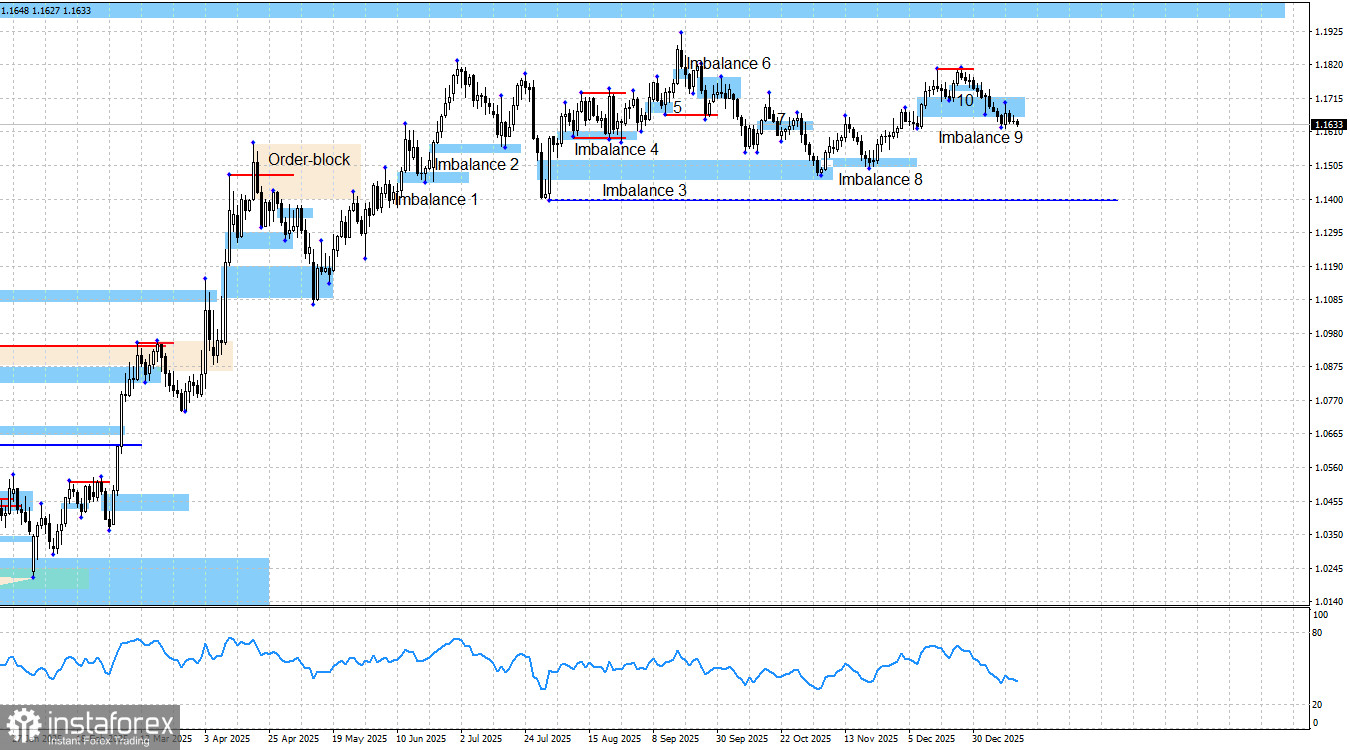
The dollar began to fall on Monday's events, but almost immediately ended that move. I continue to wait for a bullish reaction to Imbalance 9 until invalidation of this pattern forces me to conclude that the bullish impulse has been canceled. However, at the moment there is neither a reaction, nor invalidation, nor any movement at all. There is news, but there is no movement. Invalidation would occur below the 1.1616 level, but even this task seems beyond traders' capabilities right now, and there has been no talk of bulls or bears taking the initiative in recent weeks.
The chart picture continues to signal bullish dominance, but only in the long term. The bullish trend remains intact, but it is merely being maintained rather than developing. A new bullish signal can form only within Imbalance 9, but so far it has not appeared. If bearish patterns emerge or bullish ones are invalidated, the trading strategy will have to be adjusted. But at the current moment, none of this is happening. Nor are there any new patterns at all, as market movement is extremely weak.
The news background on Thursday was fairly weak. Very positive reports on German GDP for 2025 and EU industrial production for November found no response from traders—neither from bulls nor from bears. Donald Trump said he had received information that executions of protesters in Iran had stopped, and therefore the military operation was being postponed for some time. Traders did not consider this message worth reacting to either.
Bulls have had more than enough reasons for a new offensive for the past four to five months, and all of them remain relevant. These include the (in any case) dovish outlook for FOMC monetary policy, Donald Trump's overall policy (which has not changed recently), the U.S. confrontation with China (where only a temporary truce has been reached), protests by the American public against Trump under the banner of "No kings," weakness in the labor market, the bleak outlook for the U.S. economy (recession), the "shutdown" (which lasted a month and a half but was clearly not priced in by traders), and now also U.S. military aggression toward certain countries and criminal prosecution of Powell. Thus, in my view, further growth of the pair will be entirely natural.
I still do not believe in a bearish trend. The news background remains extremely difficult to interpret in favor of the dollar, which is why I do not even try to do so. The blue line shows the price level below which the bullish trend could be considered finished. Bears would need to push the price down about 300 points to reach it, and I consider this task impossible under the current news background and circumstances. The nearest upward target for the European currency remains the bearish imbalance at 1.1976–1.2092 on the weekly chart, which was formed back in June 2021.
News Calendar for the U.S. and the Eurozone:
On January 16, the economic calendar contains two events, none of which are particularly important. The impact of the news background on market sentiment on Friday will be extremely weak.
EUR/USD Forecast and Trading Advice:
In my view, the pair may be in the final stage of the bullish trend. Despite the fact that the news background remains on the side of the bulls, bears have been attacking more often in recent months. Still, I see no realistic reasons for the start of a bearish trend.
From Imbalances 1, 2, 4, and 5, traders had opportunities to buy the euro. In all cases, we saw some growth. Opportunities to open new trend-following long positions appeared after a reaction to bullish Imbalance 3, then after a reaction to Imbalance 8, and later after a rebound from Imbalance 9. This week, a second reaction to bullish Imbalance 9 may still occur. The target for euro growth remains the 1.1976 level. New long trades are quite acceptable if a new bullish signal is formed. If not, the strategy of buying will have to be reconsidered.


