
আরও দেখুন


 01.04.2026 08:39 PM
On Tuesday, the EUR/USD pair reversed in favor of the euro, and bulls have been attacking for two consecutive days. The start of the new week has been entirely dominated by buyers, as several important news events supported the growth of the euro and the pound. First, Donald Trump on Monday once again spoke about a possible agreement with Iran that could be reached in the near future, as well as about ending the war. Jerome Powell stated the same Monday that the FOMC does not consider tightening monetary policy amid inflationary pressure caused by events in the Middle East. Yesterday, it also became known that Iranian President Pezeshkian is generally ready for a ceasefire if his country is provided with security guarantees. Thus, two important geopolitical developments and one monetary factor worked against the bears. In addition, on Tuesday it became known that inflation in the Eurozone rose to 2.5%, increasing the likelihood of ECB monetary tightening as early as April. This is the fourth factor supporting the pair's growth.
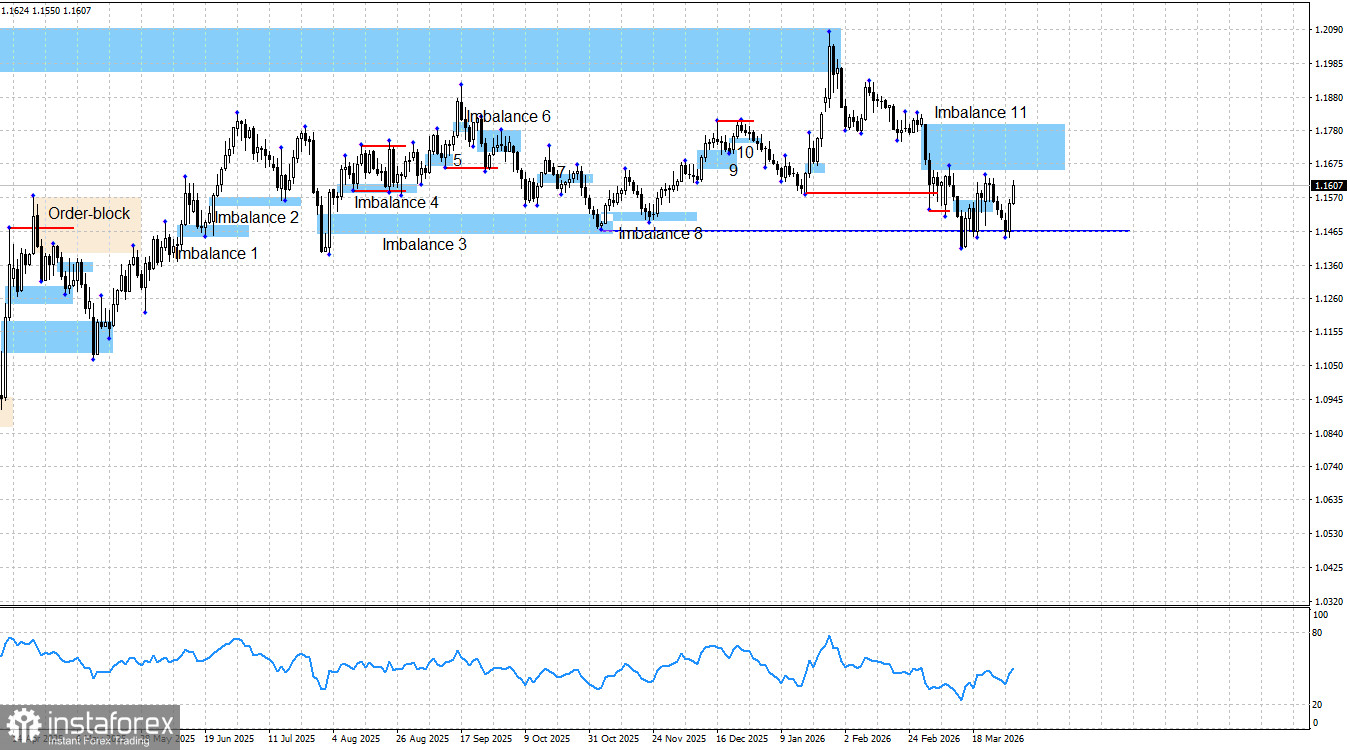
All of the U.S. dollar's growth over the past 4–5 weeks has been driven by geopolitics. I have repeatedly stated that I do not believe in the end of the bullish trend, despite the break of key trend-forming lows. No trading signals have been formed recently. The movement of the past two months could turn into a bearish trend if geopolitics continues to strongly support the dollar. However, at the moment, I still doubt the bears' ability to sustain a prolonged attack. Especially considering the latest geopolitical developments. Further growth of the U.S. dollar is possible if geopolitics continues to strongly support the bears. And as I have already said, this would require the situation in the Middle East not just to remain tense, but to worsen further.
The technical picture is beginning to transform and is becoming very interesting. First, prices across all pairs are now moving toward the "bearish" imbalance 11 and may react to it. This would be the second reaction, which could be weaker or may not occur at all. However, I would like to remind that the bullish trend remains in place, and near imbalance 11 only a sell signal could form. Also, a "bullish" imbalance may form this week, from which buy signals could later emerge, which in my view remain more attractive. Another important point is the potential liquidity grabs from the last two bullish swings, which may coincide with the reaction to imbalance 11. Thus, it is still too early to say that bulls have launched a full-scale offensive, but the probability of this exists. The key factor is whether a ceasefire between Washington and Tehran is reached.
The news background on Wednesday could have created obstacles for buyers, but no one paid attention to the Eurozone unemployment rate. Unemployment in the EU rose to 6.2%. Bulls could also have faced difficulties from the ADP employment report, which unexpectedly exceeded expectations—62K versus a forecast of 40K. Retail sales increased by 0.6%, also above market expectations. Later, the ISM manufacturing index will be released.
There are still plenty of reasons for bulls to attack, and even the outbreak of war in the Middle East has not reduced them. Structurally and globally, Trump's policies—which led to a significant decline in the dollar last year—have not changed. In the near term, the U.S. currency may strengthen due to a flight to safety, but this factor cannot support it indefinitely and requires continuous escalation of the conflict in the Middle East. There are no other supporting factors for the dollar. I still do not believe in a bearish trend. The dollar has received temporary support, but what will allow bears to continue their advance?
News calendar for the US and the Eurozone:
US – Initial Jobless Claims (12:30 UTC)
On April 2, the economic calendar contains only one entry. The impact of the news background on market sentiment on Thursday may be extremely weak or absent.
EUR/USD forecast and trader advice:
In my opinion, the pair remains in the stage of forming a bullish trend. The news background sharply shifted direction four weeks ago, but the trend itself cannot yet be considered fully canceled or completed. Therefore, traders need new patterns and signals in the near term to form short-term forecasts and open positions.
In the near future, bears may receive a signal around imbalance 11, but if geopolitics does not worsen, the signal may not form. Bulls, meanwhile, can only hope for the formation of bullish patterns and further buy signals. This may happen as early as this week.


