
আরও দেখুন


 15.05.2026 01:49 PM
Meanwhile, the dollar continues to strengthen, and today markets await April's industrial production data for the United States. Certainly, March's reading disappointed: industrial production fell well short of expectations, adding fresh reasons for concern against an already difficult macro backdrop.

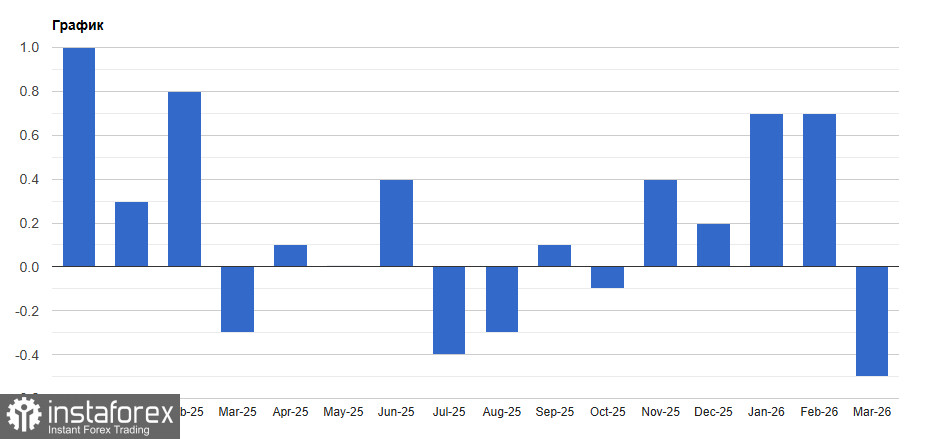
Industrial output declined 0.5% month on month, versus a market forecast of +0.1%. Capacity utilization dropped to 75.7% — a level that typically signals broad cooling in the sector rather than isolated problems in individual subsectors.
Manufacturing and utilities accounted for the bulk of the decline. Because manufacturing comprises the main component of the index, its downturn always pulls the aggregate reading down most strongly. Mining did not stand out as a key factor, which implies the problem has a systemic, not purely sectoral, character.
Note that the March drop occurred against a background of accelerating inflation, high energy prices, and rising uncertainty around the Middle East and trade tariffs. Taken together, these factors create a toxic cocktail for industry: costs rise, export demand weakens, and firms exercise caution about expanding output.
Markets await April data with heightened attention; the consensus forecast calls for a 0.3% increase, that is, a rebound after March's collapse. By comparison, one year ago in April 2025, markets expected a 0.2% rise, yet the Fed recorded zero change. In other words, even moderate optimism often proves optimistic.
Still, the data offer some reasons for cautious improvement. The S&P Global manufacturing PMI rose to 54.0 in April from 52.3 in March, indicating expanding sector activity. New orders grew faster than a month earlier, which usually supports future output. Utilities also showed a noticeable pickup in that release, and a similar dynamic remains possible now.
Tariff pressure, high commodity and energy prices, and weak exports will continue to cap a recovery, however. Manufacturing employment remains under strain, which suggests firms remain conservative on capacity expansion.
The base case for April looks like this: better than March, but without a strong rebound. The data will be published today, and they will provide an important signal about how well US industry can cope with inflationary pressure amid the ongoing Middle East conflict.
As for the technical picture of EUR/USD, buyers now need to think about taking the 1.1650 level. Only that will allow a target test of 1.1675. From there the pair can climb to 1.1700, but doing so without support from major players will prove rather difficult. The most distant target stands at the high of 1.1725. In the event of a decline, I expect significant buyer action only around 1.1620; if nobody shows there, it would be prudent to wait for a refresh of the low at 1.1600 or to open longs from 1.1580.
Regarding the technical picture for GBP/USD, pound buyers need to take the nearest resistance at 1.3380. Only that will allow a target of 1.3410, above which a breakout will prove rather difficult. The most distant target stands at the 1.3445 area. In the event of a drop, bears will attempt to seize control of 1.3335; if they succeed, a range breakout will deal a serious blow to bulls and push GBP/USD toward the 1.3280 low with a prospect of reaching 1.3250.


