
আরও দেখুন


 12.08.2026 12:40 AM
The joint currency intervention by the US and Japan at the end of July was a historic event. However, by the first week of August, the market showed that even unprecedented support could not reverse the fundamental forces pressuring the yen. The effect proved short?lived.
By August 5 the pair traded around 157.60, and by August 10 it reached 158.95, recouping a significant portion of the decline. History shows that intervention rarely changes a long?term trend without a shift in fundamentals.
The key problem is the colossal gap between the Bank of Japan's rate (1%) and the Federal Reserve's rate (3.50–3.75%); capital naturally seeks higher?yielding assets. While 30?year US Treasury yields approach 20?year highs and Japan remains the largest holder of US debt (~$1.1 trillion), any intervention faces natural limits. Selling Treasuries to buy yen would hit the dollar and the US bond market itself.
We should not forget other factors — household spending fell 3.3% in June versus an expected 1.0% rise, the current account posted a deficit of £92.3 billion in June versus an expected surplus of £1,512 billion (the first deficit in 17 months), and Japan's government debt exceeding 200% of GDP has been widely noted.
Analysts highlight three key conditions without which even a joint intervention cannot change the trend. First, the BOJ needs to raise its policy rate — the market prices roughly a 67% chance of such a hike in September–October. Second, Fed rate expectations must fall — the main trigger here is the US inflation data for July, to be published on August 12. And finally, oil prices must decline; without that, everything else will be less effective.
In a summary of BOJ board members' views published on August 10, "hawkish" signals were heard. One board member said the pace of rate increases could be faster than market expectations; another urged demonstrating resolve to prevent inflation drifting higher, allowing for larger rate hikes. The focus shifted from "achieving 2% inflation" to "preventing further deviation from the target."
Speculators cut short positions by 117,939 contracts (almost 73%), which in dollar terms amounted to about $9.36 billion. This reduced the short position to 3.11 billion. The calculated price fell largely due to forced closures of speculative short positions.
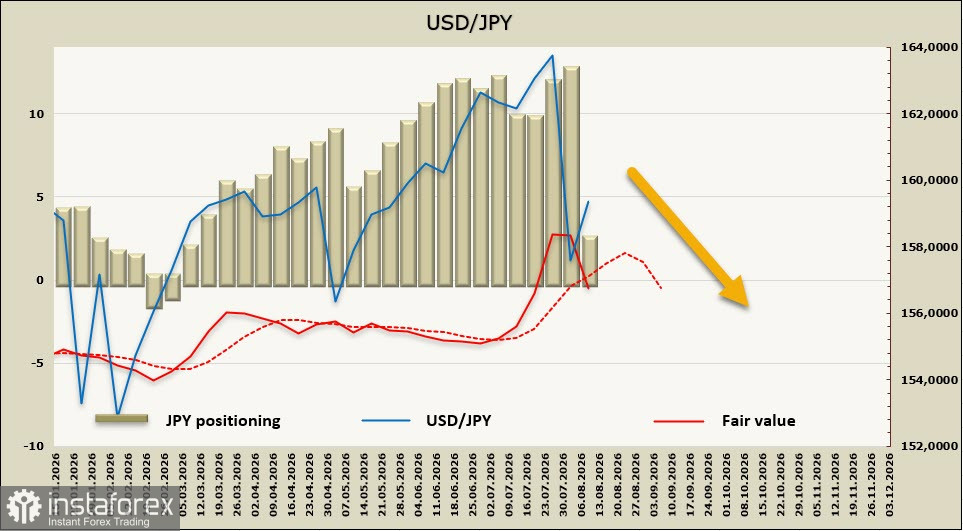
The pair will likely consolidate in the range 157–160. If US CPI comes in above forecasts, the dollar will strengthen and USD/JPY will retest 160, approaching a zone of elevated intervention risk. Before the BOJ meeting on September 17–18, there are practically no fundamental factors capable of sending USD/JPY lower.


