
আরও দেখুন


 16.11.2026 09:20 AM
Today, oil is holding gains. Brent trades around $96 per barrel after rising 3.3%, while WTI is near $89.
Geopolitics provided support. On Sunday, Iran struck a U.S. helicopter base in Bahrain, the first attack on the Gulf state in several weeks, and attacks on vessels in the Strait of Hormuz continue. "The U.S. has shown its bad faith," said Iranian Deputy Foreign Minister Kazem Gharibabadi, adding that Tehran is prepared for diplomacy, economic blockade, and military aggression. Washington is bolstering its presence: after the carrier Theodore Roosevelt arrived, three carrier strike groups are operating in the CENTCOM area of responsibility.

Last week Trump's words also supported the market. The president instructed Vice President J.D. Vance to focus on domestic matters instead of negotiating with Tehran, cooling hopes for back-channel talks. "We don't need a deal with Iran," wrote Donald Trump, adding that Washington has already taken Iran's money—hundreds of billions—and controls the strait.
Rhetoric has shifted noticeably. On November 4, Trump said there were no immediate plans for strikes; on November 8, he called new strikes highly unlikely; on November 9, he said they weren't necessary; and on November 6, he reportedly discussed a deal with advisers that would include significant concessions to Iran. That option is now sidelined. On October 29, Vance sent a letter to the secretary of Iran's Supreme National Security Council, Mohsen Rezaei—explained at the time as a medical-aid proposal—and on November 12, Tehran said it would not remove any enriched nuclear material from the country, a key U.S. demand.
Downward pressure remains. Brent retreated from its October peak due to increased flows from the Middle East and expectations that a Democratic win in the midterms—taking control of both chambers—would speed an end to the nine-month conflict. Saudi Arabia reported October output up 26%, to one of the highest levels in years, and Gulf exports are near prewar levels. U.S. DOE data added weakness: crude inventories rose by 4.66 million barrels against an expected 0.6 million draw, product stocks also increased, and refinery utilization hit a seasonal high.
Risks, however, persist. In October, there were 36 confirmed attacks on commercial vessels in the Persian Gulf, Strait of Hormuz, and Gulf of Oman—more than any other month since the war began. Ukraine continues striking Russian refineries—at least seven attacks since late October—threatening to reduce global fuel supplies. Clearly, Washington's tougher tone gives the market reason to reprice some geopolitical premium.
Overall, oil remains a two-sided market. As long as Washington refuses talks and attacks on shipping continue, I expect Brent to hold in a $90–$98 range, biased toward the top; a move above $100 would require a new escalation in the Hormuz area. I expect weekly downside pressure to persist because physical oil surplus and rising U.S. inventories limit the rally.
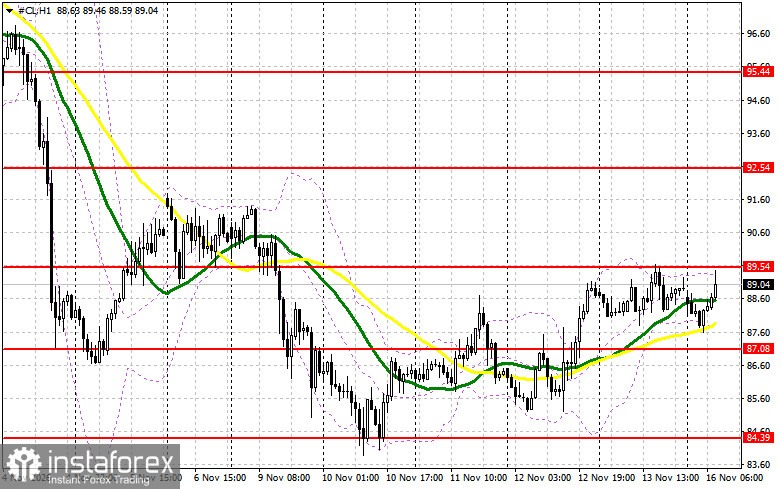
Technically, buyers need to take the nearest resistance at $89 to target $92, above which a breakout will be difficult. The further target is around $95. On a decline, bears will try to seize control below $89. If they succeed, a range breakout would hit bulls hard and push oil toward an $84 low, with prospects of reaching $81.


