
আরও দেখুন


 26.11.2026 09:07 AM
Demand for the euro has risen for two consecutive days, although it is more accurate to say demand for the U.S. dollar has eased slightly.
Most likely the pullback is linked to the closing of dollar longs. However, the pullback is so weak it does not qualify even as a local corrective wave.
Accordingly, it is too early to claim the downward segment of the trend is complete for either the euro or the pound. In the EUR/USD wave structure, the 5th wave in 5 of E is still missing. Therefore, we can expect at least one more downward thrust.
Meanwhile, there are less than two weeks until the Fed meeting on December 8–9. Ten days before the meeting, Fed officials can no longer comment freely on the economy and policy prospects, so the information flow will be sharply limited. That is not a problem for market participants, however, because virtually all FOMC officials have already spoken in recent weeks, and the Fed's position is clear: U.S. inflation continues to rise, so more hawkish measures are required.
What are those "more hawkish measures"?
Christopher Waller allows for a 50-bp move in December. Alberto Musalem sees three consecutive rounds of tightening not as a possible scenario but as a necessity.
John Williams, Anna Paulson, Mary Daly, Beth Hammack, and others allow for the possibility that additional hawkish steps—several consecutive rate increases—may be needed, while favoring a more measured approach without aggressive action.
Thus, one can no longer doubt the Fed will hike in December, and that step has been priced in for a long time. Market participants now expect at least one more round of tightening in Q1 2027, and that is priced in as well. In my view, for the dollar to remain in demand, inflation in the U.S. must continue growing at a pace above forecasts.
In that case a scenario of three consecutive tightening rounds would become an obvious reality. As soon as the market prices a real tightening cycle, dollar demand could fall sharply—that would mark the start of a new impulsive bullish phase for the euro per the current wave count. Therefore, the euro has a good chance to rise; we only need the 5th wave in 5 of E to appear.
Also see my other articles:
Analysis EUR/USD. November 26. Inflation fails to impress, but neither does EUR.
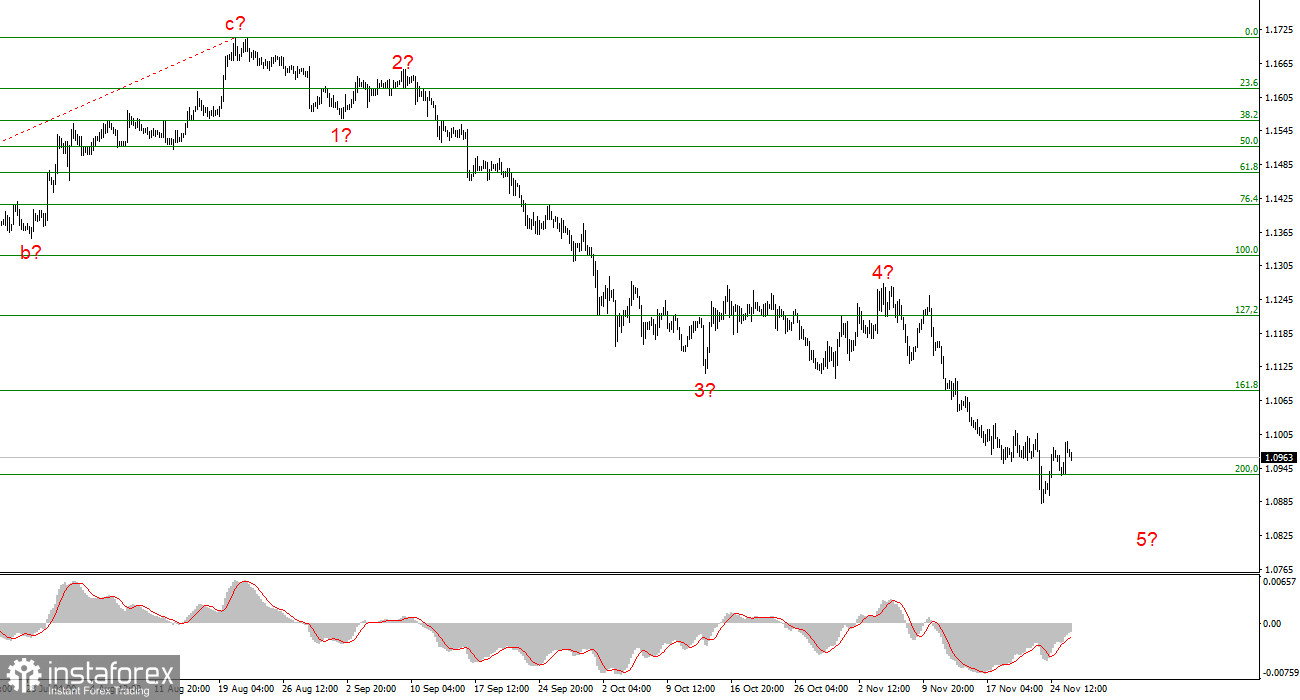
Wave analysis of EUR/USD:
Based on my EUR/USD analysis, I conclude the instrument remains within a global corrective A-B-C-D-E trend segment. However, this structure looks fully complete and may finish at any moment. In my view, now is a good time not only to buy the euro but also to expect a full bullish trend segment. On the higher timeframe, one should expect a rise of at least 1,700–1,800 pips. In my view, the deeper the instrument falls now, the stronger the subsequent rise may be.
However, confirmations of the end of the downward wave sequence are required—for example, a failed break of 1.0902 (which corresponds to 61.8% on Fibonacci on the higher timeframe).
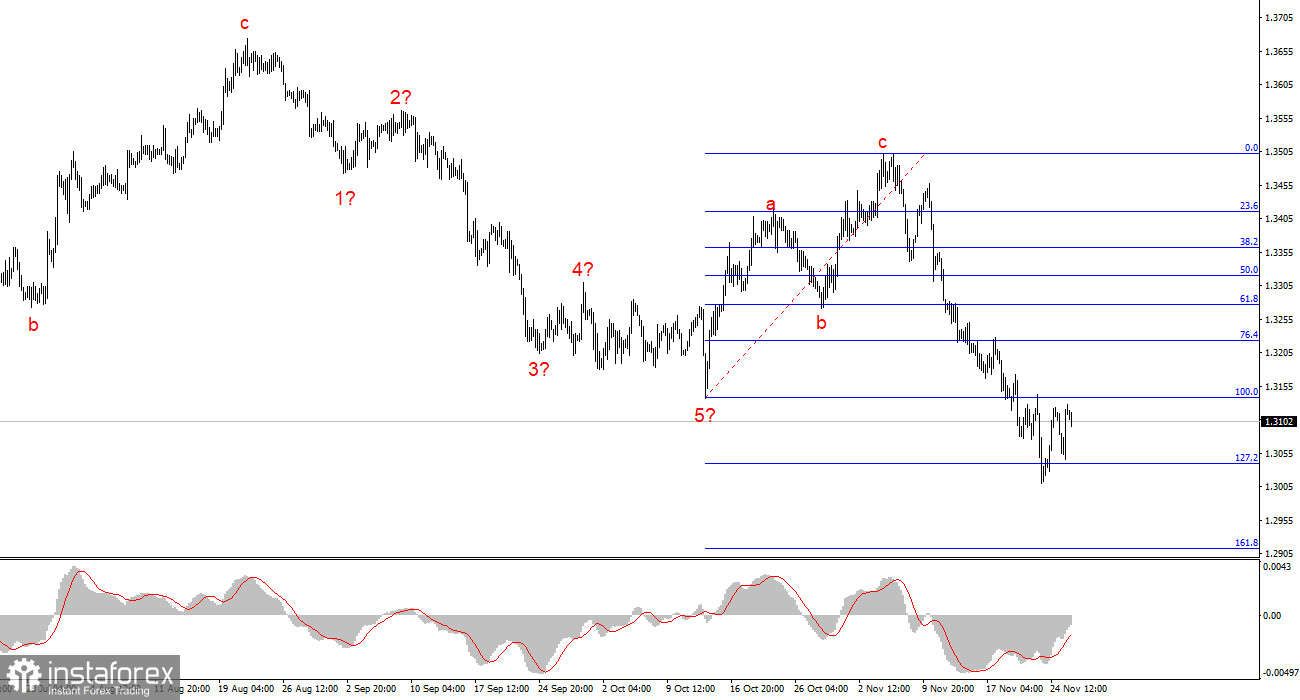
Wave analysis of GBP/USD:
The wave picture for GBP/USD has become completely clear. On the higher chart we now have a corrective A-B-C-D-E structure that, logically, should already be complete. However, the lower timeframe indicates the downward wave sequence is not finished. Consequently, the pound's decline may continue toward targets near 1.3039 and 1.2912, which correspond to 127.2% and 161.8% on Fibonacci.
The deeper the pound falls, the more I look toward long-term buy opportunities.
Key principles of my analysis:
1) Wave structures should be simple and understandable. Complex structures are hard to trade and often change.
2) If you are not confident about what is happening in the market, it is better not to enter.
3) There is no such thing as 100% certainty in direction; do not forget protective stop-loss orders.
4) Wave analysis can be combined with other types of analysis and trading strategies.


