
Lihat juga


 09.10.2026 08:25 AM
Yesterday, the euro and the pound both eked out small gains against the US dollar. No major European economic releases arrived in the morning, so focus shifted to the minutes from the ECB's September meeting, where interest rates were raised. Traders briefly tried to price in a tougher future policy, but the minutes did not confirm those expectations. By evening, both the European and British currencies bounced off local lows, supported by a statement from Washington.

The minutes showed the ECB views an energy shock and expects headline inflation to remain materially above its target through the first half of 2027. That echoed ECB President Christine Lagarde's comments after the September decision, so there was no surprise. More important for the bank and for those betting on further tightening is that secondary effects are not yet present. Wage growth is running at 2.4%, and long-term inflation expectations sit around 2%. Projections for 2026 were revised up. Inflation is near 3%, but it is expected to fall to 2.5% in 2027 and to 2.1% in 2028, implying a return to the ECB's target over three years.
That outlook supports more moderate voices on the ECB Governing Council and reduces the case for aggressive follow-through tightening. However, it is not a bullish trigger for the euro either. Risks are skewed up for inflation and down for growth. The unfavorable scenario would be prolonged inflation — a risk tied to developments in the Middle East. Separately, AI-related leverage, much of it off-balance-sheet, is a concern, but so far, it is not feeding through into secondary inflation effects. Overall, the report is neutral for the euro: there is no obvious reason for the ECB to aggressively catch up with the Fed, and that potential catch-up was the driver of euro strength in September when the deposit rate rose to 2.50%.
Additional pressure on the dollar came from Trump's statement that he won't strike Iran before the November 3 midterms. Risk assets rallied on that news, allowing the pound and the euro to recover from their lows. How lasting is that impulse? Likely short-lived: the statement delays the risk but does not remove it, and the timing ultimately depends on the political calendar rather than regional developments.
Now let's take a look at the economic calendar. Italy releases industrial production (month-on-month), which is expected to be flat after a 0.7% increase in July. That's a secondary figure unlikely to move the euro. Eurozone finance ministers meet, but their post-meeting statements rarely shift the currency direction materially. Attention will instead turn to the US, where the University of Michigan consumer sentiment index is due. Consensus is 47.6 versus 48.1 in September. The year's path reads: July 55.2, August 51.7, September 48.1, October forecast 47.6. A print below expectations would be negative for the dollar and could allow further gains for the euro and pound. Michigan's inflation expectations will also be watched as an input for Fed thinking. Fed Governor Susan Collins will speak. Previously, she described policy as "moderately restrictive," so any softer tone would be interpreted as a signal against further tightening.
We are already seeing US Treasury yields ease, which reduces demand for the dollar. Recall that recent dollar strength was mainly driven by rising yields — 10-year Treasuries reached about 5.31% this week. With yields reversing, I wouldn't be surprised to see further profit-taking in long dollar positioning and some euro/sterling strength by week-end if US data does not surprise to the upside.
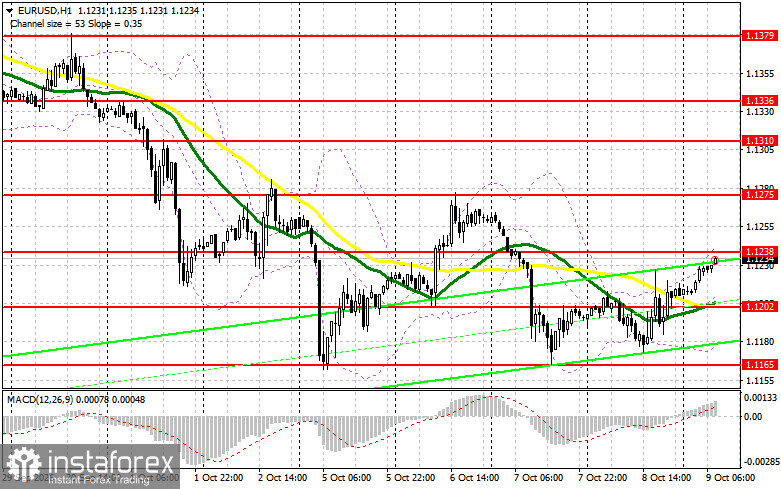
EUR/USD
Short positions should be considered on a false breakout at 1.1238, targeting a move back to the mid-channel at 1.1202. Buy entries from that level are only considered if the breakout is false. A break and consolidation below 1.1202 would renew downside pressure and open the way to 1.1165, this month's low. Long positions there are only for false-break setups, while long positions on a rebound would be appropriate at 1.1133, aiming for a 20–25 pip move. If selling activity is muted at 1.1238, a sustained break above that range would be a reason to add long positions, targeting 1.1275. Consolidation above 1.1275 would open the path to 1.1310, where I'd look to go short on a rebound, counting on a move of 25–30 pips. Sell entries from 1.1275 or 1.1238 are only valid after a false breakout.
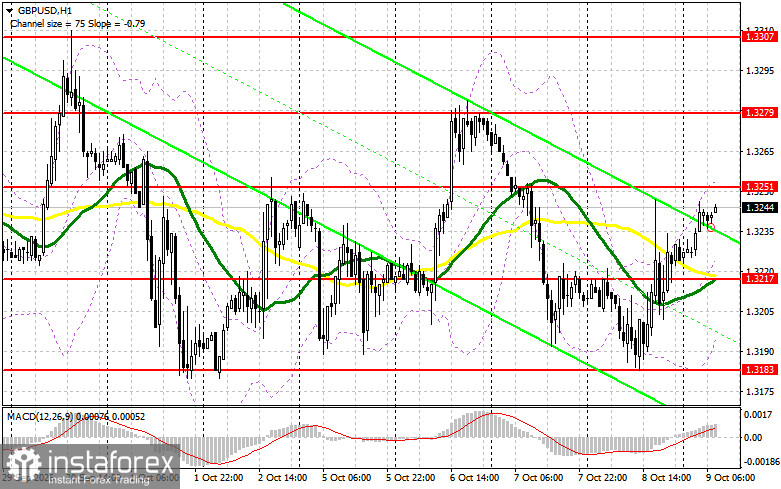
GBP/USD
The trading setup is similar. The pair remains within a wider sideways channel. Selling opportunities could arise on a false breakout at 1.3251 or 1.3289. Going short on a rebound would be prudent at 1.3307, targeting a move of 20–25 pips. On dips, I would look to buy on a false breakout at 1.3218 (moving averages sit there) or at the one-month low near 1.3183. Long positions on a rebound could be considered at 1.3155, aiming for a 25–30 pip move.
I lean toward a week where profit-taking in dollar long positions increases if US data does not surprise and yields keep drifting lower. The ECB minutes are neutral for the euro — without further tightening, the euro remains dependent on dollar dynamics — while the pound stays languid within its channel. I'd expect that any fresh flare-ups around Iran before the election will quickly drive dollar demand, while pauses in Washington's rhetoric will allow the euro and sterling to recover. A weak Michigan consumer sentiment print could be the catalyst that finally gets the pairs out of their current ranges.


