
यह भी देखें


 25.02.2026 08:47 PM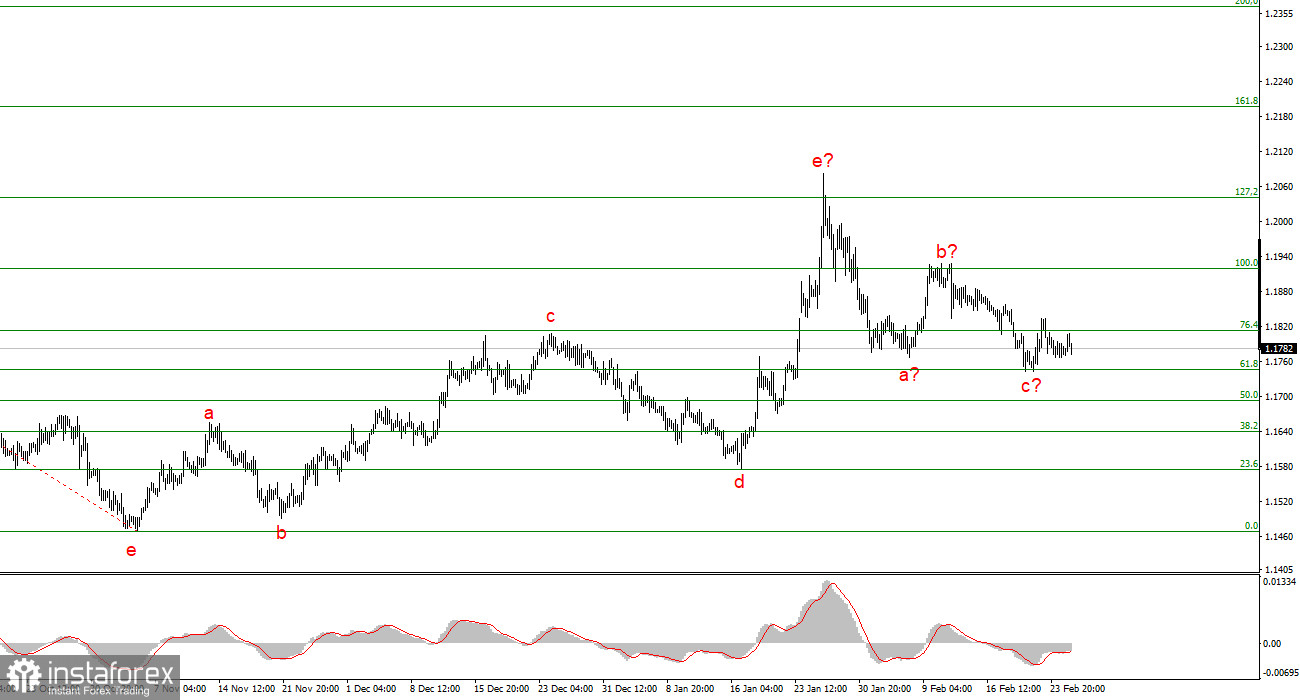
The wave structure on the 4-hour chart for EUR/USD has taken on a less favorable appearance, but it does not raise any questions. There is still no talk of canceling the upward trend segment that began in January of last year; only the internal wave structure is periodically adjusted. In my view, the instrument has completed the formation of global wave 4 (lower image). If this assumption is correct, wave 5 is currently unfolding, and it could become quite extended, with targets reaching up to the 1.2500 level.
The internal structure of the presumed wave 5 is not entirely clear (upper image). The upward wave sequence cannot be considered impulsive due to fairly strong corrective waves. Therefore, at this stage it is interpreted as a-b-c-d-e. However, if wave 5 becomes extended, its internal structure may also turn out to be complex. If that is the case, the wave count may be revised more than once. In any event, I expect the EUR/USD pair to resume its upward movement, and the corrective a-b-c structure already appears to be complete.
The EUR/USD rate again showed almost no change on Wednesday. Comparing the opening level of the current week with the present rate shows minimal difference — 1.1785 versus 1.1778. Essentially, this week has seen only unconvincing attempts by market participants to push the instrument either upward or downward, and all of these attempts have failed. On the one hand, there have been few economic events this week, and even fewer significant ones. This may explain the hesitation of both sellers and buyers. On the other hand, news continues to emerge almost daily from the White House regarding Iran or new trade tariffs announced by Donald Trump last week. Some may disagree, but I believe such developments warrant a market reaction.
At present, everything revolves around Iran and the possibility of U.S. military intervention. Tomorrow marks the third round of negotiations between Tehran and Washington, but political analysts believe the chances of success are low. Time is working against Iran. Trump does not intend to keep his naval fleet off Iran's coast for an extended period. On the contrary, the fleet's presence is intended to make Tehran more compliant and accelerate negotiations. Publicly, Tehran also expresses willingness to reach an agreement with the United States — but on its own terms, which differ significantly from those proposed by Donald Trump. Therefore, it is likely that tomorrow we will hear about unsatisfactory results from the latest round of negotiations. Whether there will be another round afterward remains uncertain.
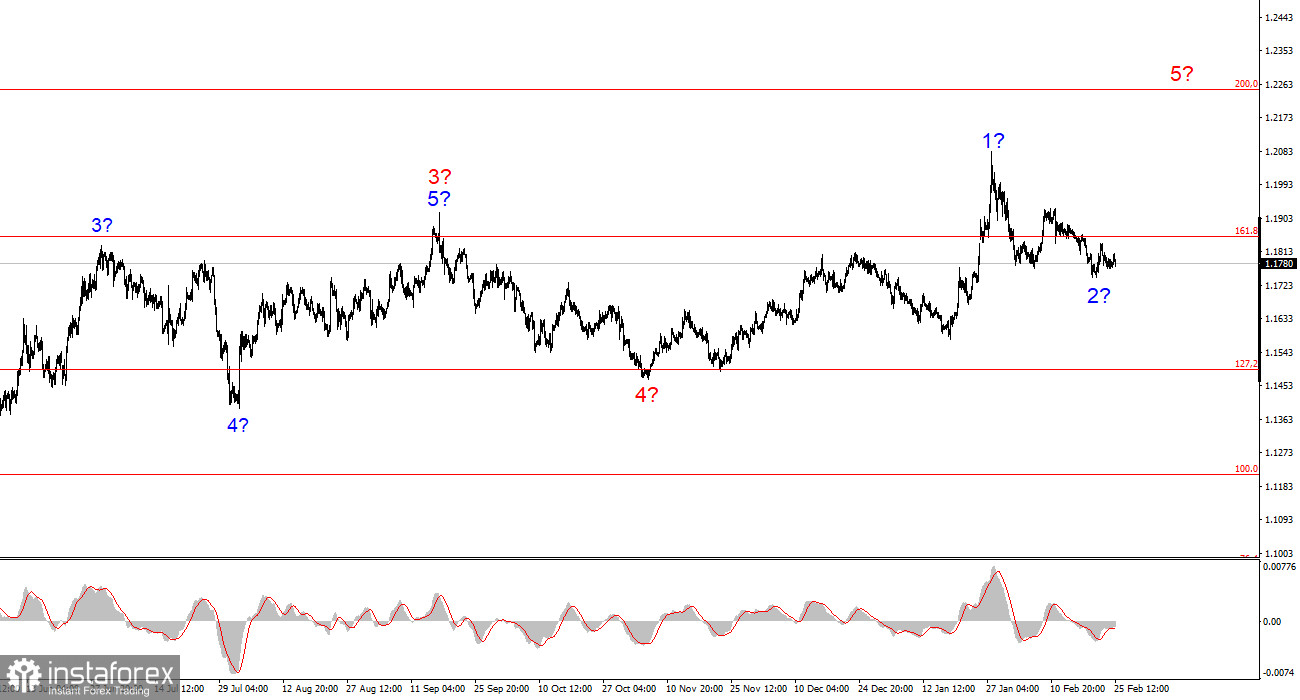
Based on the analysis of EUR/USD, I conclude that the instrument continues to form an upward trend segment. Donald Trump's policies and the Federal Reserve's monetary policy remain significant long-term factors weighing on the U.S. dollar. The targets for the current trend segment may extend up to the 1.2500 level. At present, I believe the instrument remains within global wave 5 and therefore expect higher quotes in the first half of 2026. The corrective a-b-c structure may complete at any moment, as it already appears convincing. I believe it is now reasonable to look for areas and levels for new long positions with targets near 1.2195 and 1.2367, corresponding to the 161.8% and 200.0% Fibonacci levels.
On a smaller time frame, the entire upward trend segment is visible. The wave structure is not entirely typical, as corrective waves differ in size. For example, the larger wave 2 is smaller than the internal wave 2 within wave 3. However, such formations do occur. It is important to identify clear structures on charts rather than strictly adhering to labeling every wave. At present, the upward wave structure does not raise doubts.

