
यह भी देखें


 27.03.2026 09:07 PM
The EUR/USD pair continues a weak upward movement (or at least has not completed it) amid complete geopolitical uncertainty. Over the past few days, the pair has changed direction several times, while traders have been ignoring chart patterns. On Monday, Donald Trump stated that the war in the Middle East would soon end, which immediately caused bears to retreat. However, just half an hour later, Iran reported that no negotiations with the U.S. were taking place and that the Strait of Hormuz would remain closed. In the following days, Tehran repeatedly confirmed this position. Traders who believed Trump on Monday did not fall for the same narrative again. Today it also became known that Tehran has begun turning away even Chinese tankers (China is an ally of Iran) and has destroyed a tanker that attempted to pass through the Strait of Hormuz independently. Thus, traders are now inclined to trust only Tehran.
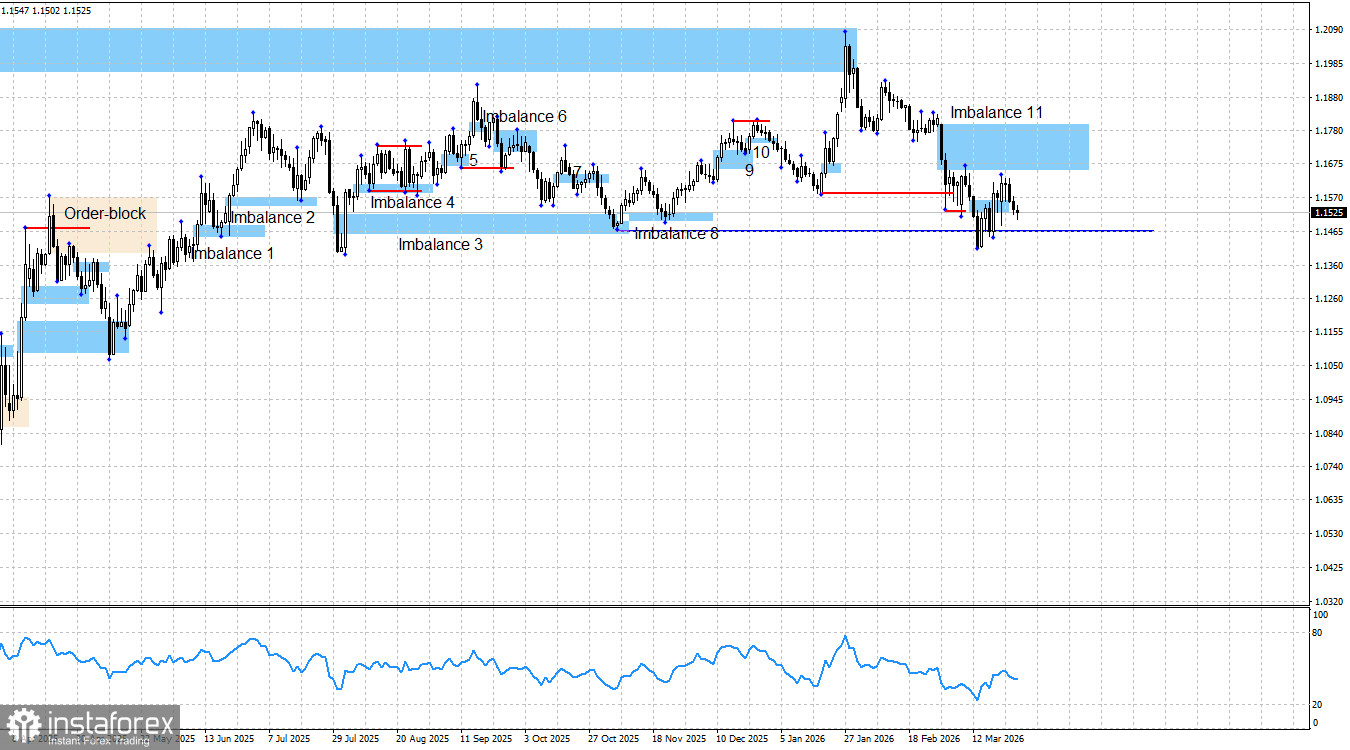
All of the U.S. dollar's growth over the past 4–5 weeks has been driven by geopolitics. That is why I have repeatedly said that I do not believe in the end of the bullish trend, despite the break of important trend-forming lows. At present, imbalance 12 can be considered invalidated, but at the same time, no reaction has been seen from imbalance 11. Thus, bulls may continue their attempts to push higher, while bears may resume their offensive. The price movement of the last two months could develop into a bearish trend if geopolitics continues to strongly support the dollar. However, at the moment, I am still not convinced that the bullish trend has ended. In any case, there are currently no new signals—neither bullish nor bearish.
Further strengthening of the U.S. dollar is only possible if geopolitics continues to strongly support bears. As I have already said, this would require the situation in the Middle East not only to remain tense but to deteriorate further. How could it get worse than it already is? Oil prices would need to continue rising toward $150–$200 per barrel (which they are currently doing), more countries would need to become involved in the conflict, and the economies of developed nations would have to suffer significantly from high oil and gas prices. The conflict itself would also need to last for many months. Previously, I said I did not see the prerequisites for such a scenario, but there has been no positive news from the Middle East. The situation could escalate again at any moment.
There are currently no new patterns for opening positions. In the near term, only imbalance 11 may be worked out, and if price reacts to this pattern, traders may have an opportunity to open short positions. However, at the moment, imbalance 11 remains untested (for the second time), and there are no other trading patterns.
The chart structure still indicates bullish dominance. The bullish trend remains in place, but at present, bulls are in a difficult position due to the sharply changing news flow. To open new long positions, new bullish patterns are needed, or at least liquidity sweeps of the last two bearish swings. A liquidity sweep has occurred, but it is not a tradable pattern on its own.
The news background on Friday was essentially absent. Neither Europe nor the U.S. released any significant data. Donald Trump continues to insist that negotiations with Iran are underway and has once again postponed strikes on Iranian energy facilities. However, these statements have done little to prevent further rises in the dollar and oil.
Bulls still have many reasons to push higher, and even the outbreak of war in the Middle East has not reduced them. Structurally and globally, Trump's policies—which led to a significant decline in the dollar last year—have not changed. In the near term, the U.S. currency may strengthen due to risk aversion, but this factor cannot support it indefinitely. There are no other strong supporting factors for the dollar.
I still do not believe in a bearish trend. The dollar has received temporary support from the market, but it is unclear how long this situation will last. However, the bullish trend has been broken, and this must be acknowledged. There is still a chance of a liquidity sweep and a resumption of the trend, but geopolitics may once again weigh heavily on EUR/USD and push it lower.
News calendar for the U.S. and the Eurozone:
Germany – Consumer Price Index (12:00 UTC).
On March 30, the economic calendar contains only one entry, which is not of significant interest. The impact of the news background on market sentiment on Monday is expected to be weak or absent.
EUR/USD Forecast and Trading Advice:
In my view, the pair remains in the process of forming a bullish trend. The news background sharply changed direction three weeks ago, but the trend itself cannot yet be considered fully canceled or completed. Therefore, in the near term, traders need new patterns and signals to form short-term forecasts and open positions.
In the near future, bears may receive a signal from imbalance 11, while the invalidation of imbalance 12 is also a form of signal. Bulls, for their part, can only hope for the formation of new bullish patterns and further buy signals.

