
यह भी देखें


 21.05.2026 08:49 AM
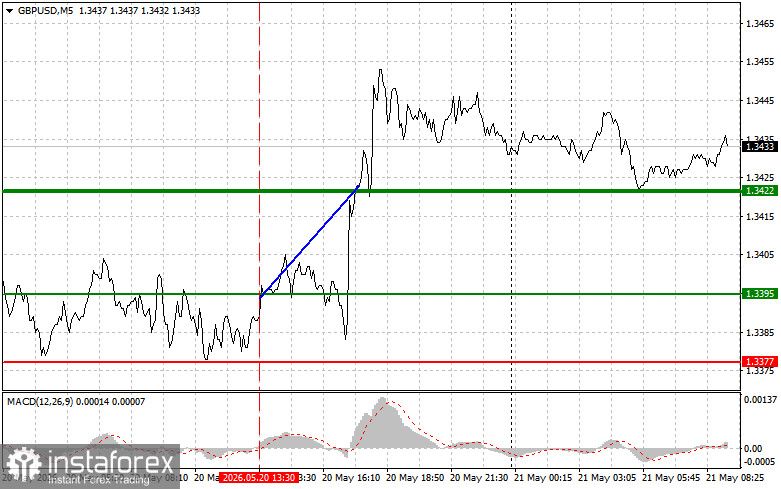
The price test at 1.3395 coincided with the MACD indicator just beginning to move upward from the zero mark, confirming the correct entry point for buying the pound. As a result, the pair rose to the target level of 1.3422.
The U.S. dollar declined against the British pound following Trump's statements that he does not want to continue the war with Iran and is looking for a deal. This became a significant signal for the financial markets, which had long feared an escalation of the conflict in the Middle East. The U.S. president's comments regarding his desire for a diplomatic resolution and an agreement with Iran were perceived as a reduction in geopolitical tension. Such a de-escalation traditionally has a positive impact on investors' sentiment, particularly those inclined to increase their allocation of risk assets in their portfolios. The British pound, one of the major global currencies, benefited from this trend, gaining additional momentum in its growth against the U.S. dollar.
Today's release of macroeconomic data, which may significantly influence the British pound's exchange rate, is highly anticipated by market participants. The publication of purchasing managers' indices (PMIs) for the manufacturing, services, and composite sectors will provide valuable insights into the state of the British economy. These indicators are leading indicators that reflect business sentiment and trends in key industries, enabling predictions of future economic developments. The services sector PMI is particularly significant, as it accounts for the largest share of the nation's GDP. Consistent growth or stagnation in this segment could be a decisive factor in shaping the tone of the Bank of England's future statements on monetary policy.
In addition to the macroeconomic releases, attention will be drawn to the speech of Bank of England Monetary Policy Committee member Alan Taylor. The tone of his remarks and hints at future interest rate changes toward increases could support the British pound in its growth against the U.S. dollar.
Regarding the intraday strategy, I will focus on implementing Scenarios No. 1 and No. 2.
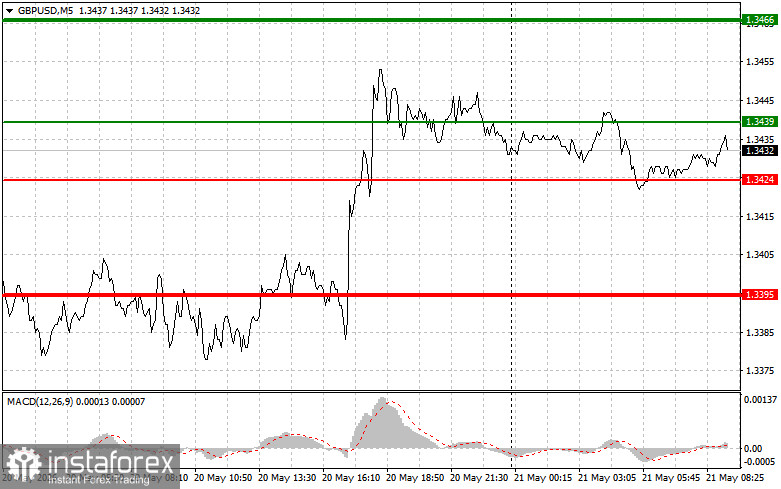
Scenario No. 1: I plan to buy the pound today upon reaching an entry point around 1.3439 (green line on the chart), targeting growth to level 1.3466 (thicker green line on the chart). At point 1.3466, I intend to exit the market and sell back, anticipating a 30-35-pip move from the entry point. Strong pound growth can only be expected after positive data. Important! Before buying, ensure that the MACD indicator is above the zero mark and is just beginning to rise from that level.
Scenario No. 2: I also plan to buy the pound today if the price tests 1.3424 twice in a row, when the MACD indicator is in the oversold zone. This will limit the pair's downward potential and lead to an upward market reversal. One can expect growth toward the opposite levels of 1.3439 and 1.3466.
Scenario No. 1: I plan to sell the pound today after the 1.3424 level is updated (red line on the chart), which will trigger a rapid decline in the pair. The key target for sellers will be level 1.3395, where I intend to exit the short positions and immediately buy back in the opposite direction (anticipating a movement of 20-25 pips in the opposite direction from the level). Pressure on the pound may return at any moment. Important! Before selling, ensure the MACD indicator is below the zero mark and just beginning to decline from that level.
Scenario No. 2: I also plan to sell the pound today if two consecutive tests of the price 1.3439 occur while the MACD indicator is in the overbought zone. This will limit the pair's upward potential and lead to a market reversal downward. One can expect a decline toward the opposite levels of 1.3424 and 1.3395.
Important: Beginner traders in the Forex market need to make entry decisions very cautiously. It is best to stay out of the market before important fundamental reports to avoid sharp price fluctuations. If you decide to trade during news releases, always set stop orders to minimize losses. Without placing stop orders, you can quickly lose your entire deposit, especially if you do not use money management and trade in large volumes.
And remember, for successful trading, it is essential to have a clear trading plan, as outlined above. Making impulsive trading decisions based on the current market situation is fundamentally a losing strategy for an intraday trader.

