
यह भी देखें


 02.07.2026 06:22 PM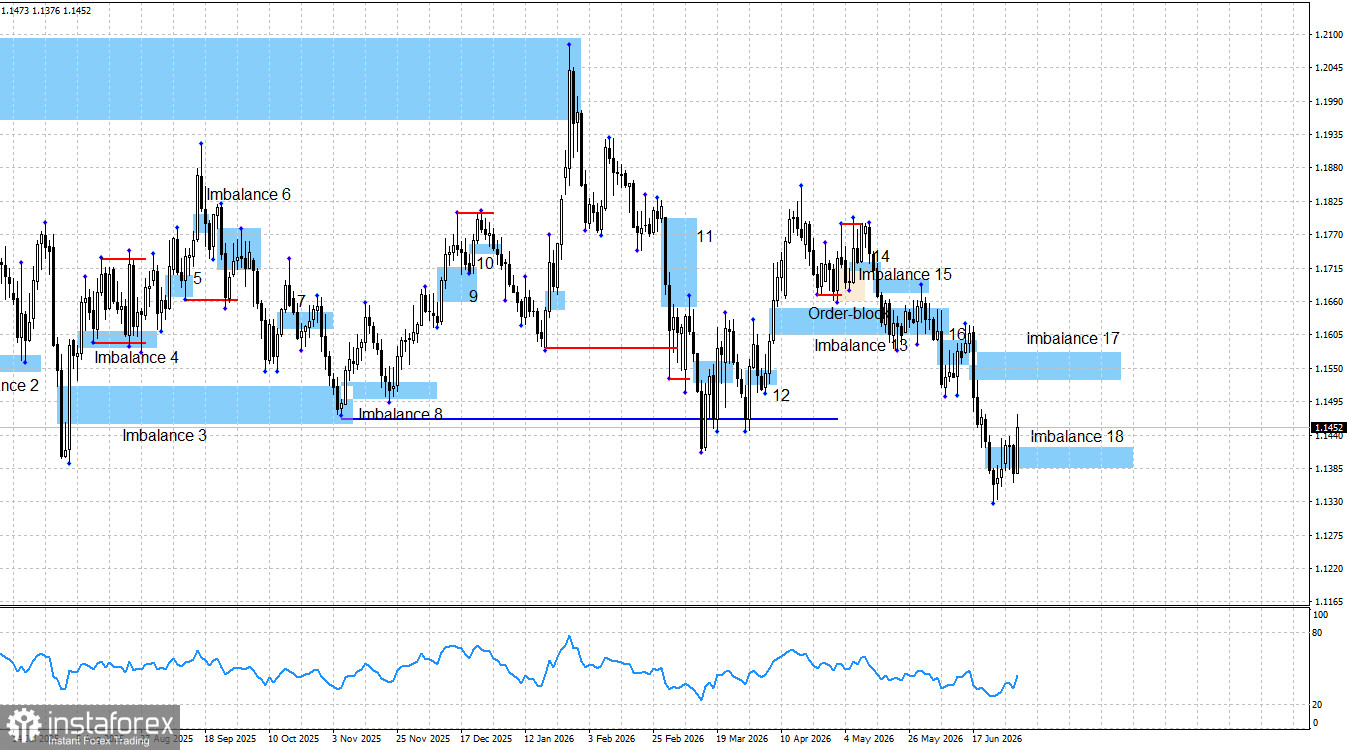
EUR/USD remains within a local bearish impulse, although the bulls gained some opportunities following developments on Wednesday and Thursday.
Yesterday, the international economic forum in Portugal featured speeches by ECB President Christine Lagarde and Federal Reserve Governor Kevin Warsh. In my view, Lagarde's tone on monetary policy became more cautious and less hawkish. At the same time, Warsh reiterated the need for higher interest rates but did not clarify whether the Federal Reserve intends to bring inflation down through further monetary tightening or expects inflation to ease as energy prices decline.
Overall, the central bankers offered plenty of rhetoric but very little concrete guidance. As a result, traders were free to interpret the remarks from both Warsh and Lagarde in different ways. The session ultimately ended with renewed strength in the U.S. dollar, suggesting that the market interpreted Warsh's comments as hawkish.
However, market conditions changed somewhat today. The U.S. Nonfarm Payrolls report came in significantly below expectations, triggering a sharp bullish reaction in EUR/USD. That move was sufficient to invalidate Imbalance 18, allowing buyers to target Imbalance 17. As long as Imbalance 17 remains valid, the broader bearish impulse remains intact. However, a new bullish impulse would provide a stronger technical signal. In any case, the bulls have been given an opportunity. The key question is whether they can capitalize on it.
Geopolitical developments have taken a back seat to Federal Reserve policy in recent weeks, but they may soon return to the forefront. Tehran and Washington have signed a memorandum of understanding, extended the ceasefire for another 60 days, and begun working toward the full reopening of the Strait of Hormuz and a comprehensive nuclear agreement.
Despite easing geopolitical tensions, the anticipated decline in the U.S. dollar never materialized, nor did the euro strengthen following the ECB's tighter monetary policy stance. On the contrary, sellers continued to dominate despite the supportive fundamental and geopolitical backdrop. Now that geopolitical developments are once again becoming less encouraging, renewed bearish pressure would not be surprising. Nevertheless, in my view, the bulls' position is not weak enough to justify another retreat.
From a technical perspective, the current chart structure continues to indicate that the bearish impulse, which began on April 17, remains intact. Bearish Imbalance 17 has not yet been filled, while Imbalance 18 was invalidated following weak U.S. labor market data. No bullish patterns have formed so far, and none are likely to appear in the coming days. Therefore, buyers may continue a corrective move toward Imbalance 17, although there is currently no attractive technical entry for such a trade.
It is also worth noting that liquidity may have been swept below the August 1 low during the past week.
Thursday's economic data finally provided support for buyers. A single Nonfarm Payrolls report was enough to force sellers to retreat. The U.S. economy added only 57,000 jobs outside the agricultural sector, well below the market consensus of 110,000. In addition, May's figure was revised downward by 50,000 jobs. It is therefore fair to conclude that the payrolls report fell far short of expectations, resulting in a well-justified decline in the U.S. dollar. The unemployment rate received little attention from market participants.
There are still numerous reasons for buyers to remain constructive throughout 2026, and the easing of the conflict in the Middle East has done little to diminish them. Structurally and fundamentally, President Trump's policies—which contributed to the sharp depreciation of the U.S. dollar last year—have not changed. At present, I see few compelling factors supporting the U.S. dollar, despite the FOMC's hawkish stance.
EUR/USD is approaching a cluster of significant lows and swing points where liquidity could be swept. Such a move could provide the catalyst for a reversal of the current bearish impulse.
Economic Calendar for the United States and the Eurozone:
The economic calendar for July 3 contains only one event, which I do not consider particularly important. As a result, the macroeconomic backdrop is likely to have only a limited impact on market sentiment on Friday, while many financial markets will remain closed in observance of the U.S. Independence Day holiday.
EUR/USD Forecast and Trading Tips
In my view, the pair remains in the process of forming a broader bullish trend. Although the fundamental backdrop shifted sharply in favor of the bears four months ago, the longer-term bullish trend cannot yet be considered invalidated.
Therefore, buyers may launch a fresh advance following a liquidity sweep below the clearly defined lows. However, opening long positions at the current levels is not advisable. It would be preferable to wait for confirmed bullish price action patterns before considering new buy positions.
At present, traders are monitoring two bearish imbalances, one of which has already been invalidated. I would also highlight the proximity of four significant swing points where liquidity could be swept, as well as the questionable fundamental basis for the recent appreciation of the U.S. dollar. Consequently, I continue to expect a bullish move, but I would first like to see technical confirmation of this scenario. Alternatively, traders may wait for a new sell signal within Imbalance 17.

