
यह भी देखें


 01.09.2026 02:05 PM
Review of Trades and Trading Tips for the Euro
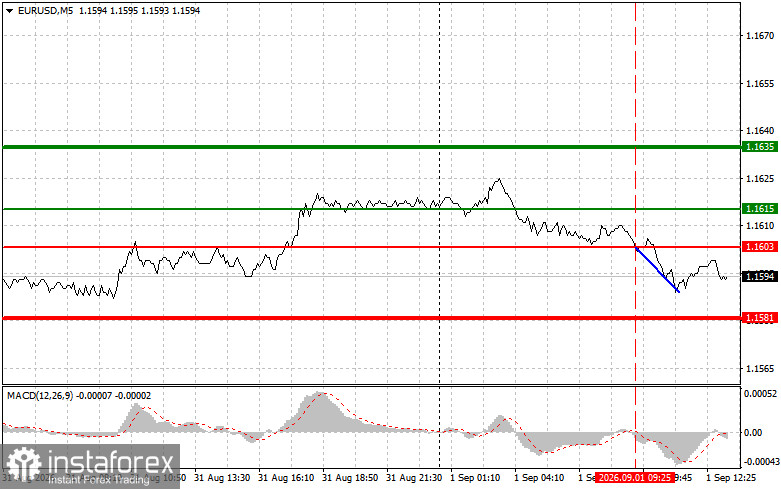
The 1.1603 price test occurred when the MACD indicator had just started moving downward from the zero line, confirming the validity of the entry point for a short position on the euro. As a result, the pair declined by 10 points.
The August surge in eurozone inflation to 3.3% year-on-year from 2.9% in July failed to impress the euro, as the figures were fully in line with economists' expectations. The single currency barely reacted to the report because the market had already priced in the acceleration, and there was no sharp movement in the absence of a surprise. The reason for the acceleration is obvious and energy-related, as energy prices rose by 14.3%, while the other components remained much more subdued. For the ECB, such data provide arguments for both hawks and doves, but the risk of a September rate hike remains.
The euro will spend the second half of the day awaiting US economic data that could increase pressure on the single currency. The ISM Manufacturing PMI and the JOLTS job openings report will be released, followed by a speech from FOMC member Michael Barr. The ISM index reflects business activity in the manufacturing sector, while job openings data help assess the condition of the labor market, and both indicators directly affect expectations for the Fed's interest rate. The outlook for the single currency is cautious. Strong data would provide additional support for the dollar and could push EUR/USD lower, while weak data would favor the euro.
As for the intraday strategy, I will rely more heavily on the implementation of Scenarios #1 and #2.
Buy Signal
Scenario #1: Today, the euro can be bought when the price reaches around 1.1602 (the green line on the chart), with a target of a rise to 1.1622. At 1.1622, I plan to exit the market and also sell the euro in the opposite direction, targeting a move of 30–35 points from the entry point. A rise in the euro can be expected today only if the US data are weak. Important! Before buying, make sure that the MACD indicator is above the zero line and has only just started rising from it.
Scenario #2: Today, I also plan to buy the euro if the price tests 1.1589 twice consecutively while the MACD indicator is in the oversold zone. This would limit the pair's downward potential and trigger a reversal to the upside. A rise toward the opposite levels of 1.1602 and 1.1622 can be expected.
Sell Signal
Scenario #1: I plan to sell the euro after the price reaches 1.1589 (the red line on the chart). The target will be 1.1570, where I plan to exit the market and immediately buy in the opposite direction, targeting a 20–25-point move in the opposite direction from the level. Downward pressure on the pair will return if the US data are strong. Important! Before selling, make sure that the MACD indicator is below the zero line and has only just started declining from it.
Scenario #2: Today, I also plan to sell the euro if the price tests 1.1602 twice consecutively while the MACD indicator is in the overbought zone. This would limit the pair's upward potential and trigger a reversal to the downside. A decline toward the opposite levels of 1.1589 and 1.1570 can be expected.
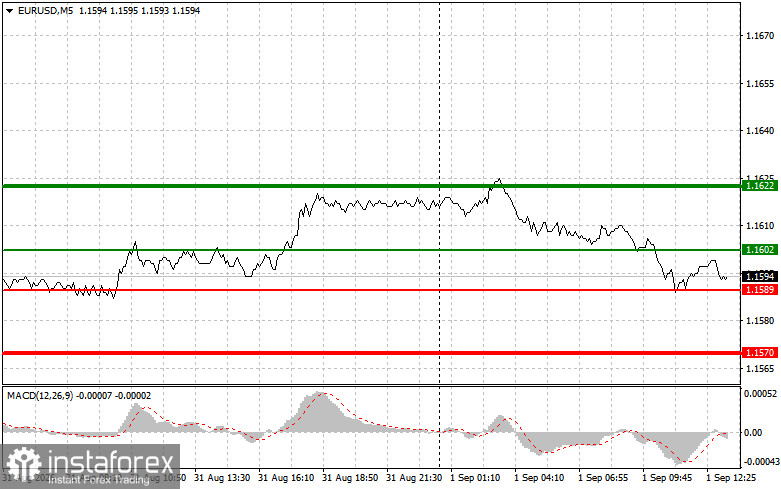
What Is Shown on the Chart:
Important. Beginner Forex traders should be very cautious when making decisions about entering the market. Before the release of important fundamental reports, it is best to stay out of the market to avoid being caught in sharp exchange-rate fluctuations. If you decide to trade during a news release, always place stop orders to minimize losses. Without stop orders, you can lose your entire deposit very quickly, especially if you do not use proper money management and trade large volumes.
And remember that successful trading requires a clear trading plan, such as the one presented above. Making spontaneous trading decisions based on the current market situation is an inherently losing strategy for an intraday trader.

