
यह भी देखें


 06.10.2026 06:25 PM
The wave count on the four-hour chart for EUR/USD is becoming more complex. There is still no reason to consider the upward section of the trend (lower chart), which began in January last year, invalidated. On the contrary, a complete A-B-C corrective structure has emerged and may have already been completed. However, recent developments related to the Federal Reserve and its monetary policy have again affected the current wave structure, making the wave count more complex. It should be noted that the fundamental background and wave count often conflict with each other, making adjustments necessary.
The wave count has now developed into a more complex structure. Wave C has taken a three-wave form, while the next wave is identified as wave D. The entire trend section beginning on January 27 may take a five-wave corrective form, A-B-C-D-E. If this assumption is correct, wave D has been completed, and on August 21 EUR/USD entered the formation phase of wave E, whose low should be below the low of wave C at 1.1325. The pair is only a short distance from this level, and below it the assumed wave E could complete its formation at any time.
The Euro Recorded a Limited Recovery, but Can Further Gains Be Expected?
EUR/USD rose by 25 basis points during Tuesday's session, but the decline resumed during the U.S. session. Therefore, by the end of the day, the European currency could give up its limited gains. The current market environment remains unfavorable for demand for the European currency. The issue is not simply the weakness of the fundamental background; market participants are largely disregarding it. Today, for example, the upward move was caused exclusively by the closure of some short positions to take profits. There was no news supporting the euro today. Moreover, when such news was available, the market ignored it. Therefore, although the current wave count once again allows for the downward section of the trend to end either now or in the near future, a reversal to the upside should be approached with considerable caution. The euro will not decline indefinitely. However, after wave 3 or wave C, another wave 5 may be formed, while the larger wave E may take any length. The key factor at present is overall market sentiment, and the market is currently showing little interest in positive factors for the European currency.
Is this justified? In the current assessment, it is not. The euro is not weak enough and the dollar is not strong enough to justify a continued decline in EUR/USD. Therefore, the U.S. currency can continue strengthening only if the fundamental background provides the market with new reasons to buy it. The most important economic reports have already been released, so the dollar appears to have limited scope for additional support. However, this does not mean that the market cannot continue buying the U.S. currency.
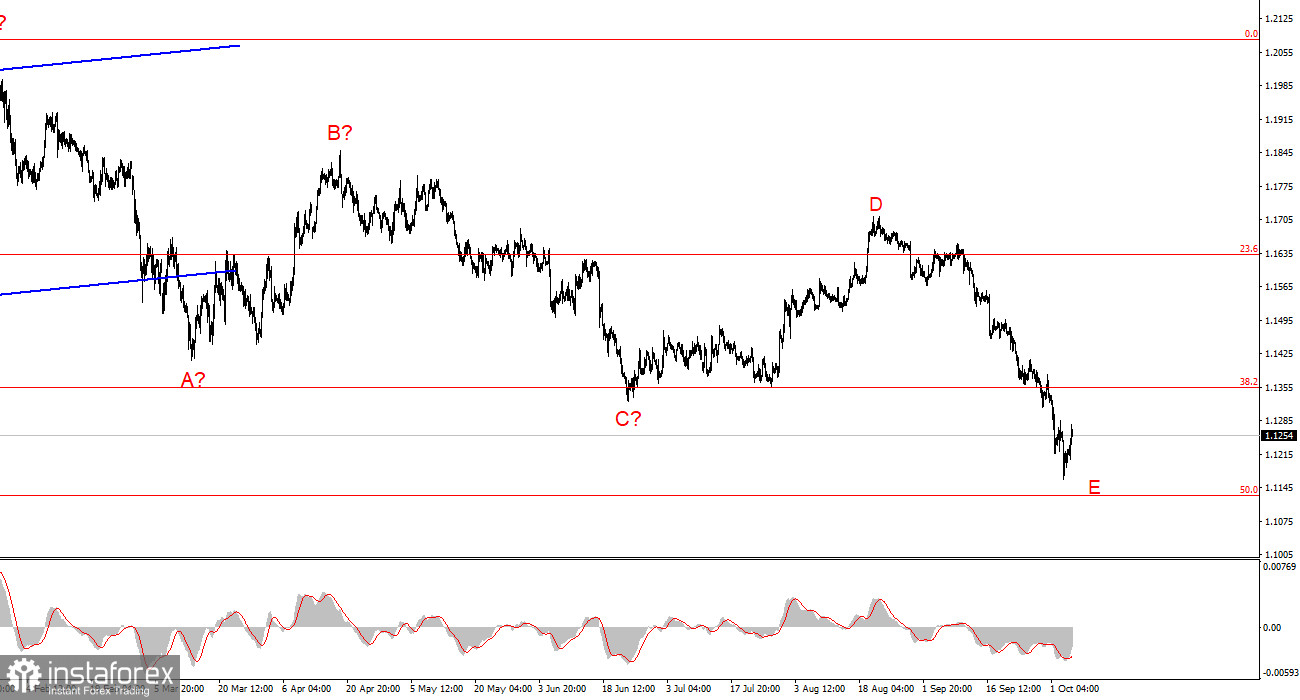
Based on the EUR/USD analysis, the pair remains within the framework of a global A-B-C-D-E corrective trend structure. If this assumption is correct, the decline will continue toward targets below the low of wave C at 1.1325. This scenario was previously considered an alternative, and without the Federal Reserve meeting, it would have remained a secondary scenario. However, the Federal Reserve delivered an unexpected outcome, leaving the market with few alternatives to renewed buying of the U.S. currency. Nevertheless, these purchases have continued for several weeks even though there are no new factors supporting the dollar. Under the current fundamental conditions, opening short positions would not be preferable; instead, preparations should be made for a potential reversal.
On the higher timeframe, a downward section of the trend can be seen in the form of A-B-C-D-E. Therefore, EUR/USD may continue declining below the low of wave C, while the internal structure of wave E may develop into a five-wave impulsive structure.
Main Principles of the Analysis:

