
यह भी देखें


 13.10.2026 09:43 AM
During Asian trading today, Bitcoin and Ether plunged sharply but then recovered quite actively. Bitcoin fell below $81,000 early in the session, then returned above $83,000 and trades around $83,600; Ether hit a five-day low at $2,450 but by morning had returned to $2,534. For now, market equilibrium largely holds: the decline did not turn into a crash, and buyers quickly bought the dip.

The trigger did not come from crypto. Stocks were sold in Asia: South Korea's Kospi fell more than 6% and dropped below 6,000; Samsung Electronics and SK Hynix lost about 8%; Nasdaq futures fell; and Asian equities hit a two-month low on AI concerns. Rising oil and a possible Federal Reserve rate hike intensified the pressure. Liquidations over 24 hours totaled about $672 million, with $586 million in long positions — the usual deleveraging-on-the-drop scenario. The Fear & Greed Index fell from 69 to 57.
Against this backdrop, two of the largest corporate buyers reported activity. Tom Lee bought 12,532 ETH for Bitmine at $31.6 million. The company now holds 6,028,946 ETH worth $15.2 billion—roughly 4.9% of the total Ether supply; cash and liquid securities total $612 million, and 5,067,309 ETH worth $12.8 billion is staked, about 84% of its holdings. The company's unrealized loss is $4.81 billion, and my estimates put its average entry price around $3,300. More importantly: last week Lee said Bitmine would stop buying at 5% of supply, and he had about 100,000 ETH left to buy. He is close to that cap, which means the market may soon lose its most notable corporate Ether buyer.
Michael Saylor bought 250 BTC for $21.5 million at an average price of $86,194, which is above current prices. Strategy's holdings rose to 848,250 BTC valued at $70.6 billion, and its USD reserve is $5.5 billion. But the announcement also reported that the company repurchased $192 million of preferred STRC shares—almost nine times what it spent on Bitcoin. Last week the ratio was similar: $176.3 million versus $28.7 million. The trend persists: major funds are supporting the company's securities rather than coin purchases. For Bitcoin, this means Saylor-type demand remains symbolic, and the market needs inflows via ETFs, which saw outflows of $681.1 million for the week.
My base scenario: until US inflation data on October 14, Bitcoin and Ether will trade in a narrow range, with Ether remaining weaker. A soft CPI will restore risk appetite and set Bitcoin on a path toward $84,600, while a strong print will bolster Fed-hike bets and lead to a retest of the $81,000 low. For Ether, the key risks are Bitmine approaching its cap and continued ETF outflows.
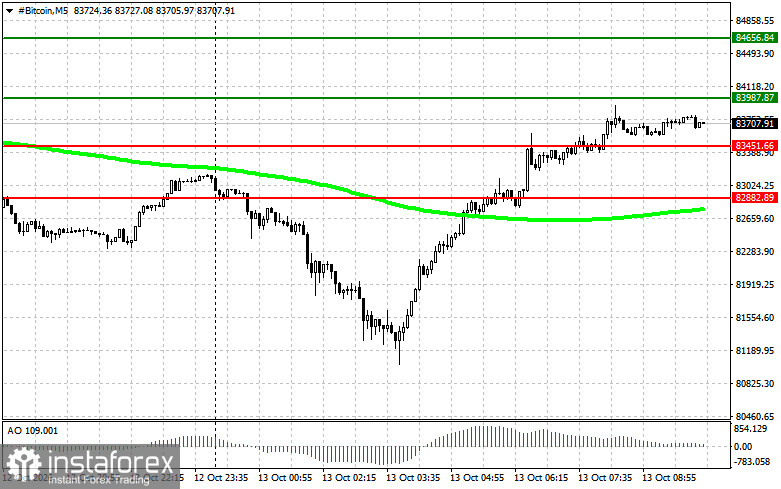
For Bitcoin, the price trades in a narrow range between support at 83,400 and resistance at 83,900, with outer bounds at 82,800 and 84,600, and the plan centers on two mirror directions: full breakout and rebound scenarios. There are two buy entry options. First, a confirmed breakout above 83,900: buy with a target at 84,600, take profit there, and consider a short on the pullback, provided price is above the 50-day moving average, and Awesome is above zero. Second, a rebound off 83,400 if the downside breakout is unconfirmed and the drop proves false: buy with a return first to 83,900, then to 84,600.
Sales are symmetric. On a confirmed break below 83,400, consider a short position targeting 82,800, provided the moving average is above price and Awesome is below zero. If the breakout above 83,900 fails and price returns below the level, short from resistance on a return to 83,400, then to 82,800.
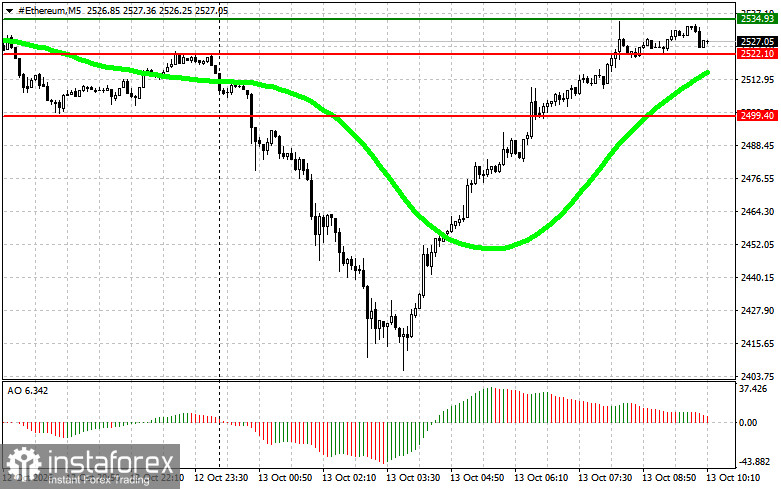
For Ether, the logic fully mirrors Bitcoin on its own price scale: inner range between support 2,522 and resistance 2,534, outer bounds 2,499 and 2,552. Buy on a confirmed breakout above 2,534, targeting 2,552, where I take profit and consider a short on the pullback; the condition is the same: price above the 50-day moving average and Awesome above zero. Buy on a rebound off 2,522; if the downside breakout is unconfirmed, go first to 2,534, then to 2,552.
For selling, a confirmed break below 2,522 opens a short targeting 2,499, provided the moving average is above price and Awesome is below zero. A rebound from 2,534, when the upside breakout fails, gives a short with a return to 2,522, then to 2,499. Both indicators serve as filters to cut false moves rather than independent reasons to enter early, and decisions are taken only after price actually confirms the specified levels.

