
यह भी देखें


 12.11.2026 08:43 AM
Bitcoin and Ethereum continue their downward move, constantly fed by one discouraging piece of news after another. I remind you that recent developments for the crypto world have been overwhelmingly negative. Central banks (notably the Federal Reserve) continue to tighten their monetary policies; the Clarity Act remains just a bill; Democrats won control of Congress, which further reduces the likelihood of the Clarity Act passing. Historically, Bitcoin tends to fall after midterm elections (as we are seeing now), and two weeks ago, the list of negatives grew with the hack of the world's largest crypto exchange, Binance. That was followed by a crash in the US stock market and a sell?off in tech stocks, which many experts closely link to Bitcoin's price. This week, the report showed that US inflation accelerated more than expected. Thus, the fundamentals for a crypto market rally remain, to put it mildly, shaky.
Meanwhile, Bitcoin faces fresh headwinds. Yesterday, it emerged that roughly $14 billion worth of USDT left circulation in just one month. What does that mean in practice? Fiat money is typically converted by traders and investors into stablecoins for subsequent purchases of cryptocurrencies and digital assets. Not all stablecoins necessarily go into Bitcoin purchases, but a significant portion does. If stablecoins are withdrawn from circulation (i.e., essentially converted back into fiat), it signals reduced investor interest in digital?asset investments. In June 2022, the stablecoin market lost about $30 billion in one month; after that, Bitcoin fell to $15,500.
Experts also note Bitcoin has reentered the "gray zone." Most traders who bought Bitcoin in recent months are now in loss, and the bullish trend promised by Cathie Wood, Michael Saylor, and Robert Kiyosaki still has not materialized. Therefore, on any rally, traders will try to close their long positions at breakeven. Demand will fall, supply will rise again, and that may trigger a new wave of declines in "digital gold." Our view remains unchanged — Bitcoin will continue to fall, and there is no bullish trend at present.
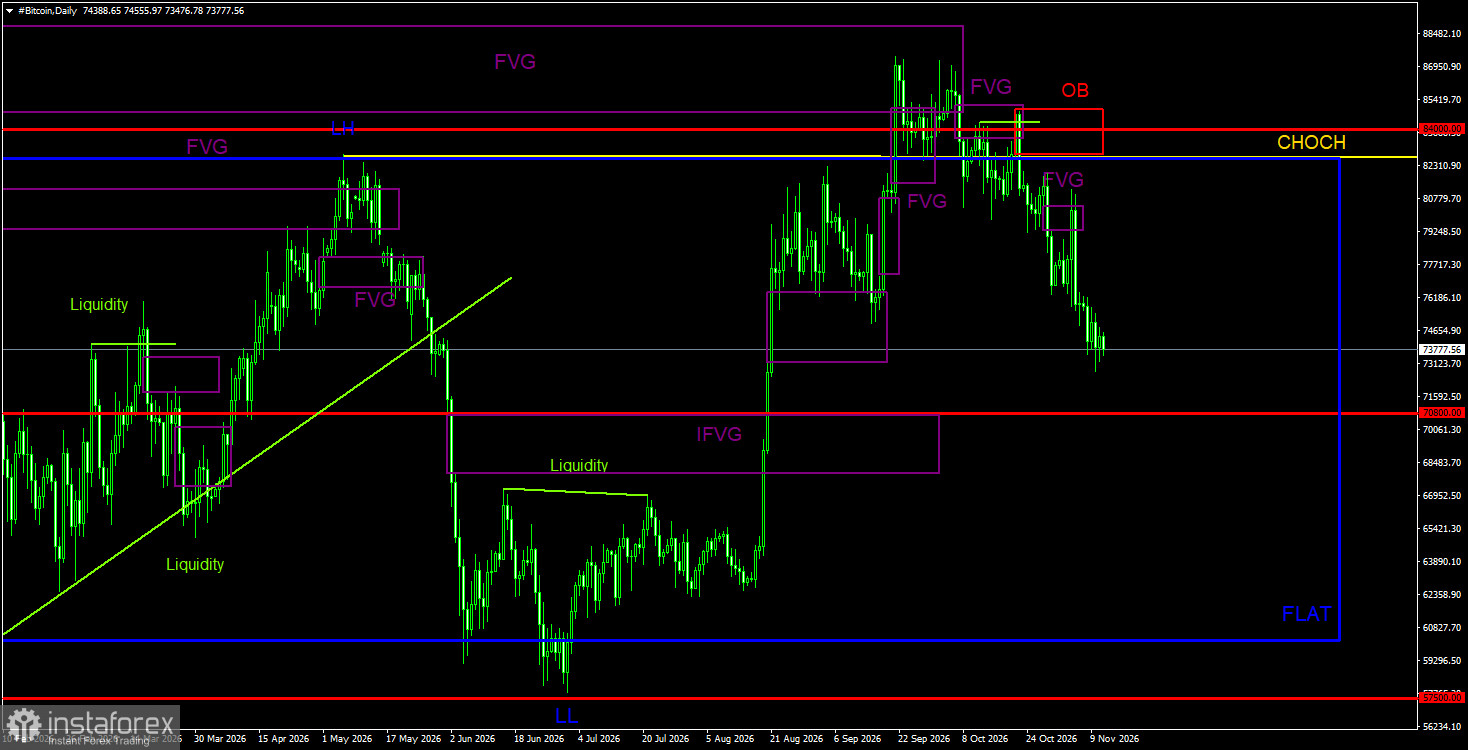
Bitcoin tried to start a new uptrend, but the fundamental backdrop, spot demand and recent news are too negative to count on its continuation. In the short term, on the daily timeframe, Bitcoin may continue to decline, as the price has already reacted to three bearish FVGs and formed a bearish order block. A breakout of the sideways channel on the daily chart is interpreted as a deviation. Thus, Bitcoin generated a reversal signal and set course for the $70,800 level. We do not believe the bearish trend is over. Short positions are currently more relevant than longs. The latest bearish FVG on the daily chart produced a new sell signal. On the 4?hour timeframe, there is another bearish FVG whose reaction could provide traders with opportunities to open new short positions.
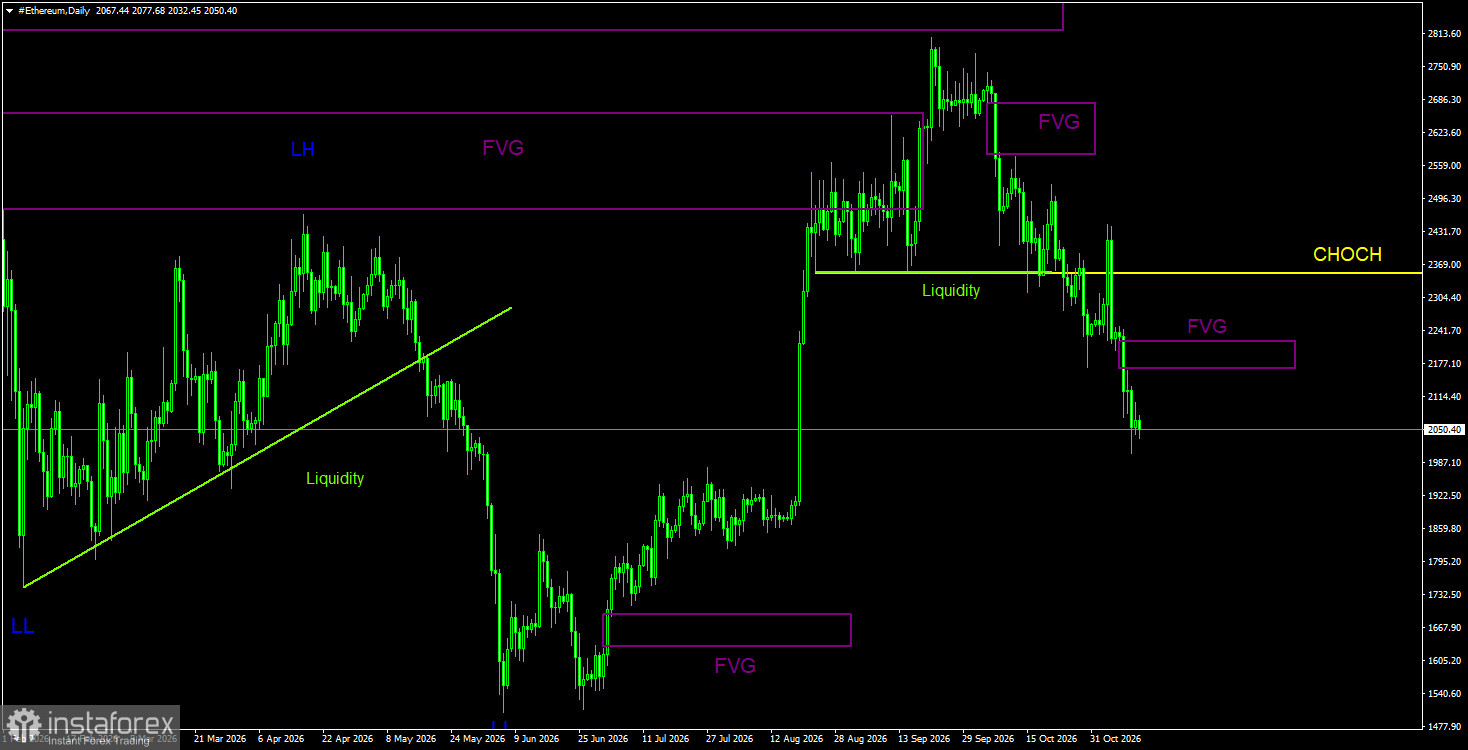
The daily technical picture for Ethereum has changed. Ethereum made a significant upward move in June–September 2026 that could mark the start of a new long?term trend. However, there is no confidence that the bearish trend in Bitcoin is over. If Bitcoin remains in a downtrend or even flat, one should not expect Ethereum to rally. Bitcoin on the daily chart has produced enough sell signals and bearish patterns to continue downward, so we also expect Ethereum to decline. Targets are around $1,850 and $1,391. On the 4?hour timeframe, there is a new bearish FVG that serves as a POI for short positions.
CHOCH is a change of character / break of the trend structure. Liquidity means traders' Stop-Losses that market makers use to build their positions. FVG stands for a Fair Value Gap (area of price inefficiency). The price often moves quickly through such areas, indicating the absence of one side in the market. Later, the price tends to return and react to these zones. IFVG is an Inverted Fair Value Gap. After a return to such a zone, the price does not react but impulsively breaks through and then tests it from the other side.
OB means an Order Block. A candle on which a market maker opened a position in order to harvest liquidity and then form their own position in the opposite direction.

