
यह भी देखें


 16.11.2026 02:43 PM
Analysis of trading opportunities and tips for trading the Japanese yen
The specified price levels were not tested during the first half of the day, so no trading opportunities arose.
For the yen, comments from US policymakers will be the key factor in the second half of the day. However, the Japanese economic data released in the morning further weakened the position of the national currency. The preliminary third-quarter GDP estimate showed stagnation, whereas modest growth had been expected. Meanwhile, industrial production increased by 2.0% in September, compared with the forecast of 2.2%. Consumer spending and the contribution of external demand also came in below expectations, leaving investment as the only source of support. This economic picture gives cautious members of the Bank of Japan, whose interest rate currently stands at 1.25%, reason to reconsider a rate hike in December. Until recently, the market had assigned a high probability to such a move, and growing doubts about it deprived the yen of one of its main sources of support.
The situation in the United States is quite different. In the second half of the day, Fed Chair Kevin Warsh, along with FOMC members Michael Barr and John Williams, will deliver speeches. Williams' tone has already become noticeably more hawkish. On November 12, he stated that inflation remained too high, even in the latest data, and required action. In September, however, he had said there was no need to rush. On October 14, he had anticipated just one rate hike in 2026 and none in 2027. Barr did not discuss interest rates on November 12, focusing instead on the impact of artificial intelligence on the labor market. However, on September 1, he had stated that the central bank should be prepared to raise rates. As long as the Japanese economy continues to struggle and US policymakers maintain their hawkish stance, USD/JPY is likely to retain its upward potential.
As for the intraday strategy, greater emphasis will be placed on the implementation of Scenarios #1 and #2.
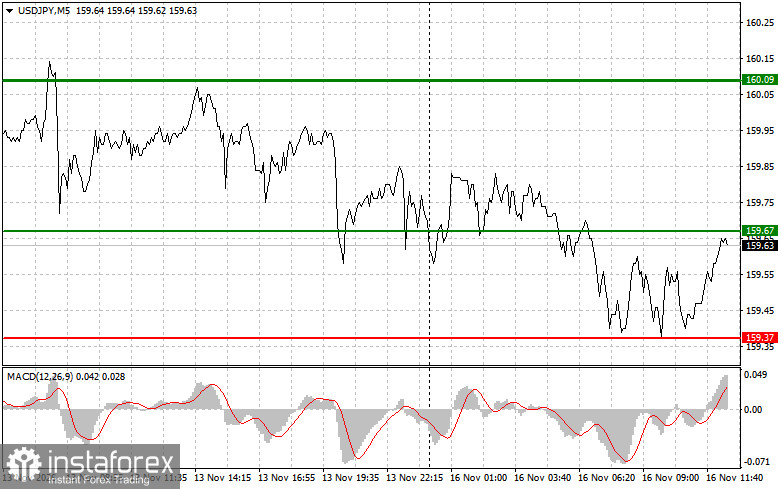
Scenario #1: USD/JPY can be bought today when the price reaches the entry level around 159.67 (the green line on the chart), with a target of 160.09 (the thicker green line on the chart). Around 160.09, long positions can be closed and short positions opened in the opposite direction, targeting a move of 30–35 points downward from that level. The pair is likely to rise today only if US economic data are stronger than expected. Important! Before buying, make sure that the MACD indicator is above the zero line and has just started moving upward from it.
Scenario #2: USD/JPY can also be bought today if the price tests the 159.37 level twice consecutively while the MACD indicator is in the oversold area. This would limit the pair's downward potential and trigger an upward market reversal. A rise toward the opposite levels of 159.67 and 160.09 can be expected.
Scenario #1: USD/JPY can be sold today following a break below the 159.37 level (the red line on the chart), which could lead to a rapid decline in the pair. The sellers' key target will be 158.95, where short positions can be closed and long positions opened immediately in the opposite direction, targeting a 20–25-point upward move from that level. Selling pressure on the pair could return if the central bank intervenes. Important! Before selling, make sure that the MACD indicator is below the zero line and has just started moving downward from it.
Scenario #2: USD/JPY can also be sold today if the price tests the 159.67 level twice consecutively while the MACD indicator is in the overbought area. This would limit the pair's upward potential and trigger a downward market reversal. A decline toward the opposite levels of 159.37 and 158.95 can be expected.
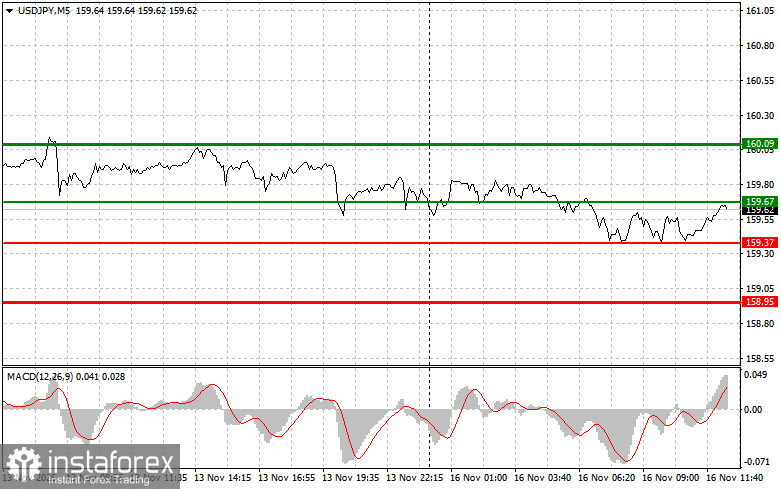
Important. Beginner Forex traders should exercise considerable caution when making entry decisions. Before the release of major fundamental reports, it is generally advisable to stay out of the market to avoid exposure to sharp exchange rate fluctuations. If trading during news releases, always place stop-loss orders to minimize potential losses. Without stop-loss orders, the entire trading account can be depleted very quickly, especially when large trading volumes are used without proper money management.
It is also important to remember that successful trading requires a clearly defined trading plan, such as the one outlined above. Making trading decisions spontaneously based on current market conditions is inherently a losing strategy for an intraday trader.

