
यह भी देखें


 18.11.2026 08:38 AM
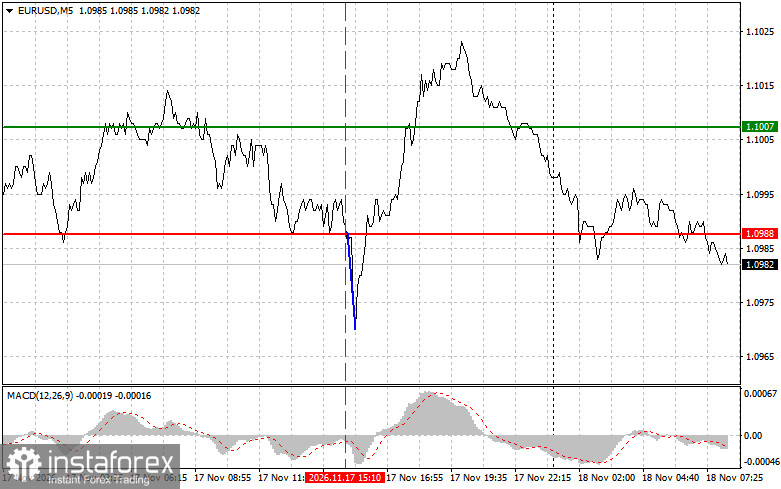
The price test at 1.0988 occurred as the MACD indicator began moving down from the zero line, confirming a valid entry point to sell the euro. As a result, the pair fell only 12 pips.
European data released yesterday were strong. The ZEW index for the eurozone rose to 26.5 versus a 19.1 forecast, while a month earlier it stood at 18.5 — a result that logically should have supported the euro. However, one investor survey is insufficient to outweigh the rate differential between the two regions, and the dollar again took the lead. US officials clearly indicated that the rate-hiking cycle will continue, and rising rates generally strengthen a currency. Musalem allowed for several hikes through spring 2027. Williams said the data leave no doubt that the economy remains strong and inflation is not falling quickly. He refrains from aggressive steps but does not rule out noticeably tighter policy next year. US releases confirmed those remarks: retail sales rose 0.2% versus a 0.1% forecast, and import prices rose 1.1% against an expected 0.7% — data that also favored the dollar. In my view, as long as the Federal Reserve looks more determined than the European Central Bank, even strong eurozone surveys will only give the euro brief support and pressure on EUR/USD will persist.
Today two important events for the euro will be released in the first half of the day. The first is the final October inflation data, forecast to accelerate to 4.0% from 3.8%, with core inflation unchanged at 2.5%. The ECB will have to act very firmly at the December meeting, but that scenario has long been priced in, and these numbers are unlikely to provide serious support for the euro.
More interesting is the second event, the ECB's Financial Stability Report. The document is released twice a year, in May and November, and assesses risks to the eurozone financial system — from bank health to bond and equity market conditions. For traders, it is important because it shows how concerned the regulator is about market fragility, which in turn affects how much room remains for further policy tightening.
The previous release was on May 27. At that time, the ECB warned vulnerabilities remained elevated because the Middle East war caused a serious energy supply shock, equity valuations remained high by historical standards, and problems in non-bank intermediaries and private-credit markets could amplify stress. The central bank called banks resilient due to capital and profitability but noted their dependence on the non-bank sector and on firms sensitive to trade and energy prices. For comparison, in November 2025 the main themes were trade tariffs, banks' links to non-bank intermediaries, and the status of US Treasuries as a safe asset.
If the tone of the report on sovereign-market and non-bank risks is tougher than in May, that will strengthen the case for caution after the December rise to 2.75% and limit the euro's upside potential.
For intraday strategy, I will rely mainly on Scenarios No. 1 and No. 2.
Scenario No. 1: Today you can buy the euro when the price reaches around 1.0991 (the green line on the chart) with a target of 1.1019. At 1.1019, I plan to exit the market and also sell the euro in the opposite direction, expecting a 30–35 pip move from the entry point. Expect euro gains today only after good data. Important: before buying, make sure the MACD indicator is above zero and is just beginning to rise from it.
Scenario No. 2: I also plan to buy the euro today in case of two consecutive tests of 1.0976 when the MACD indicator is in the oversold area. This will limit the pair's downside potential and lead to an upward reversal. You can expect a rise to the opposite levels 1.0991 and 1.1019.
Scenario No. 1: I plan to sell the euro after the 1.0976 level is reached (the red line on the chart). The target will be 1.0957, where I intend to exit the market and immediately buy in the opposite direction (expecting a 20–25 pip move back from that level). Pressure on the pair will return in case of weak data. Important: before selling, make sure the MACD indicator is below zero and is just beginning to decline from it.
Scenario No. 2: I also plan to sell the euro today in case of two consecutive tests of 1.0991 when the MACD indicator is in the overbought area. This will limit the pair's upside potential and lead to a downward reversal. You can expect a decline to the opposite levels 1.0976 and 1.0957.
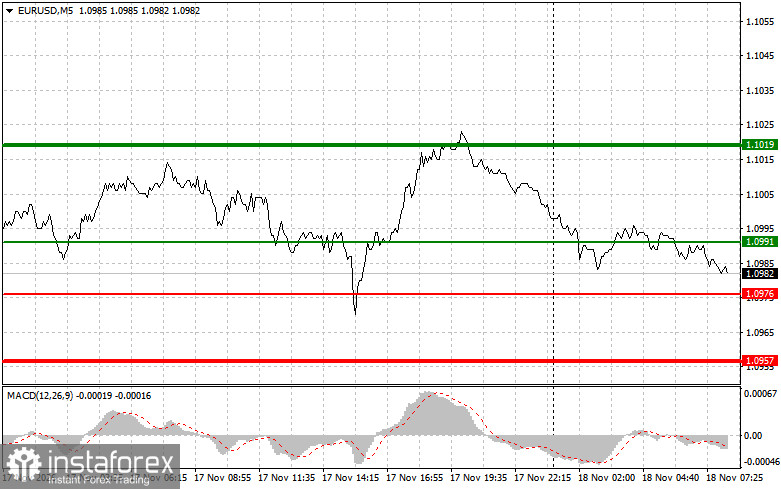
Thin green line – the entry price at which you can buy the trading instrument;
Thick green line – the suggested price where you can place a Take Profit or manually lock in gains, since further upside above this level is unlikely;
Thin red line – the entry price at which you can sell the trading instrument;
Thick red line – the suggested price where you can place a Take Profit or manually lock in gains, since further downside below this level is unlikely;
MACD indicator. When entering the market, it is important to follow the overbought and oversold zones.
Important. Beginner Forex traders must be very cautious when making entry decisions. Before the release of important fundamental reports, it is best to stay out of the market to avoid getting caught in sharp price swings. If you decide to trade during news releases, always place stop orders to minimize losses. Without stop orders, you can quickly lose your entire deposit, especially if you don't use money management and trade large volumes.
Remember, successful trading requires a clear trading plan, like the example I presented above. Spontaneous trading decisions based on the current market situation are a losing strategy for an intraday trader from the start.

