
यह भी देखें


 19.11.2026 07:57 AM
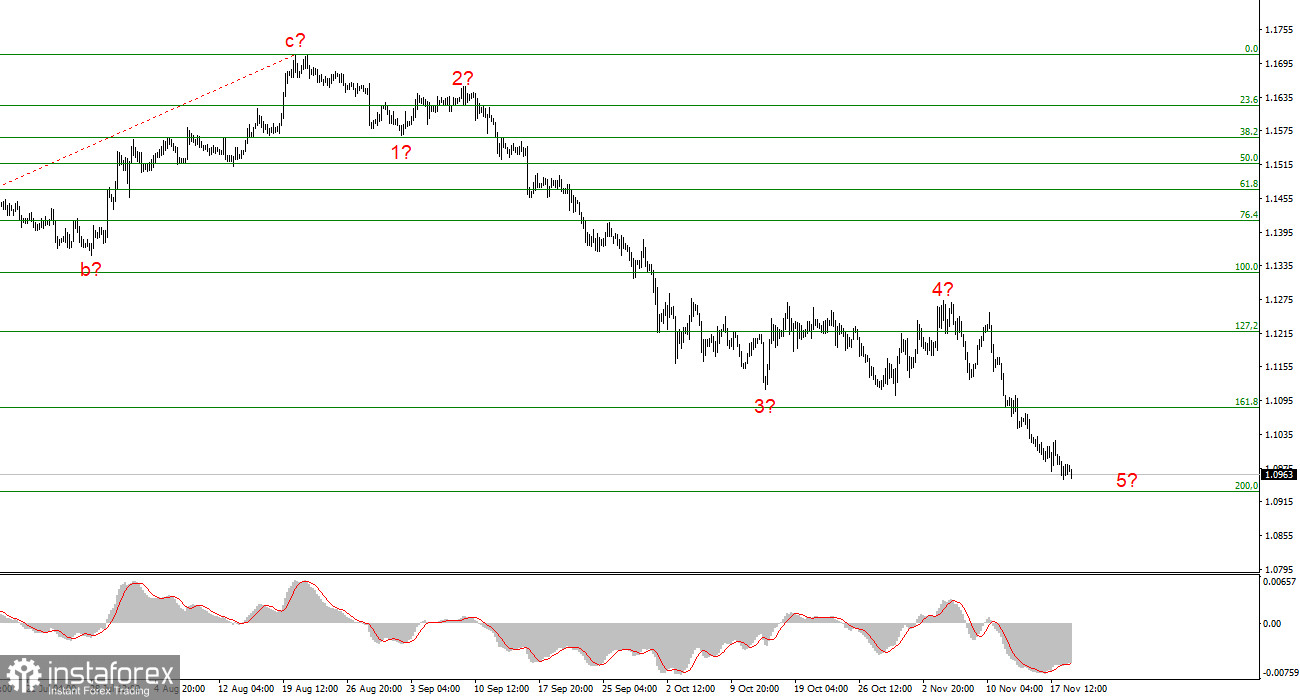
The Elliott Wave count on the 4-hour chart for EUR/USD has become more complex. On the higher time frame (lower chart), the downward trend segment has taken the form of a five-wave A-B-C-D-E structure, which could be completed at any moment, as it appears to be fully developed. All the waves within this segment are approximately equal in size, which is why I consider it corrective. If this assumption is correct, then once this structure is complete, an impulsive upward trend segment will begin to develop, with targets located well above the 20th level.
On the lower time frame (upper chart), an impulsive sequence of waves continues to develop, which may belong to wave E of the higher time frame. If this is indeed the case, then no matter how strongly the US dollar rises, its strengthening is approaching its end. The presumed wave 5 of E is nearing completion. In any case, the current wave structure suggests that the formation of the downward wave sequence is coming to an end on both charts. News developments and a sharp shift in market sentiment have led to a substantial strengthening of the US dollar, but there are few new reasons left for further dollar appreciation.
The EUR/USD exchange rate fell by another 30 basis points on Wednesday. Yesterday, the same factors were driving the market as the day before, two days earlier, a week earlier, or even a month earlier. In other words, the market continues to increase demand for the US dollar, focusing exclusively on the Federal Reserve's monetary policy. All other factors are being ignored, while analysts and economists either repeat the same mantra every day about "increasingly hawkish Fed sentiment" or do everything they can to interpret published economic data in the dollar's favor in order to somehow explain the euro's decline.
Numerous examples illustrate this trend. When inflation rises in the European Union, it is considered moderate. However, when inflation rises in the United States, it is viewed as significant. If the ECB raises interest rates, the increase is considered insufficient. In contrast, a Fed rate hike is interpreted as evidence of a more restrictive monetary policy. If the ECB signals further monetary tightening, market expectations remain cautious. However, if the Fed signals additional tightening, it is viewed as a sign that further rate hikes are likely. Similarly, a decline in unemployment in the UK is still viewed negatively, while strong US labor market data is interpreted as justification for further Fed rate hikes. This is how the market currently interprets virtually all major economic developments.
Consequently, with this approach to analyzing economic data, demand for the US dollar could continue rising indefinitely. If there is no positive news for the European currency by default, what could possibly drive it higher against the dollar, when "all the news is in the dollar's favor"? At present, the wave count of the downward trend segment continues to extend, but it is nevertheless approaching completion. For now, I am not abandoning the scenario in which the downtrend comes to an end in the near future.
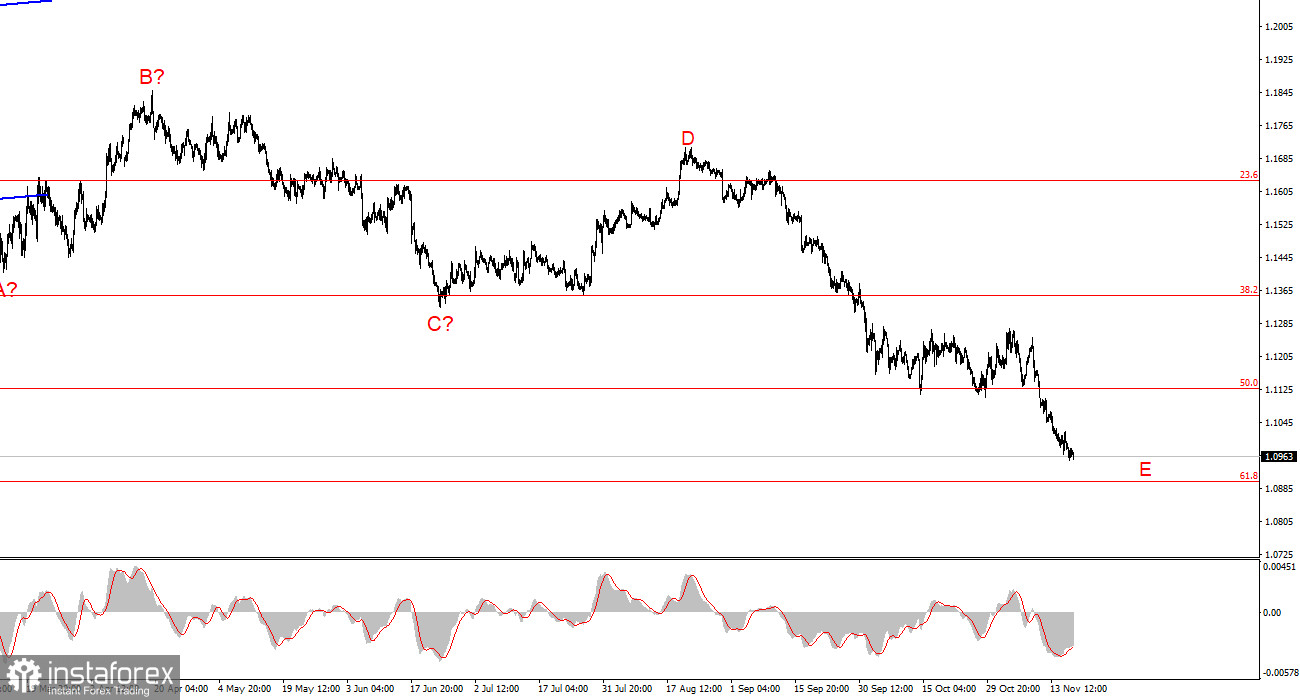
Based on my EUR/USD analysis, I conclude that the pair remains within a global corrective A-B-C-D-E trend structure. However, this structure appears to be fully developed and could therefore be completed at any moment. In my view, now is a good time not only to consider buying the European currency but also to anticipate the development of a fully fledged upward trend segment.
According to the higher time frame, we should expect the pair to rise by at least to the 17th–18th levels (1.1700–1.1800). In my opinion, the more sharply the instrument declines now, the stronger its subsequent rise will be. However, confirmation is needed that the downward wave sequence has been completed. One possible signal would be a failed attempt to break through the 1.0902 level, which corresponds to the 61.8% Fibonacci retracement level on the higher time frame.
The higher time frame shows a downward trend segment that has taken the form of an A-B-C-D-E structure. The internal wave structure of wave E has developed into a five-wave impulsive pattern, but it may already be complete. If this assumption is correct, the development of a new upward trend segment will begin in the near future.
1. Wave structures should be simple and easy to understand. Complex structures are difficult to trade and often involve changes in the market outlook.
2. If you are uncertain about what is happening in the market, it is better to stay out.
3. There can never be 100% certainty about the direction of market movement. Do not forget to use protective Stop Loss orders.
4. Elliott Wave analysis can be combined with other forms of analysis and trading strategies.

