
यह भी देखें


 25.11.2026 08:53 AM
The pound rose yesterday even though U.S. data gave several reasons for dollar strength. From a daytime low near 1.3064, the pair climbed to 1.3123, then gave back about 40 pips overnight and now trades around 1.3083.
The main surprise was the Conference Board consumer-confidence jump. The index, which gauges households' views on finances, the labor market, and prospects, jumped from 91.9 to 103.3 (consensus 92.4) — the best reading since January 2025. Case-Shiller home prices for 20 large cities fell 0.5% m/m in September, mortgage rates remain near 7.2%, and ADP employment growth eased slightly. Normally that mix would support the dollar, yet buyers did not push the move much further.
There are no major UK data today. With no fresh readings on inflation, the labor market, or activity, the pound lacks local catalysts and will likely follow broad dollar sentiment. Still, fundamental arguments can support sterling. Governor Andrew Bailey recently said a second Bank of England hike is more likely than not if energy prices revert, and he called the recent inflation jump largely already priced in. The OBR now expects inflation around 3.1% in 2026 and 3.4% in 2027, while MPC member Megan Greene expects inflation north of 4% early next year — which argues for further tightening and is constructive for the pound.
GBPUSD currently trades at 1.3083, inside a range between 1.3061 and 1.3109 — about 22 pips above the lower bound and 26 pips below the upper. A breakout is only valid after confirmation — several consecutive five-minute candles closing beyond the level — since a single poke means little.
On the upside, 1.3109 is active. A confirmed close above it opens the way to 1.3140 and then to 1.3173. Yesterday evening, price reached 1.3123 (above the level) but fell back overnight and repeatedly stalled near 1.3115, so buyers have not held this ceiling. The first upside target, 1.3140, is near Monday's high around 1.3142; the second, 1.3173, is near last week's highs near 1.3168 — sellers are likely in both zones. I have low conviction in a strong breakout because sellers still hold the initiative.
On the downside, the reference is 1.3061; a confirmed close below it would open the way to 1.3013 and then 1.2974. I view this direction as primary this morning. That level marked the start of yesterday's daytime rally, and losing it would erase that bounce. It is about 22 pips to the level and another 48 pips from there to the first downside target; there are 39 pips between the two downside targets. The first downside target, 1.3013, is near Monday's low around 1.3010, where buyers have shown up before. I would not enter on the first touch.
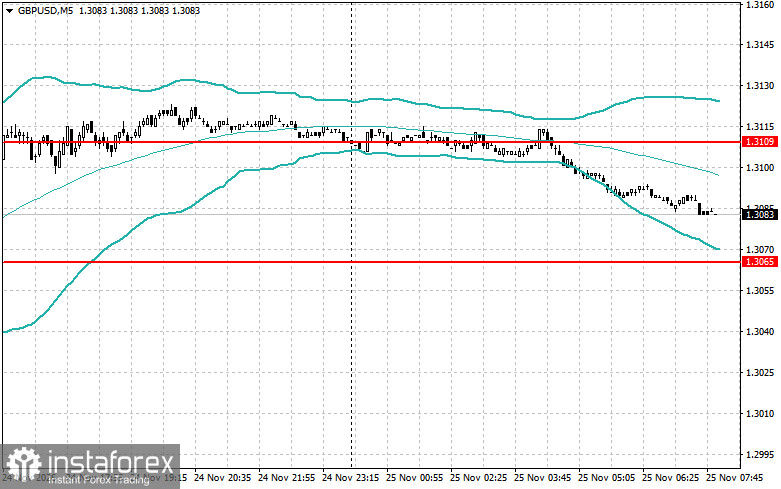
There are two levels here, 1.3109 and 1.3065. The upper reference 1.3109 coincides with the breakout point for buy positions, so the same zone serves as both a breakout signal and a return mark, and on the first touch they cannot be distinguished. It is 26 pips from the current price. If the price settles above 1.3109, that is a breakout, and selling is not allowed. But if it reached 1.3109, failed to continue, and quickly returned below, as happened overnight, I consider selling toward 1.3065 with a stop above 1.3121, i.e., above the overnight highs around 1.3115 with some margin. This picture is likely if the PCE prints near expectations and the market retraces after the first reaction. The difference between scenarios can take several minutes, so it is better to skip the first reaction in the zone.
The lower reference 1.3065 lies four pips above the breakout point for selling at 1.3061 and 18 pips below the price, so it comes into play before a downside breakout. It sits so close to the breakout point that a novice can easily mistake a bounce for the start of a drop, and only a settlement distinguishes them. The scheme is as follows. The price falls to 1.3065, cannot settle below, and returns higher, and then I look to buy toward 1.3109 with a stop below 1.3055, i.e., below the breakout point with some margin. This aligns with my idea to look for buys on dips. A bounce is likely if the U.S. data do not surprise the market. But if the price settles below 1.3061, the return is canceled, and the downside breakout toward 1.3013 becomes operative.

