
यह भी देखें


 25.11.2026 09:33 AM
Today, oil is declining as signs of rising supply outweigh escalating attacks on ships around the Strait of Hormuz. Brent fell to $90 per barrel after a 2.3% rise in the previous session, while WTI trades around $81. Over November, Brent lost more than a fifth, since on October 30 the barrel cost $116.06 and on November 17 it was already $91.70. By comparison, WTI then held around $85, so U.S. oil has fallen even more sharply.

The situation around the strait remains tense. Iran, according to local media, reports that six tankers have struck mines since Tuesday, and Tehran, as the Tasnim agency reports, has threatened to tighten control over the Strait of Hormuz until its demands are met. This shows that the nearly nine-month conflict is far from over. Recall that Tehran seeks the lifting of the U.S. blockade of ports, easing of sanctions and unfreezing of assets, and Donald Trump on November 23 leaned toward resuming strikes after the New Year if there is no deal.
Nevertheless, exports from the Persian Gulf have risen noticeably in recent months. The IEA expects the market to move into surplus this quarter and, on November 13, estimated the surplus at roughly 2 million barrels per day. The key spread on Dubai crude turned bearish this week, indicating supply is rising ahead of demand. Pressure on prices persists also because Trump refrained from new strikes on Iran after the midterms.
Risks, however, remain. The Houthis continue to attack Riyadh, and in one of the latest strikes on the capital's financial center, 11 people were injured. At the same time, the Saudi-led coalition reported intercepting four drones over Ras Tanura, one of the kingdom's main oil hubs. Recall that this facility was attacked early in the war and processing there was halted. Global oil inventories remain extremely low despite the improved supply forecast, so the market is vulnerable to new disruptions and could sharply reverse gains.
U.S. inventory data added to the weakness. According to the American Petroleum Institute, crude stocks rose by 100,000 barrels last week, after a 5.3 million barrel build the week before. Gasoline inventories were unchanged, while distillate stocks increased by 1.6 million barrels. Petroleum products are also falling after a sharp spike that had fueled inflation concerns. Ahead of Thanksgiving, trading volumes will likely be lower, which may amplify price swings.
All this suggests that in the coming days oil, in my view, will remain under pressure while the market focuses on rising Gulf exports and the prospect of a surplus rather than isolated attacks on shipping. I believe the main catalyst for a reversal would not be another attack on Riyadh but a breakdown of diplomatic contacts with Iran or the resumption of U.S. strikes, because in that scenario low global inventories would trigger a sharp price jump. If negotiations via Qatar continue, Brent will most likely keep falling and close the month down around 20%.
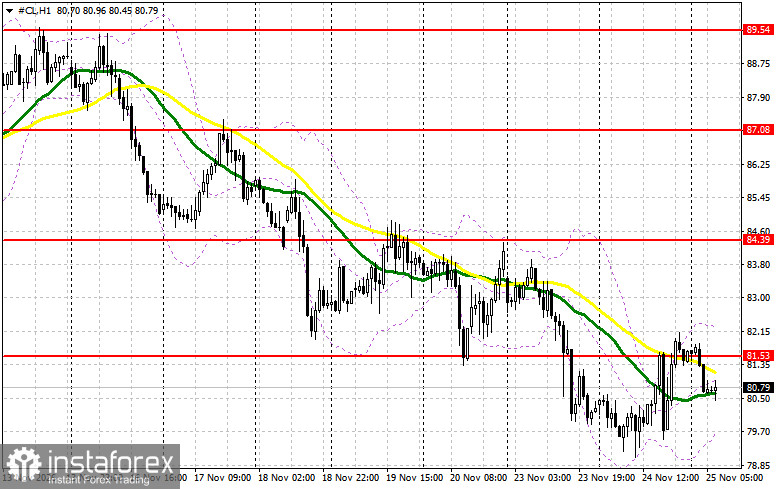
Regarding the current technical picture for oil, buyers need to take the nearest resistance at $81. This would allow targeting $85, above which a breakout will be rather difficult. The furthest target is around $87. In case of oil falling, bears will try to take control of $78. If they succeed, a range breakout would deal a serious blow to bullish positions and push Oil to a low of $76, with a prospect of reaching $74.

